5 Ways Drone Chimney Inspections Find Hidden 2026 Masonry Damage
The High-Altitude Autopsy: Why Your Chimney is Rotting from the Top Down
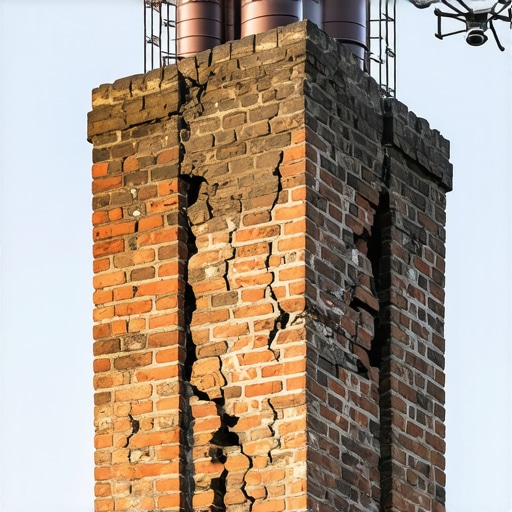
The homeowner stood in the driveway, squinting at the sun, and told me the chimney looked ‘just fine’ from where he was standing. He thought the occasional dusting of red powder on his hearth was just soot. But when I launched the drone and put the 4K lens three inches from the chimney crown, the reality hit like a hammer. The structural steel lintel was rusted to dust, expanded to twice its size, and was literally Jacking the top four courses of brick off the house. What looked like a hairline crack from 40 feet below was actually a two-inch gap where water was pouring into the wall cavity. This is the forensic reality of modern masonry: if you aren’t looking at the ‘tooth’ of the mortar from an inch away, you’re just guessing.
1. Detecting Micro-Fissures in the Crown and Cap
The chimney crown is the first line of defense, a concrete or mortar wash designed to shed water. In our freeze-thaw climate, water is a relentless wedge. When moisture finds a microscopic pore in a poorly mixed ‘mud’—perhaps a mix that was too ‘hot’ with Portland cement and lacked air entrainment—it settles in. When the temperature drops, that water expands by exactly 9% in volume. This isn’t a gentle push; it’s a hydraulic explosion at a molecular level. Drone inspections allow us to see the ‘spider-webbing’ of the crown before it becomes a full-blown failure. Using high-resolution thermography, we can identify where the crown has delaminated from the top course of bricks, a common precursor to brick veneer detachment repair. Without this ‘eye in the sky,’ you’re waiting for a brick to fall on your patio before you realize there’s a problem.
“Moisture is the primary catalyst for virtually all masonry distress, leading to efflorescence, spalling, and structural instability.” – BIA Technical Note 1
2. Identifying Interior Flue Decay and Parging Failure
While the exterior might look solid, the interior is often a chemical war zone. Chimney interior parging—the smooth coat of mortar applied to the inside of the smoke chamber—is constantly attacked by sulfuric acid, a byproduct of combustion. When I fly a drone with a 360-degree camera down the flue, I’m looking for ‘sloughing’ or ‘honeycombing’ of the mortar. If that parging fails, heat and corrosive gases penetrate the masonry carcase. We see this often in an outdoor fireplace rebuild where the builder used standard mortar instead of refractory cement. The heat causes the mortar to ‘flash set’ and eventually crumble into a sandy mess. A drone can spot the missing ‘buttered’ joints in the flue liner that a ground-based inspector would miss entirely, preventing a house fire before it starts.
3. Tracking the ‘Ghosting’ of Foundation Settlement
A chimney is a massive vertical weight, often resting on a footprint no larger than a closet. If the soil hydraulics change—perhaps due to a clogged retaining wall drainage upgrade nearby—the chimney will be the first thing to move. We look for ‘stair-step’ cracking in the mortar joints. From the ground, these look like simple age lines. From a drone, we can measure the width of the crack at the top versus the bottom. If the gap is wider at the top, the chimney is rotating away from the structure. This is when we stop talking about ‘tuckpointing’ and start talking about foundation helical pier installation. We’re looking at the physics of soil bearing capacity; if the clay is saturated, it loses its ‘grip’ on the masonry, and the entire stack begins its slow-motion tip into the yard.
4. Revealing the ‘Spall Point’ in Historic Brickwork
For homes built before 1940, the rules of chemistry change. Those old bricks were fired in ‘beehive’ kilns and are much softer than modern modular units. If a ‘handyman’ comes in and ‘slaps’ some Type S Portland cement into the joints, he has signed the chimney’s death warrant. Modern cement is harder than historic brick. When the wall expands in the summer heat, the brick tries to grow, but the hard cement won’t budge. The brick loses the fight and its face ‘spalls’ or pops off. Drone footage allows us to perform a visual hardness test, identifying where historic brickwork repointing is needed using breathable lime putty mortars. We look for the ‘cream’ or the fire-skin of the brick; once that is gone, the brick becomes a sponge, soaking up gallons of water that will inevitably freeze and shatter the unit.
“The bond strength between mortar and masonry unit is the critical factor in resisting lateral loads and moisture penetration.” – ASTM C270
5. Evaluating the Integrity of Veneer Ties and Flashing
One of the most dangerous hidden defects is the failure of the wall ties—the metal corrugated strips that ‘stitch’ the brick skin to the wooden frame of the house. In 2026, we are seeing a massive uptick in brick veneer detachment repair due to the use of cheap, non-galvanized ties in the early 2000s. A drone can fly along the ‘soldier course’—the vertical bricks usually found above windows or at the base—and spot the slight ‘bulge’ that indicates the ties have rusted through. Once those ties are gone, the brick is a free-standing curtain of 40-pound stones held up by nothing but gravity and hope. We also use the drone to check the ‘kick-out’ flashing where the roof meets the chimney. If that flashing isn’t ‘lapped’ correctly, water runs behind the brick, rotting the rim joists and making a brick paver driveway repair look like child’s play compared to the structural work required to save the house.
The Professional Solution: Beyond the Patch Job
When we find these issues, we don’t just ‘smear’ some mud in the crack and call it a day. We use fiber-reinforced mortars to provide tensile strength that standard ‘over-the-counter’ bags can’t match. We look at the ‘slicking’ of the joint—the way the tool compresses the mortar to create a ‘weather-struck’ profile that sheds water. If your driveway is sinking, we don’t just add more sand; we analyze the compaction physics, much like we do with modular retaining walls, ensuring the base is 98% compacted stone before a single paver is laid. Masonry is a game of inches and centuries. You can do it once, or you can do it twice. A drone inspection ensures you have the forensic data to do it right the first time. Our masonry repair services don’t just hide the damage; we cure the underlying pathology of the building.
![3 Reasons to Install a Chimney Heat Shield in 2026 [Pro Tips]](https://masonryrescue.com/wp-content/uploads/2026/03/3-Reasons-to-Install-a-Chimney-Heat-Shield-in-2026-Pro-Tips.jpeg)


This article really highlights how crucial drone inspections are in uncovering hidden masonry issues that are invisible to the naked eye. I’ve seen situations where routine visual checks missed serious problems like internal flue decay or rusted ties, which only became evident after a drone inspection. It’s interesting to see how thermal imaging can reveal delamination in the crown, preventing potential brick or even structural failure before it happens. I wonder, for homeowners considering these inspections, what’s the typical cost versus the long-term savings of catching these issues early? Also, has anyone had experience with drone technology detecting problems that prompted urgent repairs? It seems like a game-changer in proactive masonry maintenance.
Reading this post really opened my eyes to how much we might overlook with traditional visual inspections. I had a similar experience where I thought my chimney was in decent shape until a drone caught micro-cracks in the crown that were not visible. The thermal imaging aspect especially caught my attention because it provides such a clear warning sign before structural damage occurs. It’s remarkable how technology like this allows us to prevent catastrophic failures rather than just react afterward. I’m curious about the maintenance routines followers of this blog have adopted after such drone inspections—do you find that regular thermal inspections significantly extend the lifespan of an old masonry structure? And in terms of cost, how do such comprehensive inspections compare to the potential expense of major repairs down the line? It seems like a worthwhile investment for anyone serious about home preservation.