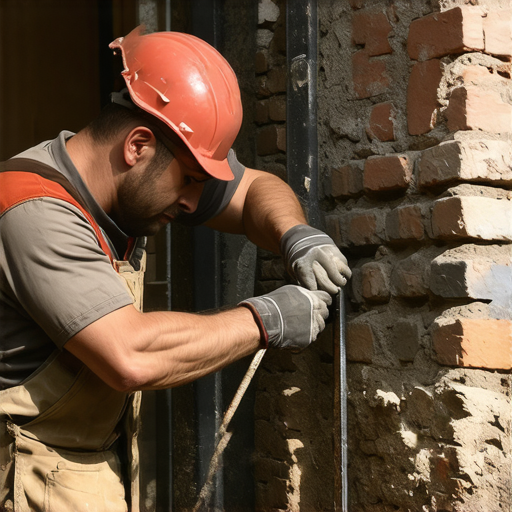
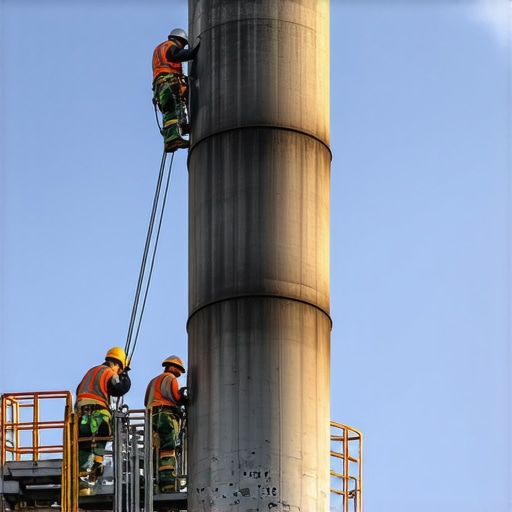
5 Critical Safety Fixes for Commercial Smokestack Repair in 2026
The Vertical Battlefield: Why Masonry Fails at Scale
When you spend forty years on a hanging scaffold, you stop seeing a smokestack as a simple cylinder of brick and mortar. You start seeing it as a pressurized vessel of thermal stress and chemical warfare. Most contractors today treat a commercial stack like a tall chimney on a residential house. That is a lethal mistake. I remember a forensic scene back in ’08 at a decommissioned power plant. The facility manager thought a vertical fissure was just a hairline crack caused by age. But when I threaded my borescope into the cavity, the reality was grim: the internal structural steel hoops, meant to provide tensile strength, had oxidized so severely they had expanded to four times their original thickness. This phenomenon, known as ‘oxide jacking,’ was literally detonating the brickwork from the inside out. If we hadn’t caught it, that 120-foot stack would have pancaked onto the boiler room within a month. This is the grit of professional masonry restoration—it is not about aesthetics; it is about the physics of survival.
1. Internal Chimney Interior Parging: The Chemical Shield
In 2026, we are seeing the cumulative effects of decades of low-grade fuel combustion on old masonry. The first critical safety fix is the restoration of the chimney interior parging. Parging isn’t just ‘smearing mud’ on the inside. It is a sacrificial layer of high-aluminate cement designed to resist the sulfuric acid condensation that eats calcium hydroxide for breakfast. When flue gases cool, they reach their dew point. If your parging is cracked or missing, those acidic droplets migrate into the mortar joints. Through a process called leaching, the acid dissolves the binder in your mortar repointing services, leaving nothing but a handful of loose sand between your bricks. We now use a specialized concrete pump masonry mixes specifically engineered with micro-silica to close the pore structure, ensuring that the ‘tooth’ of the parging grips the substrate without allowing acid migration. This isn’t your neighborhood outdoor kitchen masonry build; this is high-stakes chemistry where the pH balance of your mortar determines the lifespan of the stack.
“The mortar should be designed to be weaker than the masonry units so that any stress-induced cracking occurs in the mortar joints, which are easier to repair.” – BIA Technical Note 1
2. Advanced Chimney Leak Detection and Thermal Management
The second fix involves chimney leak detection using infrared thermography. In a commercial stack, heat is the enemy of stability. A ‘hot spot’ detected on the exterior often indicates a failure in the refractory lining. As a master mason, I look for the ‘ghosting’ of the internal structure. If the heat isn’t uniform, the stack is expanding unevenly. Masonry has a specific coefficient of thermal expansion. In a 100-foot stack, the sun alone can cause the ‘sunny side’ to grow by half an inch while the ‘shady side’ stays put. This creates a bowing effect. If the chimney flashing repair at the roofline isn’t designed to accommodate this vertical heave, you get a cold joint failure where the stack meets the building. We are now integrating green roofing masonry integration techniques to manage runoff at the base, but the primary focus remains on the ‘slip’ of the flashing. You have to butter the joints with a high-flexibility sealant that doesn’t ‘burn’ under high temps.
3. Structural Repointing and the Sacrificial Principle
The third fix is the technical mastery of mortar repointing services. Most ‘handymen’ will slap Type S mortar into a 100-year-old stack. Type S is hard. It’s brittle. It’s a death sentence for old, hand-pressed brick. When the stack sways in high winds—and it does sway—a hard mortar won’t give. Instead, the edges of the brick will crush, a process we call spalling. The fix is a lime-rich, Type O or Type K mortar. You have to understand the ‘suction’ or the Initial Rate of Absorption (IRA) of the brick. If the brick sucks the water out of your mud too fast, the mortar ‘flashes’ and never develops a crystalline bond. It just sits there like dried cake. We use a slicker to pack the joints tight, ensuring no honeycombing exists deep in the bed joint. This is the same level of precision required in outdoor masonry fountain restoration, where water pressure is the constant, but in a smokestack, the pressure is wind and heat.
“Chimneys and smokestacks are subject to thermal shock and chemical attack that domestic masonry never encounters.” – ASTM C199 standard principles
4. Reinforcement Stabilization and Retaining Wall Logic
Fix number four is the stabilization of the ‘tension hoops.’ Many commercial stacks use external or internal steel bands. When these rust, they lose their ‘grip’ on the masonry cylinder. We approach this with the same mindset as a retaining wall installation. You aren’t just stacking stones; you are resisting lateral force. We now use carbon-fiber wraps or stainless steel helical ties to stitch the masonry back together. This prevents the ‘soldier course’ of bricks at the top from vibrating loose. If you don’t have a solid ‘hawk’ and ‘trowel’ technique to butter these reinforcement points, you’re just wasting the client’s money. The bond must be molecular. We use concrete pump masonry mixes to pressure-inject grout into the voids, ensuring that the reinforcement is fully encapsulated, preventing the oxygen-rich environment that leads to further corrosion.
5. Crown Restoration and Flashing Integrity
The final fix is the crown. The ‘cap’ of the stack. This is where the most violent weather hits. If the crown is cracked, water enters the core of the wall. In cold climates, that water expands 9% when it freezes, acting like a thousand tiny hydraulic jacks. Chimney flashing repair at the crown isn’t just about lead or copper; it’s about the ‘drip edge.’ Without a proper drip, water runs down the face of the brick, causing efflorescence—those white salt stains—which eventually lead to the face of the brick popping off. Whether I’m supervising a professional masonry restoration on a historic stack or a high-end outdoor kitchen masonry build, the rule is the same: Water must be shed, not shed into the masonry. We are moving toward cast-in-place concrete crowns with air-entrainment to survive the freeze-thaw cycles of the next century. This is the ‘Cure’ rather than the ‘Band-Aid.’ Don’t settle for a contractor who doesn’t understand the ‘ring’ of a good brick or the proper ‘slump’ of the mix. In 2026, the margin for error is zero. You do it once, or you watch it crumble.”
![Stop Retaining Wall Leans with 3 Pro Reinforcement Fixes [2026]](https://masonryrescue.com/wp-content/uploads/2026/03/Stop-Retaining-Wall-Leans-with-3-Pro-Reinforcement-Fixes-2026.jpeg)

![5 Retaining Wall Geogrid Installation Mistakes to Avoid [2026]](https://masonryrescue.com/wp-content/uploads/2026/04/5-Retaining-Wall-Geogrid-Installation-Mistakes-to-Avoid-2026.jpeg)
![Emergency Masonry Repair: 3 Signs Your Wall Might Collapse [2026]](https://masonryrescue.com/wp-content/uploads/2026/03/Emergency-Masonry-Repair-3-Signs-Your-Wall-Might-Collapse-2026.jpeg)