Why Poor Mortar Matching Ruins 2026 Tuckpointing Projects
The Forensic Scene: A Wall Suffocating in Silence
The homeowner called me out because she thought she had a simple hairline crack. From the curb, it looked like a minor blemish on a 1920s Tudor revival. But as soon as I pulled my scope out and peeked into the cavity, the reality was grim. The structural steel lintels were rusted to mere flakes of iron oxide, and the interior wythe of the brick was turning to orange dust. The culprit? A ‘handyman special’ from five years prior. Someone had used a high-strength, Portland-heavy Type S mortar to patch a wall built with soft, lime-based units. They didn’t just fix a crack; they signed the wall’s death warrant. By 2026, we are seeing a massive surge in these failures as DIY-mentality and cheap labor collide with historic preservation needs.
The Physics of the Sacrificial Joint
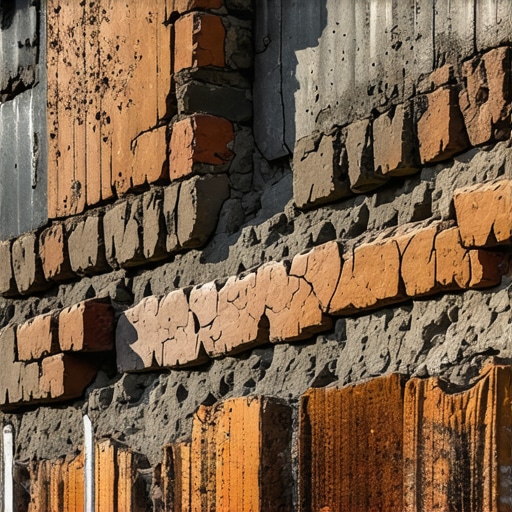
In the world of historic restoration, the mortar is meant to be the sacrificial lamb. It is the part of the wall that is supposed to fail first. If the mortar is softer and more vapor-permeable than the brick, it allows moisture to escape through the joint. When you introduce modern Portland cement into a historic brick wall, you reverse the physics. The mortar becomes a dense, impenetrable plug. Moisture gets trapped behind that plug, and during the winter, that water freezes and expands by approximately 9% in volume. Since it can’t push through the hard mortar, it pushes through the face of the brick. This is what we call spalling, and it’s the most expensive mistake a property owner can make.
“Mortar should always be weaker than the masonry units it binds, ensuring that stresses and moisture movement occur within the joints rather than the masonry itself.” – ASTM C270 Standard Specification for Mortar
Historic Mortar Analysis: Beyond the Color Match
Too many contractors think ‘matching’ means getting the color close enough for the neighbor to not notice. Real historic mortar analysis is a chemical autopsy. We look at the sand gradation—was it river sand with rounded edges or sharp, crushed pit sand? We look at the binder-to-aggregate ratio. In 2026, the industry is shifting toward more rigorous testing because the stakes are higher. If you are dealing with a brick arch restoration, the structural integrity of that arch depends on the compressive strength of the mortar being exactly what the original mason intended. A mortar that is too hard will cause the ‘shoulders’ of the arch to pinch and snap under thermal expansion.
The Chemistry of Lime vs. Portland
To understand why your 2026 tuckpointing project might fail, you have to understand the carbonation process. Traditional lime mortar doesn’t ‘set’ like concrete; it cures by absorbing carbon dioxide from the atmosphere over months, or even years. This creates a flexible, self-healing matrix. If a micro-crack forms, water dissolves a bit of the free lime and redeposits it into the crack—a process known as autogenous healing. Modern Portland cement, however, undergoes a hydration reaction. It’s fast, it’s hard, and it’s brittle. When you butter a brick with ‘mud’ that has too much Portland, you lose that self-healing property. You’re left with a wall that can’t breathe and can’t move.
Historic Pointing Styles and Aesthetic Integrity
When we talk about historic pointing styles, we aren’t just talking about looks. Whether it’s a beaded joint, a grapevine joint, or a weathered struck joint, the geometry of that ‘slicker’ work determines how water sheds off the wall. If a mason doesn’t know how to strike a joint properly, they create ‘ledges’ that catch water. This leads to accelerated decay. In stone wall repair, the pointing is even more critical because the stones are irregular. You have to follow the ‘tooth’ of the stone, ensuring the mortar is packed deep and not just smeared on the surface like peanut butter.
“Water penetration is the single greatest threat to masonry durability, and the choice of mortar is the first line of defense.” – BIA Technical Note 7
The Retaining Wall Trap: Weep Holes and Hydrostatic Pressure
I see it every spring: a beautiful stone wall leaning at a 15-degree angle. The homeowner spent thousands on stone veneer repair, but they forgot the most basic rule of masonry: water always wins. If your retaining wall weep hole cleaning isn’t part of your maintenance routine, you’re asking for trouble. Hydrostatic pressure—the weight of water-saturated soil—is immense. Without clear weep holes and a proper drainage plane, that pressure will pop your veneer right off the substrate or, worse, tip the entire structure. When repairing these walls, we often find ‘honeycombing’ behind the face—pockets of air and weak mortar where water has pooled and frozen, rot from the inside out.
The Scam of Lick-and-Stick Veneer
We are currently in a crisis of ‘lick-and-stick’ stone veneer installation. It looks great for the first two years, but because it’s often applied by crews who don’t understand masonry cleaning or moisture barriers, it becomes a moisture trap. Unlike a traditional soldier course of brick that has a cavity behind it, thin veneer is often glued directly to a substrate. If that substrate isn’t perfectly flashed, water gets in and has nowhere to go. I’ve seen OSB sheathing rotted to mush behind a six-figure stone facade because the ‘masons’ didn’t understand the physics of the ‘cold joint’ where the stone met the foundation.
The Process: Doing it Once, or Doing it Twice
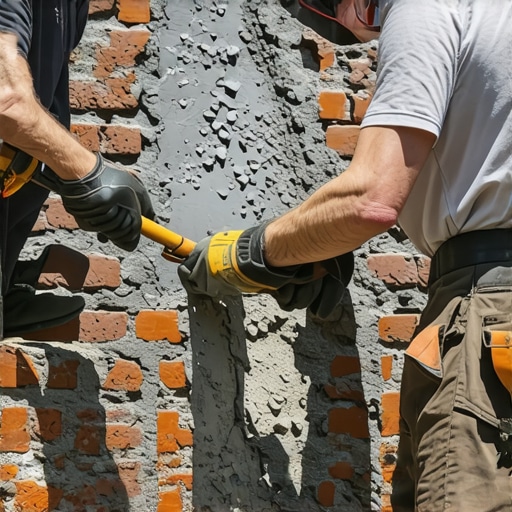
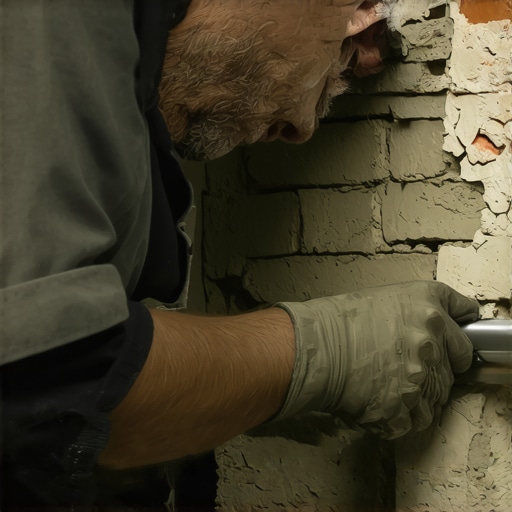
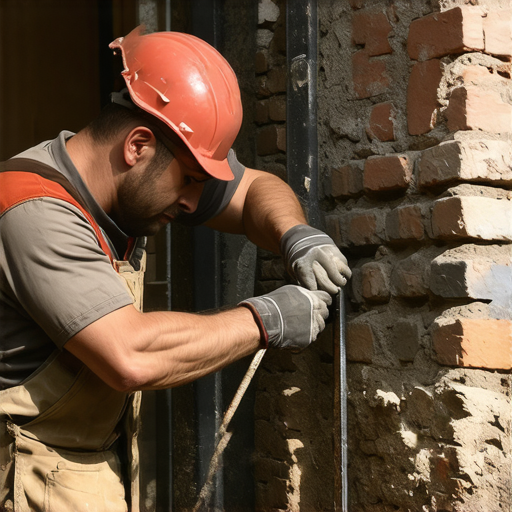
A proper tuckpointing job begins with a hawk and a slicker, and a lot of patience. You don’t use a high-speed grinder to remove old mortar on historic brick; you use a pneumatic chisel or a hand tool to avoid scarring the brick edges. You ‘butter’ the joints in lifts, allowing the first layer to reach thumb-print hardness before applying the next. This prevents shrinkage cracks. It’s labor-intensive, it’s dusty, and it’s expensive. But in the world of forensics, I can tell you this: the cheapest bid is usually the one that results in a total wall failure within a decade. When you’re looking at cracked brick wall repair, you aren’t just fixing a gap; you’re restoring a system. If you ignore the chemistry and the physics, you’re just putting a Band-Aid on a gunshot wound.