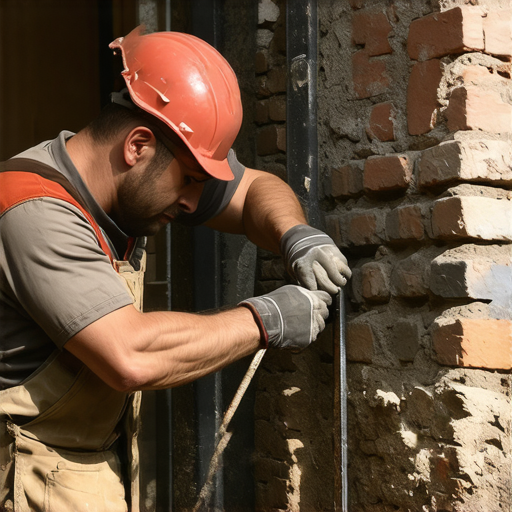
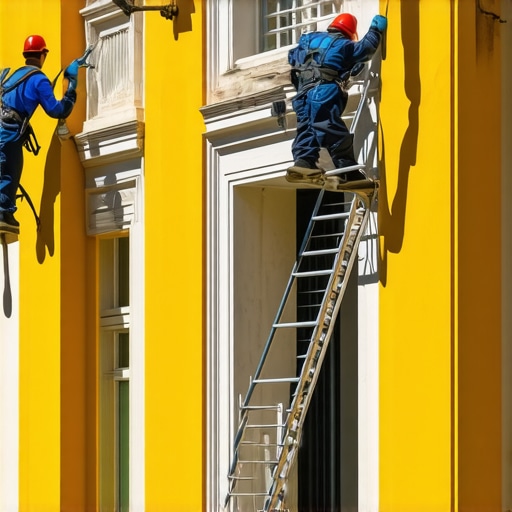
Expert Facade Cleaning & Restoration for Lasting Curb Appeal
Elevating Structural Durability Through Expert Masonry Restoration Techniques
In the realm of building preservation and enhancement, understanding the nuanced interplay between foundational stability and aesthetic restoration is paramount. Skilled intervention not only prolongs the lifespan of masonry structures but also sustains their visual appeal, thus safeguarding property value over decades. This article delves into the sophisticated methodologies employed by industry experts to optimize foundation repair, facade cleaning, tuckpointing, and concrete patching, illustrating how integrated approaches can yield durable results.
Precision in Foundation Rehabilitation: The Bedrock of Longevity
What are the latest advancements in foundation repair for ensuring long-term stability?
Modern foundation restoration leverages high-tech materials and geo-engineering insights to address subsurface instabilities effectively. Techniques such as underpinning with helical piers or micropiles are demonstrated to distribute loads uniformly, preventing differential settlement. For comprehensive solutions, consulting expert resources like foundation repair specialists can provide evidence-based guidance on application strategies tailored to soil conditions and structural demands.
Facilitating Aesthetic Durability Through Masterful Facade Cleaning
How can specialized cleaning protocols extend the aesthetic appeal and protective layer of masonry exteriors?
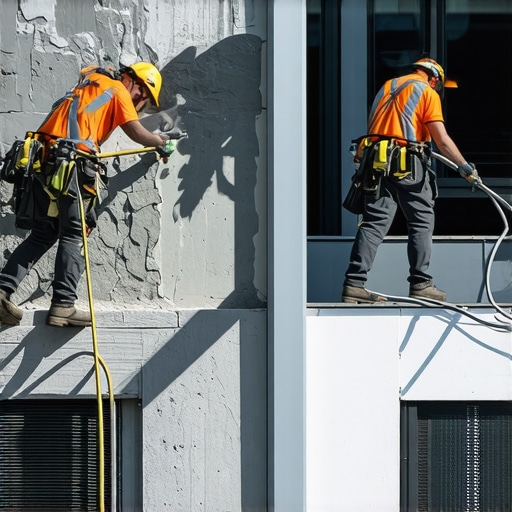
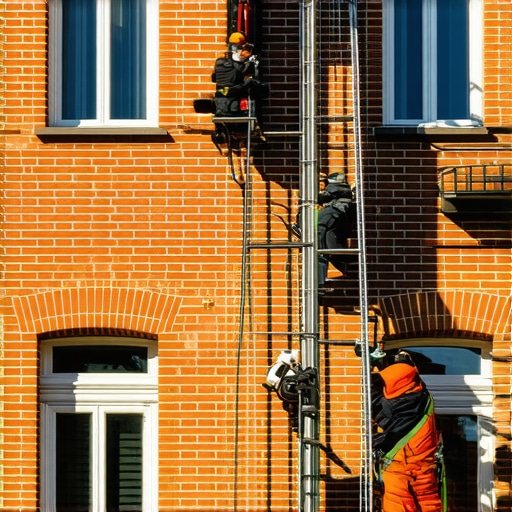
Advanced facade cleaning employs eco-friendly, low-pressure techniques paired with targeted chemical treatments to remove biological growth, pollutants, and efflorescence without risking surface integrity. Regular maintenance prevents deterioration and reveals the intricate textures of stone and brickwork. For detailed protocols, professionals often reference trusted procedures such as those outlined on trusted facade cleaning guidelines.
The Art and Science of Tuckpointing: Restoring Strength and Elegance
In what ways does tuckpointing influence both the structural health and visual sophistication of masonry walls?
Tuckpointing involves precision removal of deteriorated mortar followed by meticulous application of new mortar joints that match original profiles. This process restores bond strength and prevents water penetration. An innovative aspect includes integrating high-performance mortar mixes that are compatible with historic substrates, ensuring preservation of architectural authenticity while bolstering wall resilience. For expert insights, visit tuckpointing best practices.
Innovative Approaches to Concrete Patch Repairs
What innovations in concrete patch materials and techniques optimize durability against environmental stressors?
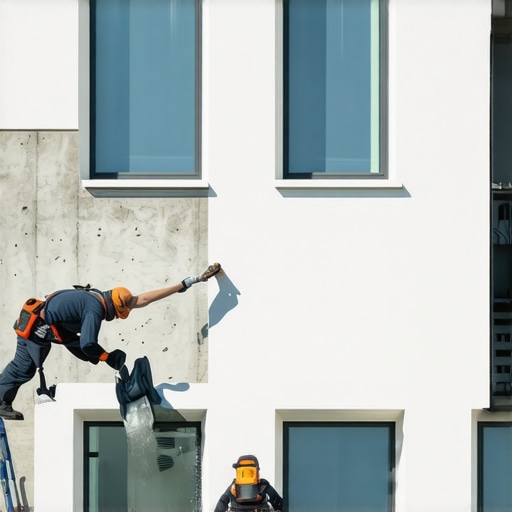
State-of-the-art concrete patches utilize polymer-modified cementitious composites that exhibit superior adhesion, flexibility, and resistance to freeze-thaw cycles. Precision application methods, including rapid-setting formulations and textured overlays, facilitate seamless integration with existing surfaces. To master longevity, contractors consult resources like concrete patch repair guides that synthesize empirical data and field-experience benchmarks.
Are there emerging materials that promise to redefine masonry repair standards, especially in high-risk environments?
If you possess advanced expertise in masonry maintenance, sharing insights on innovative materials or techniques can significantly benefit the community of practitioners striving for excellence. Exploring cutting-edge advancements ensures that restoration efforts meet the rigorous demands of durability, aesthetics, and sustainability within our built environment.
Unlocking the Potential of Advanced Sealants and Coatings for Masonry Durability
Effective masonry restoration extends beyond just repairing visible damage; it encompasses safeguarding structures against future environmental hazards. Modern sealants and protective coatings, such as breathable, elastomeric paints and penetrating water repellents, create a formidable barrier against moisture ingress and pollutants. Incorporating these materials into routine maintenance can significantly prolong the lifespan of your masonry surfaces. For expert techniques and tailored solutions, visiting reliable masonry coating strategies can provide valuable insights.
Addressing Subsurface Challenges with Innovative Underpinning Solutions
How can emerging geo-engineering methods redefine foundation stabilization for complex sites?
New advancements in underpinning involve minimally invasive techniques like jet grouting and soil stabilization injections, which fortify weak grounds without extensive excavations. Integrating such technologies ensures that foundation repair is both effective and sustainable, especially in urban environments with limited access. These solutions, supported by expert research such as foundation stabilization innovations, enable precise management of subsurface conditions, reducing long-term maintenance costs.
Refining Tuckpointing with Eco-Friendly and High-Performance Mortars
As sustainability gains prominence, masonry professionals are turning to eco-conscious mortar formulations that deliver strong adhesion while minimizing environmental impact. High-performance mortars with reduced carbon footprint and enhanced resistance to freeze-thaw cycles are now setting new standards for repair longevity. Incorporating these materials requires a nuanced understanding of substrate compatibility and curing processes. Explore eco-friendly tuckpointing practices to stay ahead in sustainable masonry restoration.
Innovations in Concrete Patching: Embracing Nanotechnology and Smart Materials
Emerging research highlights the potential of nanomaterials and self-healing concretes in repair applications. These advanced materials can fill micro-cracks autonomously, provide enhanced durability, and adapt to environmental stresses. While still evolving, such innovations promise to revolutionize masonry repair strategies, reducing the frequency of interventions and improving overall structure resilience. Considering these advancements, how might your practice incorporate such materials to elevate repair success rates? For more detailed insights, review concrete patch innovations in 2024.
What are some emerging material technologies that could challenge traditional practices and set new benchmarks for masonry repair longevity?
Sharing your experiences with innovative materials or techniques not only advances your expertise but also empowers the masonry community to push boundaries in craft excellence. Staying informed about scientific breakthroughs ensures that your restoration projects meet the most rigorous standards of durability, aesthetics, and environmental responsibility.
Embracing Robotic Precision and Automation in Masonry Restoration Processes
With the advent of robotics and automation, masonry restoration is entering a new era of precision, safety, and efficiency. Autonomous drones equipped with high-resolution imaging and laser scanning capabilities enable comprehensive structural assessments, identifying microcracks and deterioration patterns invisible to the naked eye. Robotic mortar applicators and bricklaying machines can perform tuckpointing and rebuilding tasks with unparalleled uniformity, reducing human error and accelerating project timelines. Industry leaders like Construction Technology Review highlight how these innovations are revolutionizing traditional practices, providing detailed data analytics that inform targeted interventions for enhanced longevity.
Integrating Smart Materials to Proactively Combat Environmental Damage
One of the most promising advancements lies in the development of smart, responsive materials integrated into masonry components. These materials can detect environmental stressors such as moisture levels, chemical attacks, or temperature fluctuations and respond by altering their properties—either expanding to seal cracks or releasing protective agents. For instance, embedding microencapsulated corrosion inhibitors within mortar formulations allows for on-demand chemical defense against steel reinforcement deterioration. According to recent research published in Materials Science & Engineering A, such innovations significantly extend the service life of masonry structures, especially in aggressive climates where deterioration accelerates. Advocates for sustainable building argue that combining these smart materials with existing restoration techniques creates a resilient, adaptive infrastructure fit for climate resilience initiatives.
How can the fusion of robotics and smart materials redefine project outcomes in high-stakes restoration efforts?
By integrating real-time monitoring systems with autonomous repair units, restoration teams can shift from reactive to predictive maintenance paradigms. Imagine drones equipped with sensors that continuously evaluate structural health indicators, dispatching repair bots to address detected issues immediately—before visible damage even manifests. This convergence not only minimizes disruptions but also optimizes resource allocation, potentially lowering costs while maximizing durability. Leading industry experts suggest that such systems could be essential in maintaining critical infrastructure, such as historical monuments and essential public facilities, where preservation precision is non-negotiable. For those eager to explore these transformative approaches, reviewing the pioneering work in smart automation in masonry maintenance offers valuable insights.
Revolutionizing Subsurface Reinforcement Strategies with Nano-Engineered Polymers
At the microscopic level, nano-engineered polymers are pushing the boundaries of traditional reinforcement techniques. These materials demonstrate exceptional tensile strength, flexibility, and chemical stability, enabling the creation of ultra-thin, high-performance barriers that can be injected into existing masonry to reinforce against seismic activity or ground movement. Their ability to form durable, seamless matrices within cracks enhances load transfer and prevents further deterioration. Researchers in the field of nanotechnology, like Dr. Maria Lopez at the Institute for Advanced Materials, are exploring how these compounds can be tailored to specific environmental conditions, offering personalized reinforcement solutions that outperform conventional methods. Such innovations could dramatically reduce the need for invasive excavation or complete façade replacement, especially in sensitive heritage sites.
Implementing Real-Time Data Analytics for Dynamic Preservation Strategies
Modern masonry restoration is increasingly reliant on big data and analytics to inform decision-making processes. Sensors embedded within structures track parameters such as temperature fluctuations, moisture ingress, and load stresses, transmitting data to centralized monitoring systems. By applying sophisticated algorithms, restoration teams can predict deterioration trajectories and preemptively schedule interventions, thereby extending the lifespan of their structures. The integration of machine learning models facilitates continuous improvement of predictive accuracy, turning vast datasets into actionable insights. As noted in the Engineering News-Record, the convergence of IoT devices and artificial intelligence not only enhances structural safety but also allows budget-friendly maintenance planning. Embracing these technologies positions experts at the forefront of sustainable, intelligent masonry conservation.
Public Engagement and Documentation Through Virtual Reality and Augmented Reality Tools
Beyond technical advancements, innovative visualization tools like Virtual Reality (VR) and Augmented Reality (AR) are transforming stakeholder engagement and education in masonry restoration. Immersive experiences enable clients, conservationists, and the public to virtually explore restoration progress or visualize future scenarios, fostering transparency and collaborative planning. Furthermore, AR applications assist onsite workers by overlaying structural data, inspection points, and step-by-step procedures directly onto their field of view, reducing errors and training time. Companies such as ArchDaily highlight how these immersive technologies facilitate a deeper understanding of complex projects, ensuring continued support and funding. As these tools become more accessible, their integration will undoubtedly become a standard component of advanced masonry restoration workflows.
Are you prepared to incorporate these emerging technologies into your next project? Embracing innovation is not merely about staying current but about setting new standards for durability, efficiency, and aesthetic excellence in masonry restoration. Share your insights or seek expert advice to navigate these exciting developments—your structures deserve nothing less than cutting-edge care.
Deciphering Environmental Factors That Accelerate Masonry Degradation
Understanding the multifaceted impact of environmental stressors—ranging from acid rain to urban pollution—is critical for designing resilient masonry restoration plans. Elevated levels of sulfur dioxide, for instance, react with moisture to produce sulfuric acid, accelerating surface erosion of stone and brick materials. Moreover, climate-induced fluctuations, like freeze-thaw cycles, cause micro-cracks to propagate, undermining structural integrity over time. Recognizing these localized and global factors allows specialists to tailor interventions that proactively mitigate future deterioration, ensuring long-term durability.
What sophisticated analytical tools enable us to predict environmental wear patterns on historic masonry?
Advanced spectroscopic devices and environmental sensors provide data to model material decay under specific conditions. For example, portable X-ray fluorescence (XRF) analyzers quantify compositional changes, while remote sensing captures spatial degradation trends across large structures. Integrating these insights with predictive analytics derived from high-fidelity simulations—such as finite element modeling—empowers restoration experts to prioritize interventions effectively, conserving resources and extending the lifespan of heritage assets. According to guidelines from the Heritage Science Journal, combining material analysis with environmental data enhances predictive accuracy significantly.
Enhancing Repair Durability with Nano-Enhanced Polymer Composites
Recent breakthroughs in nanotechnology have led to the development of polymer composites infused with nanostructures like carbon nanotubes and nano-silica. These materials exhibit enhanced tensile strength, improved adhesion, and superior resistance to environmental aggressors such as moisture ingress and chemical erosion. When applied as bonding agents or surface sealants, nano-enhanced polymers create a resilient barrier that adapts at the molecular level, maintaining flexibility while resisting cracking. Implementing these in restoration projects promises unprecedented longevity, especially in harsh climates or high-traffic environments, by actively combating micro-scale damage before it develops into larger problems.
Embed Smart Monitoring Systems for Proactive Preservation
Integrating smart sensor networks into masonry structures transforms maintenance from reactive to predictive. These systems continuously track parameters like humidity, stress distribution, and crack initiation, transmitting real-time data to centralized platforms. Utilizing machine learning algorithms, maintenance teams can forecast deterioration trajectories, scheduling interventions precisely when needed—minimizing unnecessary work and preventing catastrophic failures. For heritage conservationists and facility managers alike, deploying these intelligent systems offers a sustainable approach that preserves structural integrity with minimal disturbance. Industry pioneers cite success stories from projects such as the Monitoring Ancient Masonry Sites initiative, demonstrating tangible benefits of these tech-driven strategies.
The Role of Bio-Inspired Materials in Masonry Revival
Drawing inspiration from natural systems, researchers are developing bio-mimetic materials that emulate self-healing properties observed in biological tissues. Incorporating microcapsules containing healing agents within mortar matrices allows cracks to autonomously seal upon formation, significantly extending maintenance cycles. Organic compounds inspired by calcifying organisms facilitate mineral regeneration within damaged areas, restoring strength and impermeability with minimal human intervention. These innovations herald a paradigm shift—transforming repair materials into active defenders against degradation, which is especially valuable in remote or hazardous environments where frequent manual repairs are impractical.
Revolutionizing Structural Reinforcement with Functionalized Nano-Polymers
Nano-engineered polymers capable of forming nanostructured reinforcement networks are redefining masonry stabilization. These materials can be injected into compromised areas, creating an interconnected matrix that enhances load-bearing capacity while maintaining flexibility. Functionalized with specific chemical groups, they also provide corrosion inhibition for embedded steel reinforcements, safeguarding against rust and related failures. Experts believe that such nano-faceted solutions could replace conventional reinforcement methods, reducing invasive procedures, and preserving historic fabric. For further exploration, the publication in Nano Materials & Engineering provides an in-depth analysis of these emergent technologies.
Advanced Data Analytics and Artificial Intelligence for Restoration Optimization
Utilizing big data analytics combined with AI models allows for complex pattern recognition in structural health monitoring datasets. Deep learning algorithms analyze temporal sensor data to identify subtle signs of deterioration, enabling targeted interventions. These systems facilitate dynamic resource allocation, optimizing budgets while maintaining high preservation standards. Furthermore, integrating digital twins—virtual replicas of physical structures—permits simulation of various remediation scenarios, informing decision-making with empirical confidence. Leading institutions recommend adopting these technologies to elevate restoration projects from routine repairs to intelligent infrastructure management, ensuring structures remain resilient amid changing environmental conditions.
Engaging Visualizations and Virtual Experiences for Stakeholder Collaboration
Emerging immersive technologies like AR and VR enhance stakeholder participation by vividly illustrating restoration plans and progress. These tools make complex structural concepts accessible to non-experts, fostering transparency and support for preservation initiatives. For instance, virtual walkthroughs can demonstrate proposed reinforcement measures or aesthetic enhancements, reducing resistance and facilitating consensus. Additionally, AR-equipped field devices guide contractors during intricate repair procedures, overlaying real-time instructions and structural data. As these technologies become more cost-effective, their integration into routine workflows promises to elevate project management and educational outreach, ensuring that the significance of advanced masonry methods resonates with diverse audiences.
Expert Insights: Elevating Masonry Restoration Strategies
Embrace Multi-Layered Protection Approaches
Combining traditional techniques with cutting-edge materials such as nano-engineered polymers enhances the longevity of masonry structures by providing adaptive, self-healing capabilities that preempt deterioration.
Prioritize Non-Invasive Ground Stabilization Methods
Utilizing minimally disruptive geo-engineering solutions like soil stabilization injections ensures foundation stability without extensive excavation, preserving structural integrity and reducing costs.
Leverage Data-Driven Maintenance Schedules
Integrating real-time sensor networks with AI analytics allows proactive intervention, significantly extending the lifespan of masonry assets through predictive maintenance.
Curated Resources for Depth and Precision
- Heritage Science Journal: Offers advanced research on environmental impacts and preservation techniques applicable to historic masonry.
- Nano Materials & Engineering: Publishes breakthroughs in nanotechnology applications within masonry repair, guiding material selection and implementation.
- Construction Technology Review: Provides insights into emerging robotic and automation tools transforming restoration workflows.
Reflections from the Forefront of Masonry Innovation
Integrating expert-level insights, innovative materials, and smart technologies positions masonry restoration as a resilient, sustainable practice. It’s essential for professionals to stay abreast of advancements like nano-aggregates and AI monitoring, which revolutionize traditional repair paradigms. Advancing your expertise not only elevates project outcomes but also supports the preservation of our architectural heritage for generations. Engage with these resources and insights—your mastery in masonry durability depends on continuous knowledge expansion and application.
This post offers an insightful deep dive into the latest advances in masonry restoration, especially the emphasis on integrating traditional techniques with cutting-edge materials like nano-enhanced polymers and smart sensors. I have personally seen the benefits of using polymer composites in high-traffic urban settings where environmental stresses are harsh, and the durability far exceeds standard repairs. The idea of combining AI analytics and real-time monitoring to preempt issues before visible deterioration is a game-changer for proactive maintenance. It makes me wonder, how accessible are these advanced technologies for mid-sized restoration firms? And what are some practical steps smaller teams can take to incorporate elements like data-driven schedules without a hefty investment? Overall, embracing these innovations seems vital for elevating the quality and longevity of masonry projects beyond conventional methods.