My uncle spent forty years on the scaffold, and he had a peculiar ritual. Before laying a single course of reclaimed clay units, he would press his tongue to the side of the brick. If it stayed stuck for a second, he’d mutter about the ‘suction’ being too high and order the laborers to hose down the pallet. He knew, intuitively, what modern forensic masonry now proves through lab testing: the relationship between a brick and water is the most volatile marriage in the built environment. When you approach an old wall with the intent to clean it, you aren’t just washing a surface; you are performing surgery on a living, breathing respiratory system. If you use the wrong pressure, the wrong chemical, or a ‘handyman special’ approach, you don’t just lose the dirt—you lose the building’s soul.
The Biology of a 100-Year-Old Brick
To understand why aggressive cleaning is a death sentence, we have to look at the ‘fire-skin.’ During the traditional kiln-firing process, the exterior surface of the clay vitrifies, forming a dense, protective layer often less than a sixteenth of an inch thick. This skin is the brick’s only defense against the elements. Beneath it lies a core that is far more porous and significantly softer. If you use a high-pressure washer or abrasive blasting, you effectively peel that skin off. What’s left is a raw, exposed ‘wound’ of soft clay that will soak up water like a sponge. Once that skin is gone, the brick will begin to spall, turning into a pile of red dust within a few seasons of freeze-thaw cycles. This is why tuckpointing machine services must be handled with extreme care; if the grinder nicks the brick face because the operator is rushing, the damage is permanent.
“The removal of the fired outer skin of a brick by sandblasting or high-pressure water cleaning will result in accelerated weathering and eventual disintegration of the masonry units.” – BIA Technical Note 20
The Chemistry of the Clean: PH Balance and Pore Physics
Most people think of dirt as something that just sits on top of the brick. In reality, carbon crusts, atmospheric pollutants, and biological growth integrate themselves into the pore structure. Using a generic ‘acid wash’ is a recipe for disaster. If you apply a heavy concentration of hydrochloric acid to an old common brick, you risk mobilizing metallic oxides within the clay. This results in ‘manganese staining’—those ugly brown or purple streaks that look like the building is bleeding. Instead, we use surfactants and neutralized detergents. We talk about ‘dwell time’—letting the chemical do the heavy lifting of breaking the molecular bond between the soot and the substrate, rather than relying on mechanical force. This is where sustainable masonry materials come into play; modern bio-based cleaners are often more effective and far less abrasive to the underlying calcium carbonate structure of the historic mortar matching services we utilize to keep the wall consistent.
The Structural Red Flags: When Cleaning Reveals the Rot
Often, a homeowner wants a clean facade but doesn’t realize the dirt is the only thing holding the wall together. As I strip away decades of ivy and soot, I often find the ‘Three Horsemen’ of masonry failure. First is crumbling mortar joint repair needs. If the mortar is soft enough to scratch with a fingernail, it’s likely a high-lime mix that has been leached of its binder. Second is brick veneer detachment repair issues. If the wall feels ‘bouncy’ or I see a bulge in the soldier course, the wall ties have likely rusted to nothing. Finally, we look for foundation crack repair requirements. A crack that follows the mortar joints in a stair-step pattern is usually settlement; a crack that shears straight through the bricks is a sign of serious lateral pressure or soil failure. In complex cases, we use BIM masonry projects to map these failures in 3D, allowing us to predict where the next ‘hot spot’ for spalling will occur.
The Sacrificial Principle: Why Your ‘Mud’ Matters
In the world of historic restoration, the mortar must always be the ‘sacrificial’ element. It should be softer, more porous, and more permeable than the brick itself. If you repoint a soft 19th-century brick with modern Type S Portland cement, you have created a structural conflict. The hard cement won’t move, and it won’t breathe. When the wall expands in the summer heat or when water gets trapped behind the face, the brick—being the softer material—is the one that breaks. This is why we use fiber-reinforced mortars specifically designed with lime putty or Type O formulations. We ‘butter’ the joints carefully, ensuring no ‘cold joints’ are created where new mud meets old. We use a slicker to strike the joint only after the mortar is thumbprint hard, ensuring a tight seal against the brick edge. This is the difference between a repair that lasts fifty years and a ‘lick-and-stick’ job that fails in five.
“Mortar should be designed to be weaker than the masonry units so that any stress-related cracking occurs in the mortar joints where it can be easily repaired.” – ASTM C270 Standards Commentary
The Micro-Zoom: Hydrostatic Pressure and Capillary Action
Let’s talk about the physics of the ‘wavy’ wall. When you see stone veneer over brick starting to delve or peel away, it’s usually due to vapor entrapment. Brick is a capillary material; it draws moisture from the ground up (wicking) and from the air in. If you ‘seal’ an old brick wall with a non-breathable coating or a hard modern mortar, that moisture gets trapped. In a freeze-thaw environment, that trapped water expands by 9%. That’s enough force to shear a brick in half. When we perform masonry birdsmouth cuts for architectural detailing, we are essentially creating water sheds—ensuring that liquid gravity takes the water away from the face and doesn’t let it sit on a ledge. If the ‘tooth’ of the stone or brick is clogged with improper sealants, the internal hydrostatic pressure will eventually pop the face of the masonry off, a process known as subflorescence, where salts crystallize just beneath the surface and act like tiny jackhammers.
Technical Execution: Do It Once, or Do It Twice
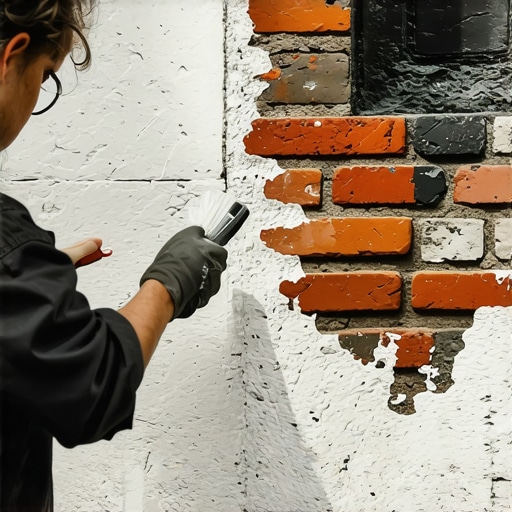
The forensic reality is that there are no shortcuts. If you see a contractor showing up with a gas-powered pressure washer and no chemical sprayers, fire them. The process starts with a low-pressure pre-soak to satisfy the brick’s ‘thirst’ so it doesn’t drink the cleaning chemicals. Then, the application of the surfactant, the dwell time, and a gentle scrub with natural-bristle brushes. We finish with a low-pressure rinse—usually no more than 400 PSI, which is basically a garden hose with a thumb over the end. We check for ‘honeycombing’ in the joints and address any structural voids immediately. You don’t just ‘wash’ a historic building; you curate its survival. Using sustainable masonry materials and respecting the original chemistry of the site isn’t just about aesthetics—it’s about structural integrity. If you treat the brick with respect, it will stand for another century. If you treat it like a sidewalk, it will be in a dumpster within a decade. It’s that simple. Do it right, or don’t touch it at all.