
The Ghost in the Wall: Why Modern Masonry is Failing
My mentor, a man who spent forty years with a trowel fused to his palm, once handed me a piece of hardened mortar he’d chipped out of a 1920s warehouse. “Look at the pores, kid,” he said, pointing to the microscopic voids with the tip of a rusted slicker. “This mud lived because it could breathe. Today’s guys are sealing the lungs of the building, then wondering why the face is popping off like a bad scab.” That lesson in material breathability is the foundation of everything I do in forensic structural inspections. We are currently in a crisis of craftsmanship, where the demand for speed has outpaced the physics of the materials we use. This is where reducing labor costs with smart modular masonry systems enters the conversation, not as a shortcut for the lazy, but as a technical necessity to bypass the human error currently plaguing our jobsites.
“Water penetration is the single greatest threat to masonry durability, accounting for over 90% of all premature failures in veneer systems.” – BIA Technical Note 7
The Physics of the ‘Lick-and-Stick’ Disaster
When we talk about brick veneer installation, the industry has shifted toward speed. Traditional multi-wythe walls are a thing of the past, replaced by thin veneers that rely entirely on the integrity of the drainage plane. The problem isn’t the brick; it’s the mud. In the freeze-thaw cycles of the North, water doesn’t just sit; it migrates. If you’re using a high-strength Portland cement on a modular system without a clear path for vapor drive, you are creating a ticking time bomb. As water freezes, it expands by 9%. If that expansion happens behind a dense, non-breathable mortar joint, the pressure has nowhere to go but through the face of the brick, causing catastrophic spalling. Smart modular masonry systems solve this by engineering the air gap and the weep system into the panel itself, removing the ‘handyman’s’ ability to accidentally plug the vents with excess mortar droppings.
Revolutionizing the Site: Self-Leveling Masonry Lifts and Robotics
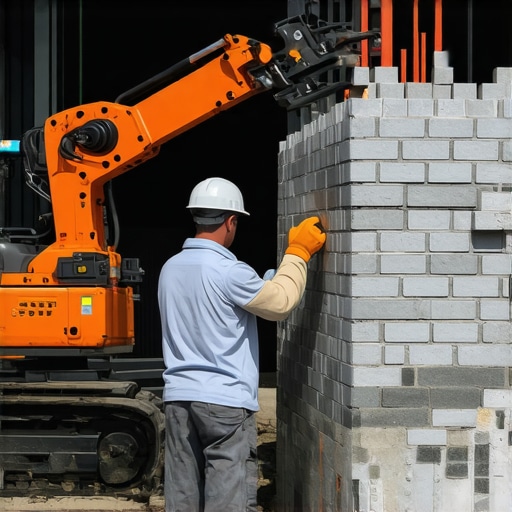
The labor shortage is real, and it’s ugly. I’ve seen brick patio restoration jobs where the ‘contractor’ didn’t even bother with a plate compactor, leading to a wavy mess that looks like a topographical map of the Ozarks within six months. This is why self-leveling masonry lifts are becoming the backbone of the modern commercial site. These systems ensure that the soldier course and the running bond stay true even when the operator is exhausted. Furthermore, robotic masonry repair is no longer science fiction. In forensic scenes where a brick infill panel repair is required at heights that make scaffolding costs astronomical, robotic arms can now execute precision repointing with a consistency no human can match after eight hours in the sun. They don’t get tired, they don’t ‘butter’ the edges of the brick incorrectly, and they don’t leave honeycombing in the deep joints where structural integrity lives.
Structural Triage: From Foundation Underpinning to Chimneys
When a homeowner calls me about a ‘hairline crack’ in their outdoor fireplace rebuild, I usually find a nightmare. Usually, it’s a cold joint where the new masonry met the old without proper reinforcement, or worse, the chimney repair services they hired previously just smeared a ‘band-aid’ of caulk over a structural separation. For serious settlement, foundation underpinning is the only cure. We’re talking about driving steel piers down to load-bearing strata because the original builder thought four inches of uncompacted fill was ‘good enough.’ Modular retaining walls offer a solution here because they are designed to move. Unlike a rigid poured wall that cracks under hydrostatic pressure, modular units allow for slight articulation and built-in drainage, preventing the wall from becoming a dam that eventually bursts.
“The stability of a structure depends not on the weight of the stones, but on the precision of their placement and the management of the forces acting upon them.” – Vitruvius, De Architectura
Restoring the Past: Stone Balustrade Restoration
In the realm of stone balustrade restoration, the ‘old world’ meets modern modular tech. You cannot treat a 100-year-old limestone railing like a suburban brick veneer installation. The chemistry of the stone requires a sacrificial mortar—something softer than the stone itself, usually a Type O or a pure lime putty. If you use a modern, hard mortar, the stone will shatter during the first hard freeze. Smart modular systems in restoration involve pre-casting replacement units using forensic matches of the original aggregate, then using self-leveling masonry lifts to set them with zero impact on the surrounding historic fabric. This reduces the ‘man-hours’ on the hawk and trowel while increasing the lifespan of the restoration by decades. Whether it’s a chimney repair service or a full-scale brick patio restoration, the goal is the same: stop fighting the physics of water and start using systems that respect the ‘tooth’ of the material. Do it once, do it right, or don’t bother picking up the trowel.