
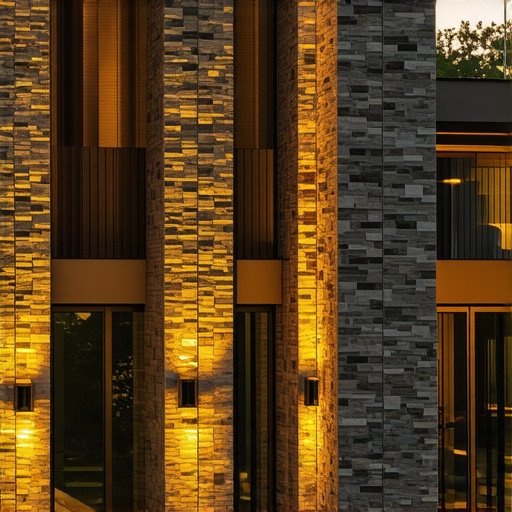
I was standing in the basement of a boutique hotel converted from an 1890s garment factory when I saw the first sign of a disaster. The owner thought it was just a cosmetic hairline crack, a little ‘character’ for the guests. But when I slid my fiber-optic scope into the cavity between the exterior brick and the structural backup, I saw a ghost. The steel wall ties, meant to hold the facade to the building, had rusted to red dust. The entire brick skin was essentially ‘floating,’ held up by nothing but gravity and luck. This is the reality of masonry forensics: the most dangerous problems are the ones you can’t see until they’re lying on the sidewalk. For the hospitality industry, where the facade is the first thing a guest touches, the shift toward modular masonry design isn’t just about speed; it is about controlling the physics of failure before they start.
The Tactile Reality of Modular Design
In the world of high-end hotels and resorts, the ‘lick-and-stick’ stone veneer craze is finally dying a deserved death. Designers are returning to modular masonry—real brick, real stone, and structural block—because it offers a level of thermal mass and sound dampening that cheap siding can’t touch. But modular design requires a master’s eye for the ‘mud.’ When we talk about modular masonry design, we are talking about the precision of the unit. A modular brick is designed to fit a 4-inch grid, but if your mason doesn’t understand the ‘suction’ or the initial rate of absorption (IRA) of that brick, the bond will fail before the grand opening.
Hospitality venues love this because it allows for rapid construction without sacrificing the ‘Old World’ feel. However, the forensic reality is that these modern systems are only as good as their moisture management. If you don’t have a retaining wall drainage upgrade in your site plan, your beautiful patio is going to be a wavy mess within three winters. It’s about hydrostatic pressure—the weight of water-saturated soil pushing against the back of the wall. Without weep holes and a proper gravel backfill, that wall will ‘bow’ and eventually blow out.
“Water penetration is the single greatest threat to masonry durability. Proper flashing and weep hole systems are the primary defenses against moisture-related distress.” – BIA Technical Note 7
The Physics of the Freeze-Thaw Cycle
If you’re building in a climate that sees the thermometer drop, you’re in a constant war with physics. Water expands by 9% when it turns to ice. If your bricks are absorbing too much water because of a lack of brick spalling prevention measures, that internal pressure will literally pop the face of the brick off. You’ll see it on the ground—little shards of red clay. That’s spalling. It happens when some ‘handyman’ uses a high-strength Portland cement on a historic brick facade. The mortar must be the sacrificial lamb. It needs to be softer than the brick so that moisture escapes through the mortar joints, not the brick face.
This is where historic brick salvage becomes a double-edged sword for developers. Using reclaimed brick looks fantastic in a hotel lobby or an exterior accent wall, but those bricks are often softer than modern units. You can’t just slap any ‘mud’ on them. You need mortar matching services that analyze the sand-to-lime ratio of the original material. If you ‘butter’ a soft 19th-century brick with modern Type S mortar, you are signing its death warrant. The brick will expand, the mortar won’t give, and the brick will crush itself.
The Art of the Joint: Pointing and Restoration
I’ve watched guys try to ‘tuckpoint’ a wall by just smearing new mortar over the old, shallow cracks. We call that ‘masking a corpse.’ True historic pointing styles, like the weather joint or the grapevine joint, are about more than just looks. They are designed to shed water away from the core of the wall. When we perform cracked brick wall repair, we don’t just fill the crack. We grind out the joint to a depth of at least twice its width to ensure the new mortar has enough ‘tooth’ to grab onto the old material. We use a ‘slicker’ or a jointer tool to compress the mortar, which seals the surface against driving rain.
In many boutique hotels, the focal point is a massive, original fireplace. But the chimney structural repair needed for these old beasts is intense. Often, the original lime mortar has turned to sand. I’ve seen chimney interior parging where the mortar was so decayed that smoke was leaking into the wall cavities. Parging—applying a smooth coat of mortar to the interior flue—is the only way to ensure the guest’s cozy fire doesn’t turn into a structural fire. It’s gritty, dirty work, standing on a ‘hawk’ and ‘buttering’ the inside of a dark flue, but it’s the difference between a safe stay and a lawsuit.
Hardscapes and the Hospitality Landscape
The exterior of a resort is as important as the interior. A retaining wall installation isn’t just about stacking blocks; it’s about soil mechanics. I’ve seen 30-foot walls lean because the contractor didn’t account for the ‘angle of repose’ of the soil. We see ‘honeycombing’ in the concrete footings where the air wasn’t vibrated out, leaving weak pockets that eventually crumble under the weight. For stone balustrade restoration, the stakes are even higher. These are safety features. If the ‘cold joint’—the place where one pour of concrete or mortar ended and another began—wasn’t properly prepared, the balustrade will snap under the weight of a guest leaning against it.
“Mortar shall be specified by either proportion or property specifications. The choice of mortar should be based on the type of masonry unit and the environmental exposure.” – ASTM C270 Standard Specification
We see a lot of ‘soldier courses’—bricks laid vertically on their ends—used as decorative lintels over windows in modular designs. They look great, but they are notorious for catching water on their top edge. If they aren’t flashed correctly, that water travels down into the window frame. This is why we insist on stainless steel flashing and high-quality end-dams. It’s not a ‘game-changer’; it’s just doing the job right the first time so you don’t have to do it twice.
The Forensic Verdict
When I’m called to a site where a wall is failing, it’s rarely the material’s fault. It’s usually a failure of the human element—a lack of respect for the chemistry of the ‘mud’ or the physics of the water. The hospitality industry loves modular masonry because it represents permanence and luxury. But that permanence is an illusion if you don’t respect the ‘suction’ of the brick, the ‘breathability’ of the lime, and the relentless pressure of the earth. Don’t trust a ‘handyman special.’ If your mason doesn’t know the difference between Type N and Type O mortar, or if they can’t tell you why your wall needs a control joint, send them packing. In this trade, you either do it once, or you pay me to tell you why it fell down.