
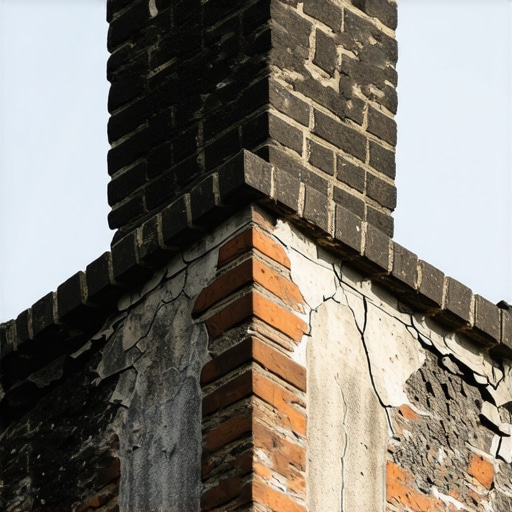
The Forensic Reality of the ‘Tiny’ Hairline Crack
I recall a specific inspection on a Queen Anne restoration where the homeowner pointed to a single, vertical hairline crack running through the mortar joints of the chimney stack. They thought it was a fifty-dollar patch job. I didn’t reach for my trowel; I reached for my borescope. When I fed that lens into the cavity between the flue liner and the brick wythe, the screen didn’t show me masonry—it showed me a graveyard. The structural steel lintels were rusted to nothing but orange dust, and the interior wythe of brick had literally melted into a pile of red silt because of decades of acidic condensation. That chimney wasn’t just ‘leaking’; it was a three-thousand-pound pillar of loose rubble held together by nothing but habit and old soot. This is the reality of masonry. It doesn’t scream when it’s hurting; it whispers until it collapses. Avoiding re-pointing services or ignoring the salt-white bloom of brick efflorescence removal needs isn’t saving money—it’s deferring a catastrophic structural failure.
The Chemistry of Destruction: Acid, Water, and the Pore Structure
To understand why your chimney is failing, you have to understand the micro-physics of a clay brick. A brick isn’t a solid, inert block; it is a capillary network. When you burn fuel, you aren’t just creating heat; you’re creating water vapor and sulfuric acid. If your chimney liner is compromised, that acidic moisture migrates into the ‘mud’—the mortar.
“Water penetration is the single greatest threat to masonry durability, leading to efflorescence, subflorescence, and the eventual disintegration of the binder.” – BIA Technical Note 7
This migration triggers a process called carbonation, where the calcium hydroxide in the mortar reacts with CO2, slowly turning your structural bond back into a weak, powdery limestone. If you are in a freeze-thaw climate, the stakes are even higher. Water trapped in the pore structure expands by 9% when it turns to ice. This creates internal hydraulic pressure that exceeds the tensile strength of the brick, causing the face to pop off—a process we call spalling. Once the hard-fired ‘skin’ of the brick is gone, the soft interior core absorbs water like a sponge, and the chimney’s lifespan is effectively over.
The Specialized Art of the Repair: From Tuckpointing to Underpinning
When we talk about tuckpointing cost estimation, most homeowners are shocked because they don’t see the labor involved in the ‘tooth.’ You don’t just smear new mud over old. You have to grind out the failing joints to a depth of at least 3/4 inch, ensuring the substrate is clean and has enough ‘suction’ to bond with the new material. Using tuckpointing machine services can speed up the process, but in historic restoration, the hand-struck joint is king. We often use a slicker to compress the mortar into the joint, which densifies the surface and creates a weather-tight seal. For chimneys that have begun to lean due to soil movement, we move beyond the surface. Foundation underpinning might be required to stabilize the mass of the masonry. I’ve seen chimneys that required masonry birdsmouth cuts for complex transitions into an outdoor kitchen masonry build, where the thermal expansion of the grill area wasn’t properly isolated from the main stack, causing the whole structure to shear.
The Hardscape Connection: Patios and Retaining Walls
The chimney is often the most visible failure, but it’s rarely an isolated incident. If the chimney is crumbling, look down at the brick patio restoration needs or the failing garden walls. Often, the same lack of retaining wall geogrid installation that causes a wall to bow is what’s happening beneath your chimney’s footing. Without geogrid to provide soil reinforcement, the lateral earth pressure shifts the masonry. If you’re building a new feature, like a sustainable masonry project, sustainable block cutting techniques—which minimize waste and maximize structural integrity—are non-negotiable.
“The durability of any masonry structure is entirely dependent on the management of moisture and the selection of compatible materials.” – ASTM C270 Standard Specification
When I’m buttering a brick for a soldier course, I’m not just laying a unit; I’m creating a hydraulic barrier. If the mortar is too hard (high Portland cement content) and the brick is soft, the mortar will win the fight, and the brick will crack. This is why we use Type O or Type K lime mortars for older homes—they are ‘sacrificial,’ designed to weather so the brick doesn’t have to.
Prevention vs. Forensic Reconstruction
The cost of an annual inspection is a pittance compared to the five-figure nightmare of a full rebuild. If you see honeycombing in your mortar or a cold joint where a previous ‘handyman’ tried to patch things with hardware-store caulk, you are already in the danger zone. Proper masonry isn’t about looks; it’s about the management of physics. It’s about ensuring that your brick patio restoration doesn’t just look pretty but drains away from the house. It’s about knowing that brick efflorescence removal is a chemical cleaning process, not just a power-washing job (which usually just drives more water into the wall). Do it once, and do it right with the correct ‘mud’ and the correct technique, or be prepared to watch your investment crumble into the soil. Masonry is forever, but only if you respect the water.