
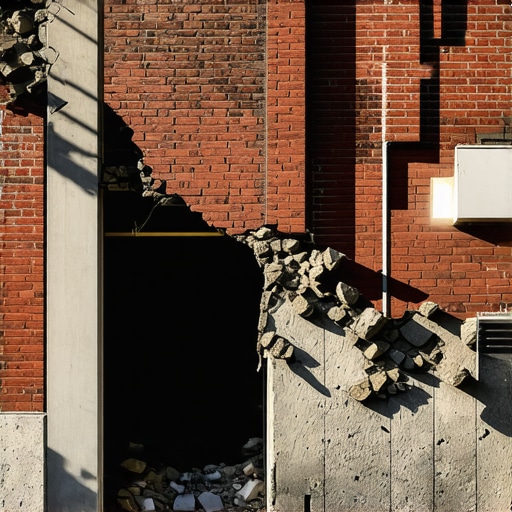
The Anatomy of a Failing Facade
I was standing on a scaffolding four stories above a busy city sidewalk last Tuesday, looking at a vertical shear crack that ran from the roofline of a 1910-era warehouse straight down to the second-story lintel. The building owner called me because a few bricks had fallen onto the pavement, but when I took my hammer and tapped the soldier course above the windows, the sound wasn’t the sharp ring of solid masonry; it was a dull, hollow thud. When I peered into the void with my borescope, I didn’t see solid backup. I saw structural steel that had been eaten alive by rust, expanding to three times its original thickness and pushing the brick infill outward like a slow-motion explosion. This wasn’t just a maintenance issue; it was a forensic scene waiting for a tragedy.
The Physics of the ‘Oxide Jack’
In commercial masonry, we often deal with infill—brickwork that fills the gaps in a steel or concrete frame. The problem is that these materials don’t play well together over a century. Steel moves, concrete shrinks, and brick expands as it absorbs moisture from the atmosphere. When the brickwork sealants application is done poorly, or when someone uses a modern, non-breathable coating, the moisture is trapped. Inside that wall, a chemical war begins. The iron in the steel reacts with water and oxygen to create iron oxide. This isn’t just a surface stain; the physical expansion of rusting steel exerts up to 10,000 psi of pressure against the masonry. This is what we call ‘oxide jacking.’ It shears the brick quoin repair sites and forces the historic pointing styles to pop out like dry scabs. If you see a crack that follows the line of an underlying beam, you aren’t looking at settlement; you are looking at the building trying to shed its own skin.
“Differential movement between the masonry veneer and the structural frame must be accommodated through the use of properly designed and spaced expansion joints.” – BIA Technical Note 18
The Suction and the Pore Structure
Old-world bricks, the kind fired in kilns before the 1940s, have a specific ‘suction’—an initial rate of absorption that dictates how the mud bonds to the unit. When a modern contractor comes in and tries to do a masonry water damage repair using high-strength Portland cement (Type S), they are signing the building’s death warrant. The old bricks are soft and porous. The new mortar is hard and brittle. When the wall expands in the summer sun, the mortar doesn’t give; it crushes the face of the brick. This is known as spalling. I’ve seen historic tuckpointing jobs ruined in under three seasons because the ‘pro’ didn’t understand the sacrificial principle: the mortar must always be weaker than the brick. We mix our mud with lime putty and specific sands to ensure that the wall can breathe. If the moisture can’t escape through the mortar joints, it will force its way through the face of the brick, destroying the historical integrity of the structure.
The Danger of Modern ‘Lick-and-Stick’ Overlays
One of the most cynical trends I see in commercial ‘renovations’ is stone veneer over brick. It’s a cheap way to make a failing building look modern, but it’s a structural disaster. By sticking a heavy, non-breathable stone veneer over shifting brick infill, you are hiding the warning signs of structural failure while simultaneously adding thousands of pounds of dead load to a system already in distress. It creates a cold joint where moisture collects, leading to honeycombing in the mortar behind the veneer. You can’t see the cracks, you can’t see the rust, and you can’t see the masonry water damage repair needs until the entire assembly peels off and hits the sidewalk. It is the ultimate handyman special, and it’s a liability nightmare.
Verticality and the Chimney Crisis
In these old commercial blocks, the chimneys are often the first to go. A chimney rebuild services call usually starts with a crumbling chimney crown repair. The crown is the first line of defense; if it’s cracked, water saturates the entire stack. In a commercial setting, these stacks are often massive, and when the internal liners fail, the acidic condensate from modern high-efficiency boilers eats the mud from the inside out. I’ve walked onto roofs where you could push the top five courses of a chimney over with one hand because the mortar had turned back into sand. This is where mortarless masonry systems or 3D printed masonry repairs are starting to be discussed, but for a true forensic restoration, nothing beats the hand-struck joint. You have to get the hawk and the slicker out, butter the joints properly, and ensure that the historic pointing styles match the original shed-water profile.
“Mortar for masonry construction must be selected based on the properties of the masonry units and the environmental exposure of the wall.” – ASTM C270 Standard Specification
The Capillary Trap and Vapor Drive
Let’s talk about the chemistry of water migration. In a commercial brick wall, you have ‘vapor drive’—moisture moving from the warm side of the wall to the cold side. If you apply a brickwork sealants application that is not ‘vapor permeable,’ you trap that moisture inside the brick’s pore structure. During a freeze-thaw cycle, that water expands by 9% in volume. This creates internal hydraulic pressure that literally blows the face of the brick off. You’ll see it as a pile of red dust at the base of the wall. When we perform masonry water damage repair, we don’t just slap on a sealer; we fix the chimney crown repair, we address the brick quoin repair at the corners, and we ensure the historic tuckpointing allows the wall to exhale. If the wall can’t dry, the wall will die.
Identifying the Critical Failure Points
When I’m doing a forensic walkthrough, I look for three things: the ‘smile’ (a sagging lintel), the ‘stair-step’ (foundation or frame settlement), and the ‘bulge’ (infill detachment). A bulge in a commercial wall is a life-safety issue. It means the ties that hold the brick to the frame have rusted through. At this point, the brick is just stacked weight held up by friction and luck. No amount of historic tuckpointing will fix a detached wall. You need structural anchors, sometimes helical piers, and often a partial teardown to replace the rusted steel with galvanized alternatives. Don’t let a ‘handyman’ tell you that a little bit of caulk will fix a shifting infill. They are looking at the surface; I’m looking at the physics of gravity and the inevitable march of oxidation.