
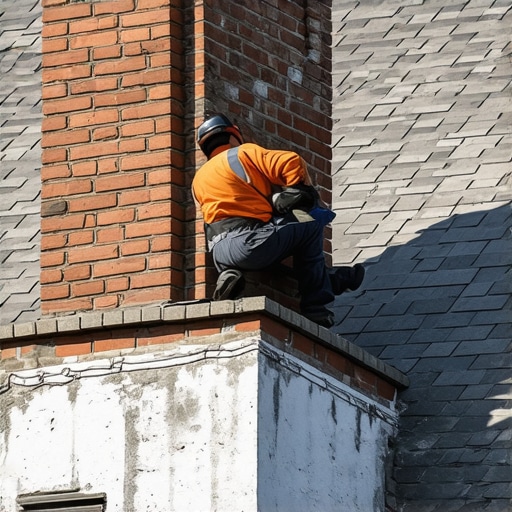
The Ghost in the Flue: A Forensic Look at Masonry Failure
The homeowner thought it was just a faint, persistent scent of woodsmoke in the upstairs master suite—a cozy atmospheric quirk, or so they thought. But when I pushed my digital borescope through a hairline crack in the attic-level brickwork, the screen revealed a nightmare. The structural clay liner had shattered into a dozen shards, and the house’s framing was charred black, just millimeters away from a flash-point. It wasn’t a chimney fire yet, but it was a ticking clock. The structural steel and wood were being toasted by 800-degree gases escaping through failed mortar joints. This is where the romance of the fireplace meets the cold, hard physics of masonry damage assessment.
As a third-generation mason, I’ve seen what happens when people treat their chimneys like decoration rather than the high-intensity thermal engines they actually are. A chimney is a vertical furnace that must withstand extreme temperature fluctuations, corrosive chemical byproducts, and the brutal reality of the freeze-thaw cycle. When you ignore professional masonry restoration, you aren’t just risking a drafty house; you are inviting a catastrophic structural failure.
“Water penetration is the single greatest threat to masonry durability, particularly in chimney structures where thermal cycling accelerates the degradation of saturated materials.” – BIA Technical Note 7
The Physics of Heat and the ‘Sacrificial’ Joint
To understand why your chimney is failing, we have to talk about the ‘mud’—the mortar. In the old world, we used lime-based mortars that were softer than the brick. This is the sacrificial principle. The mortar is meant to take the brunt of the movement and the moisture, failing before the brick does. Modern ‘handyman specials’ often involve slapping high-strength Portland cement over old, soft clay bricks. This is a death sentence for the structure. Because the cement is harder than the brick, the brick cannot expand when it gets hot. Instead, the face of the brick pops off in a process we call spalling.
When I perform a masonry damage assessment, I’m looking for more than just cracks. I’m looking for the ‘tooth’ of the repair. If a previous contractor didn’t grind out the joints to a proper depth of at least three-quarters of an inch before applying new mud, that new mortar is just ‘lick-and-stick’ garbage that will peel off within two seasons. Proper tuck pointing services require surgical precision: removing the spent, sandy material and ‘buttering’ the joints with a mix that matches the original’s compressive strength and vapor permeability.
Chimney Interior Parging: The Invisible Shield
One of the most overlooked aspects of chimney health is chimney interior parging. Think of parging as a smooth skin of specialized mortar applied to the interior smoke chamber and flue. When you have ‘honeycombing’—those jagged, recessed holes in the mortar—it creates turbulence. Instead of the smoke rising smoothly, it swirls, cools, and deposits creosote. Creosote is a fuel, and in a jagged, un-parged chimney, it finds a million places to hide.
Micro-zooming into the chemistry: as wood burns, it releases moisture and unburned hydrocarbons. If your masonry is cold and porous, that moisture condenses. This acidic condensate eats away at the calcium carbonate in your mortar, turning it into a soft, mushy paste. If you don’t have a professional mason apply a smooth parge coat, you’re essentially building a soot-trap that will eventually ignite. This is why concrete masonry unit restoration in chimney builds is so technical; the thermal expansion of the block and the liner must be accounted for with proper expansion gaps, or the whole stack will ‘stair-step’ crack under the pressure of its own heat.
The Freeze-Thaw War on Your Facade
In the North, we fight a constant battle against the 9% expansion of water. When liquid water enters a hairline crack in a chimney crown or a stone balustrade, it sits there until the temperature drops. As it turns to ice, it exerts thousands of pounds of pressure per square inch. This is the primary driver of freeze-thaw damage restoration. You’ll see it first in masonry staining—white, powdery efflorescence where salts are being leached out of the brick—and eventually, the stone simply disintegrates.
For a commercial masonry facade maintenance program, we look for ‘cold joints’ where the masonry meets different materials. If the flashing is gone or the retaining wall capstone replacement was done with cheap, non-breathable sealants, the water gets trapped behind the stone. It cannot ‘breathe’ out. In the summer, that water turns to steam, and in the winter, it turns to ice. Either way, the stone is being pushed off the wall from the inside out.
“Mortar for masonry restoration should be selected based on the physical properties of the existing masonry units to ensure compatibility and prevent accelerated weathering.” – ASTM C270 Standards
The Art of the Restoration: Beyond the Trowel
When I’m restoring a stone balustrade or a chimney, I don’t just reach for a bag of pre-mix. I’m looking at the suction of the brick. If you ‘butter’ a dry brick without wetting it first, the brick will suck the water out of the mortar before it can hydrate. The result is a ‘burnt’ joint that looks fine for a month but will crumble like a dry biscuit the moment you touch it with a slicker. We call this ‘flash setting,’ and it’s the hallmark of an amateur.
Professional masonry restoration is about managing the ‘wetting and drying’ cycles. Whether it’s a simple retaining wall capstone replacement or a complex commercial masonry facade maintenance project, the goal is the same: keep the water out, and give it a way to escape if it gets in. This means installing weep holes, using air-entrained mortars in freeze-prone areas, and ensuring that every soldier course is perfectly pitched to shed water.
Don’t Ignore the Warning Signs
If you see ‘stair-stepping’ cracks in your chimney, if your bricks are flaking off in thin layers, or if you notice your mortar joints are receding like an old man’s hairline, you are already in the danger zone. A chimney fire can reach temperatures of 2,000 degrees Fahrenheit—enough to melt the mortar and collapse the structure into your living room. A masonry check isn’t just about aesthetics; it’s about the structural integrity of your home. Do it once, and do it right, or you’ll be doing it again after the fire trucks leave.