The Winter Betrayal: Why Your Chimney Flashing is the First to Fail
I’ve spent forty years crawling across pitched roofs and peering into the dark, damp corners of attics, and if there is one thing I can tell you with absolute certainty, it’s that winter is a predator. It looks for the weakness in your home’s armor, and that weakness is almost always the chimney flashing. To the untrained eye, a chimney is a solid pillar of strength. To a forensic mason, it is a porous straw that spends its life trying to suck the atmosphere into your living room. When the mercury drops and the first ice storm hits, the battle between metal and mud begins in earnest.
The Lesson of the Thirsty Brick
My father used to say that a brick is never truly dry; it’s just waiting for its next drink. I remember standing on a scaffold in a biting wind when I was nineteen, watching him dip a 1920s-era clay brick into a bucket of water. If the brick hissed—a sound like a quiet gasp—he’d tell me the ‘suction’ was too high and the mud would never bond. ‘If you don’t hydrate the substrate, the brick will steal the moisture from the mortar before the crystals can grow,’ he’d growl. That lesson applies directly to why chimneys fail today. Most modern masons treat a chimney like a static object. It isn’t. It is a dynamic, breathing heat-exchanger that expands and contracts at a different rate than the lead or copper wrapped around its waist. When that ‘thirsty’ brick meets the freezing condensation of a winter night, the physics of destruction take over.
The Physics of the Freeze-Thaw Cycle
The primary culprit in winter flashing failure is the differential expansion of materials. Your masonry—the brick and the mortar—is a mineral composite. Your flashing—typically lead, copper, or galvanized steel—is a metal. During a typical winter day, the sun hits the chimney, warming the brick. Inside, the furnace is kicking out heat, warming the internal flue. The metal flashing heats up rapidly, expanding in its reglet. Then the sun goes down. The metal cools in minutes; the masonry takes hours. This creates a microscopic gap, a ‘cold joint’ that invites moisture via capillary action.
“Water penetration is the single greatest threat to masonry durability. In cold climates, the expansion of trapped water upon freezing can exert internal pressures exceeding the tensile strength of the masonry units themselves.” – BIA Technical Note 7
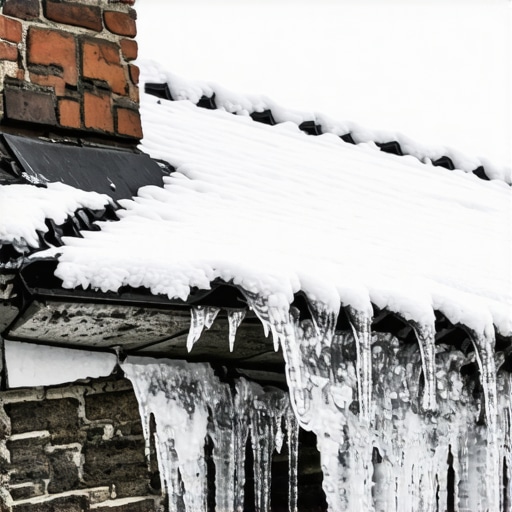
When water gets behind that flashing, it doesn’t just sit there. Because water expands by approximately 9% when it turns to ice, it acts like a slow-motion hydraulic jack. It pushes the mortar out of the joint. This is why tuckpointing brick walls becomes a necessity rather than an aesthetic choice. If you see the mortar behind your flashing crumbling into a fine powder, the freeze-thaw cycle has already won the first round.
Commercial Masonry Maintenance and the Green Roof Complication
In high-end commercial masonry maintenance, we see a new threat: green roofing masonry integration. While beautiful, these living roofs maintain a high level of constant humidity at the base of the masonry. When the winter frost hits, that moisture is wicked up into the chimney stack. If the flashing isn’t perfectly integrated with a through-wall system, the vegetation-induced moisture freezes inside the brick core. This leads to brick efflorescence removal becoming a constant headache, as salts are pushed to the surface of the brick, leaving those white, crusty stains that signal a deeper structural rot.
Tuckpointing vs. Repointing: Don’t Let the DIY Videos Fool You
I see it every spring: homeowners with a tuckpointing tools for DIY kit they bought online, trying to ‘butter’ over a structural crack. They use a hard Portland-based cement on a soft, historic brick. This is a death sentence for the chimney. Tuckpointing is the art of using two different colors of mortar to create the illusion of a perfect joint, while repointing is the actual structural repair. If you use a mortar that is harder than the brick—common in ‘handyman specials’—the brick will be the one to break during the next freeze. You must use a sacrificial mortar, something like a Type O or a lime-putty mix, especially if you are working with historic brick salvage. The mortar must be the sponge, not the brick.
The Internal Enemy: Chimney Heat Shield Installation
Sometimes the failure isn’t coming from the outside. If a chimney lacks a proper chimney heat shield installation, the internal temperatures of the flue can fluctuate wildly. This thermal shock stresses the masonry from the inside out, cracking the mortar joints that hold the flashing in place. Without a shield, the heat transfer to the exterior brick is uneven, causing ‘bowing’ in the stack that shears the flashing away from the roofline. Once that seal is broken, no amount of silicone caulk—the ultimate ‘lick-and-stick’ sin—will save it.
“Masonry units must be compatible with the mortar type to ensure a resilient bond. The use of high-strength mortars on low-strength units often leads to irreversible spalling.” – ASTM C270 Standards
Advanced Finishes and Final Inspections
Modern architecture has introduced metallic masonry finishes and specialized tile grouts on masonry chimneys. While these look sharp, they often lack the breathability of traditional materials. They trap moisture behind a vapor-impermeable skin. In winter, this trapped vapor turns to ice lenses. You’ll see the entire face of a brick pop off—a process called spalling—leaving the raw, orange interior exposed to the elements. If you see this, or if you notice the ‘ringing’ sound of your bricks has turned into a dull thud when tapped, the internal structure is compromised.
The Forensic Conclusion
If you want your chimney to survive the winter, stop thinking about flashing as a piece of metal and start thinking about it as a water-management system. It requires proper ‘weep holes’ to let internal moisture out and a ‘soft’ mortar joint to allow for movement. When you hire a mason, ask them about the ‘tooth’ of the mortar and the suction of the brick. If they don’t know what you’re talking about, keep looking. A real master knows that we don’t build against nature; we build to accommodate it. Do it right once, or you’ll be paying me to come out and tell you why it fell apart twice. Keep your mud wet, your bricks thirsty, and your flashing flexible.