
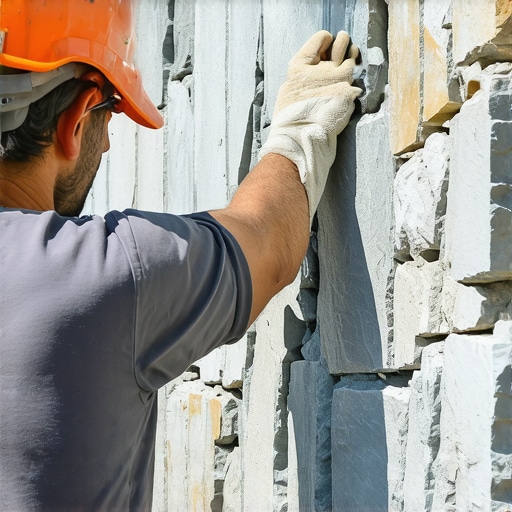
The Gravity Problem: Why Stone Wants to Fall
I remember a job site in the dead of a humid July, staring at a three-story chimney where the ‘lick-and-stick’ stone veneer was literally sliding off the scratch coat like melted wax. My old mentor, a man who smelled of wet lime and stale coffee, used to say a stone doesn’t want to stay on a wall; it has spent eons in the dirt and that is exactly where it wants to return. He’d run his calloused hand over a substrate to check the ‘tooth’—that essential roughness that allows the mud to bite. If your mud doesn’t have the ‘grab’ to fight gravity from the first second, you are not masonry-building; you are just decorating a future landslide. In the world of modern construction, vertical stone veneer slippage is the silent killer of curb appeal and structural liability. We are no longer just using suction; we are using advanced polymer chemistry to defy physics.
The Physics of the Bond: Mechanical vs. Chemical
To understand why a stone stays put, you have to look at the interface between the masonry unit and the substrate. Traditional Type S mortar relies heavily on mechanical interlocking. When you butter the back of a stone, the mud is forced into the microscopic pores of both the stone and the concrete backer board or scratch coat. As the water is pulled out—a process called suction—the cement crystals grow into those pores, creating a physical anchor. However, with heavy natural stone or large-format thin brick, mechanical anchoring alone often fails under the stress of thermal expansion. This is where advanced adhesives change the game. These are not your hardware store ‘liquid nails.’ We are talking about thixotropic, high-polymer-modified thin-sets. These materials exhibit a unique property: they are thick and viscous when stationary but become fluid when worked with a trowel. Once the stone is set, the adhesive regains its ‘body’ instantly, providing the initial tack needed to prevent slippage without the need for self-leveling masonry lifts or mechanical shims.
“Adhesion is not merely a surface phenomenon but a complex interaction of mechanical interlocking and chemical bonding.” – Brick Industry Association (BIA)
The Chemistry of High-Performance Polymers
When we perform a masonry damage assessment on a failed facade, the culprit is usually ‘flash setting’ or a lack of polymer density. Modern adhesives utilize redispersible polymer powders (RPP) and cellulose ethers. These chemicals do two things: they retain water so the cement can hydrate fully even in thin layers, and they create a flexible ‘bridge’ between the stone and the wall. Think of these polymers as millions of tiny rubber bands that can stretch when the building moves or when the sun beats down on a soldier course during a 100-degree afternoon. Without this flexibility, the difference in the coefficient of thermal expansion between the stone and the wall creates a cold joint or a total shear failure. In high-freeze-thaw environments, this bond is even more critical. Water expands by 9% when it freezes; if it finds a microscopic void behind a stone because the mortar didn’t have 100% coverage, it will pop that stone off like a bottle cap. Advanced adhesives are designed to be ‘full coverage’ materials, wetting out the entire back of the unit to eliminate those deadly voids.
Integrating BIM and Modern Inspection Tech
In the era of BIM masonry projects, we are now modeling the dead load of stone veneers before a single bag of mud is mixed. Building Information Modeling allows us to predict where stress concentrations will occur, especially around openings or at the transition between a retaining wall geogrid installation and a vertical house wall. For existing structures showing signs of distress, we no longer just climb a ladder with a hammer. We utilize drone chimney inspections to identify early-stage slippage or chimney cap replacement needs before they become catastrophic. If a stone has moved even a fraction of an inch, it leaves a tell-tale shadow or a crack in the historic pointing styles of the surrounding mortar. These tools allow us to pinpoint if the failure is due to adhesive breakdown or retaining wall batter correction issues where the underlying structure is tilting.
“The bond strength of the mortar to the masonry unit is the most important property of the hardened mortar.” – ASTM C270 Standard Specification
The Practical Execution: Buttering and Striking
A master mason knows that the hawk and trowel are instruments of precision. When applying advanced adhesives, you don’t just ‘glob’ it on. You must ‘key’ the mortar into the substrate using the flat side of the trowel to ensure maximum contact, then use a notched trowel to create ridges that allow air to escape when the stone is pressed home. This prevents the ‘suction cup’ effect from failing. If you’re working on a brick infill panel repair or a retaining wall batter correction, you have to be mindful of the moisture content. A bone-dry brick will suck the life out of the adhesive too fast, ‘burning’ the bond. We use mortar matching services to ensure that any visible joints between the stone veneer match the existing aesthetic, but the ‘guts’ of the wall—the adhesive—must be modern. Even when recreating historic pointing styles, the underlying bond is where you cannot afford to be a traditionalist. Modern adhesives solve the slippage problem by providing a shear strength that far exceeds the weight of the stone itself, ensuring that once you slick that joint, it stays slick for a century.
Final Forensics: Why it Matters
The difference between a 30-year wall and a 5-year wall is found in the chemistry of the bond. Whether we are dealing with retaining wall geogrid installation to stabilize a slope or self-leveling masonry lifts to ensure a flat floor, the principles of masonry remain the same: respect the material, understand the physics, and never trust a ‘handyman special.’ Advanced adhesives have given us the ability to push the limits of vertical design, but they require a forensic understanding of the substrate to work. If you ignore the masonry damage assessment or fail to address a chimney cap replacement that is letting water into the wall cavity, no adhesive in the world will save your veneer from the relentless pull of gravity. Do it once, do it right, and let the polymers do the heavy lifting.