
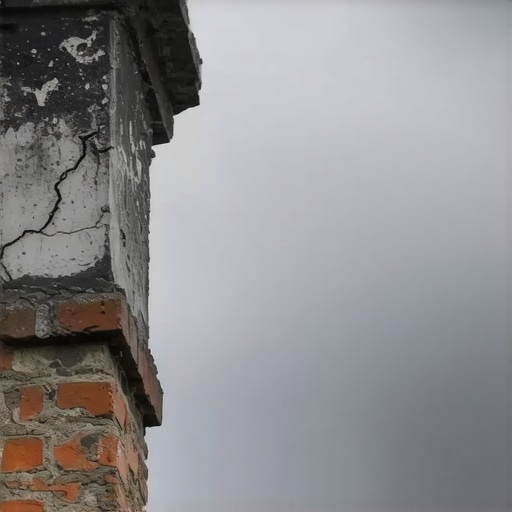
The first sign of a dying chimney isn’t a collapse; it’s a whisper in the form of a hairline fracture on the crown. My father, a man who spent forty years with a hawk and trowel in hand, used to tell me that a chimney without a sound crown is just a vertical drainpipe leading directly to your bank account. He had a ritual: he’d climb a ladder with a spray bottle of water and a piece of chalk. He’d soak the crown, and if the water disappeared into a crack faster than it evaporated off the surface, he’d mark it with a ‘dead man’s cross.’ He knew that once moisture bypasses that top seal, the clock starts ticking on a total masonry water damage repair project that could cost five figures.
“Water penetration is the single greatest threat to masonry durability. The chimney crown, being the first line of defense, must be constructed to shed water away from the masonry below.” – BIA Technical Note 7
The Physics of the Freeze-Thaw Jack
In our northern climate, we aren’t just fighting rain; we are fighting the laws of thermal expansion and phase-change physics. When water enters a crack in a concrete chimney crown, it settles into the microscopic pores of the cementitious matrix. When the temperature drops, that water expands by 9% as it crystallizes into ice. This creates an internal hydraulic pressure that can reach upwards of 114,000 PSI. Your standard concrete masonry unit restoration project often begins because someone ignored this 9% expansion. The pressure exceeds the tensile strength of the mortar, causing the face of the brick to pop off—a process we call spalling. If you see red dust on your roof, your bricks are literally exploding from the inside out because your crown failed.
The Restoration Reality: Why Your Handyman is Killing Your Chimney
I’ve walked onto countless jobs where a ‘handyman’ tried to fix a crown with a bucket of roofing tar or cheap caulk. This is a death sentence for historic masonry preservation. Those materials aren’t breathable. They trap moisture behind the seal, accelerating the rot. True chimney sweep and repair involves a deep understanding of material science. For a crown to survive, it needs to be a ‘wash’—a sloped surface that sheds water. If the crown is flush with the bricks, water just runs down the face, leading to commercial tuckpointing needs within a few seasons. We look for a 2-inch overhang with a drip edge. This prevents the water from ever touching the soldier course of bricks below.
The Forensic Inspection of Commercial Parapet Walls
In commercial settings, the stakes are higher. Commercial parapet wall repair is often the result of poor drainage and ‘cold joints’ during the original pour. A cold joint happens when the first lift of concrete starts to set before the second lift is poured, creating a weak plane where water can migrate. When I perform a forensic audit on a commercial building, I’m looking for efflorescence—that white, salty staining. It’s not just an eyesore; it’s the ghost of a leak. It tells me that water is leaching minerals out of the mud and depositing them on the surface. If you see this, you likely need a full stone facade restoration or, at the very least, an application of high-grade porous stone sealers to stop the capillary action.
“The use of mortar that is harder than the masonry units themselves can lead to irreversible damage of the units during thermal expansion cycles.” – ASTM C270 Standards
Mastering the Mud: The Chemist’s Approach to Tuckpointing
When we talk about commercial tuckpointing, we aren’t just ‘filling holes.’ We are matching the compressive strength and the vapor permeability of the existing structure. If you’re working on an old building and you use high-strength Portland cement, you’re creating a ‘hard’ joint. The old, soft bricks will expand against that hard joint, and because the mud won’t give, the brick will crack. This is why historic masonry preservation requires Type O or Type N lime-based mortars. We ‘butter’ the joints carefully, ensuring no honeycombing exists within the wall. Honeycombing—those air pockets left behind by poor compaction—is a playground for moisture and insects.
Modular Retaining Walls and Hydrostatic Pressure
It isn’t just chimneys that fail. I’ve seen modular retaining walls bow and burst because the contractor forgot about the physics of soil. Every square foot of wet soil behind a wall exerts hundreds of pounds of hydrostatic pressure. If you don’t have a proper gravel backfill and weep holes, that wall is a ticking time bomb. It doesn’t matter if you use the most expensive stone; if the base isn’t compacted to 95% Proctor density, it will shift. This is the tactile reality of masonry: it’s 90% what you don’t see (the base, the drainage, the mortar chemistry) and 10% what you do (the finish).
Advanced Finishes and Modern Solutions
For those looking for a contemporary aesthetic, metallic masonry finishes can provide a striking look, but they must be applied over a perfectly sound substrate. You cannot hide structural failure with a decorative coating. Before any aesthetic work, we ensure the masonry water damage repair is complete. We use a slicker to strike the joints, ensuring they are concave to shed water efficiently. This isn’t just for looks; a concave joint compacts the mortar face, making it more resistant to water penetration. When we finish, we often recommend porous stone sealers. Unlike the ‘film-forming’ sealers of the past that peel and yellow, modern silane-siloxane sealers penetrate deep into the stone, chemically bonding to the silica to create a hydrophobic barrier that still allows the building to ‘breathe’ out any internal vapors.