
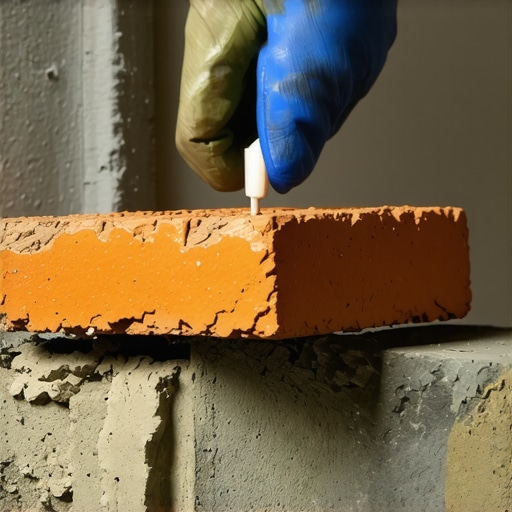
The first time I saw a major thin-brick failure was on a twenty-story commercial parapet wall repair job in downtown Chicago during a January thaw. I stood on a swing stage, sixty feet up, looking at a section of veneer that had buckled outward like a wet cardboard box. The homeowner and the building manager thought it was just a few loose bricks, a minor headache. But when I slid my inspection scope into the cavity, the truth was far uglier. The structural steel was weeping rust, and the ‘structural’ adhesive used to butter those thin-brick units had turned into a brittle, chalky film. It wasn’t masonry; it was a disaster waiting to happen. The installer had treated the facade like kitchen tile, forgetting that out here, the wind, the rain, and the freeze-thaw cycle don’t care about aesthetics. They only care about physics.
The Anatomy of the Modern Veneer
In the world of commercial masonry facade maintenance, we are seeing a massive shift toward thin-brick applications. These aren’t your grandfather’s full-depth units. We’re talking about 5/8-inch to 1-inch thick slices of real fired clay. While they save weight and cost, they rely entirely on the integrity of the bond. To understand why these systems fail, you have to micro-zoom into the hydration of the cementitious substrate. When you apply a parge coat—what we often call chimney interior parging in residential contexts—you are creating the ‘tooth’ for the adhesive. If that parge coat is too smooth, or if it’s ‘burned’ (meaning the water evaporated before the chemical reaction could complete), the adhesive will never bite. It just sits on the surface, a cold joint waiting to happen.
“The performance of thin-brick veneer depends heavily on the compatibility of the adhesive with both the unit and the substrate, particularly regarding shear strength and moisture resistance.” – BIA Technical Note 28C
We use structural adhesives to bridge the gap between the rigid brick and the slightly more flexible substrate. In commercial tuckpointing, we’re often dealing with movement. A building breathes. It expands in the noon sun and shrinks in the midnight cold. If you use a rigid, old-school mud without polymer additives, the thermal expansion will snap the bond. Modern structural adhesives are often Silyl Modified Polymers (SMP) or high-grade polyurethanes that maintain a degree of elasticity. They act as a shock absorber. When I’m buttering a course of thin-brick, I’m looking for that specific suction. You feel it in the trowel. If the brick doesn’t grab the mud and hold on, your mix is wrong, or your brick is too dry, sucking the life out of the adhesive before it can cure.
The Enemy: Hydrostatic Pressure and Vapor Drive
In northern climates, the biggest threat to any masonry, whether it’s stone coping installation or a brick paver driveway repair, is the freeze-thaw cycle. Water is a relentless force; it expands 9% when it turns to ice. If moisture gets trapped behind a thin-brick unit because the installer didn’t understand vapor drive, it creates hydrostatic pressure. That pressure will pop the face off a brick faster than you can say ‘lawsuit.’ This is the primary cause of brick spalling prevention failure. You need an adhesive that is ‘breathable’ or a system that incorporates a drainage plane. Many of these lick-and-stick jobs fail because they create a ‘vapor barrier’ that traps water inside the wall. I’ve seen commercial parapet wall repair projects where we had to strip thousands of square feet of veneer because the original contractor used a non-permeable epoxy that turned the wall into a swimming pool.
The Mechanics of the Grip
When we talk about the ‘mud’ used in these applications, we’re really talking about a complex chemical soup. You have Portland cement for strength, lime for workability (and a bit of self-healing property), and then the polymers. These polymers are what make it a ‘structural adhesive.’ They create long molecular chains that weave into the microscopic pores of the fired clay. This is why cleaning the back of the brick is non-negotiable. If there’s kiln dust on that brick, you aren’t bonding to the clay; you’re bonding to the dust. I’ve seen emergency masonry repair calls where I could peel the bricks off with my bare hands because the installer was too lazy to use a brush on the hawk. You have to treat every unit with respect. You ‘butter’ the back, ensuring 100% coverage, and you press it into the scratch coat until you see that slight ‘squeeze-out’ at the edges. That’s how you know you’ve eliminated the air pockets where water likes to hide.
“Selection of mortar and adhesive types must be based on the specific physical properties of the masonry unit, including initial rate of absorption (IRA) and surface texture.” – ASTM C1088 Standard Specification for Thin Veneer Brick Units
Hardscape Realities and Retaining Walls
The same logic applies to retaining wall installation. You see guys trying to use thin-stone veneer on a wall that’s holding back ten tons of saturated soil. If they don’t have a robust drainage system and a high-performance structural adhesive, that wall will look like a mess in three seasons. The salt from the soil will migrate through the stone (efflorescence) and attack the bond line. For a brick paver driveway repair, the physics shifts slightly toward compaction and shear, but the ‘tooth’ of the material remains king. If you’re not using a polymeric sand or a stabilized base, those pavers will shift and sink, creating a wavy mess that no slicker or jointer can fix. It’s about the foundation, every single time. Whether you’re doing chimney flashing repair or a massive commercial facade, you’re only as good as the surface you’re sticking to.
The Forensic Verdict
So, how do you do it right? You start by testing the suction of your brick. You ensure your substrate is structurally sound and free of ‘honeycombing.’ You choose an adhesive that matches the climate—air-entrained for the north to handle the freeze, or high-tack for the south to handle the heat. And you never, ever skip the flashing. I’ve spent my life fixing the mistakes of people who thought they could shortcut the laws of chemistry. Masonry is an honest trade. If you lie to the wall, the wall will eventually tell the truth to everyone walking by on the sidewalk. Do it once, do it right, and use the mud that was engineered for the job, not just whatever was on sale at the big-box store. Your reputation, and the safety of the public, is held together by that 1/8-inch bond line. Don’t let it be the weak link.