
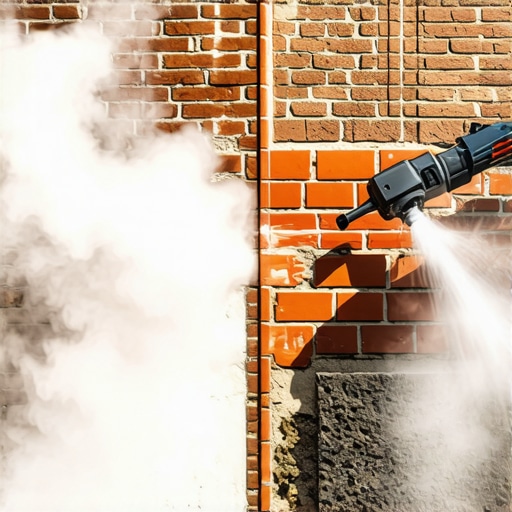
The Tragedy of the Scoured Facade
I remember walking up to a 1912 Victorian in the heart of the city where the homeowner was beaming with pride. He’d just paid a ‘guy with a rig’ to sandblast the soot of a century off his red clay bricks. As I got closer, my heart sank. What used to be a hard, fire-kilned protective skin was now a porous, fuzzy mess. He hadn’t just cleaned the brick; he had lobotomized it. The protective vitrified face was gone, leaving the soft inner core exposed to the elements like a raw nerve. That house will be a sponge for the rest of its shortened life, and no amount of masonry staining or sealant will ever truly fix the structural theft that occurred in the name of aesthetics.
The Anatomy of the Brick: Why the Surface is Sacred
To understand why the choice between chemical cleaning and sandblasting is the difference between a restoration and a demolition, you have to micro-zoom into the kiln-firing process. When a clay brick is fired, the minerals on the exterior surface vitrify, creating a dense, glass-like ‘fire-skin.’ This skin is the brick’s only defense against the freeze-thaw cycle. Sandblasting is an indiscriminate brute. It uses high-pressure air to hurl abrasive media—silica sand, crushed glass, or walnut shells—at the masonry. While it removes the dirt, it also rips away that vitrified skin, opening up the capillary pores of the clay. Once those pores are open, water ingress becomes an unstoppable force, leading to catastrophic spalling when the temperature drops. Unlike self-healing concrete foundations which can mitigate minor fissures through crystalline growth, once a brick’s face is gone, the damage is irreversible.
“Sandblasting and other abrasive cleaning methods are generally not recommended for historic masonry because they can cause permanent, physical damage to the masonry units.” – BIA Technical Note 1
Chemical Cleaning: The Surgical Approach
When we talk about chemical cleaning, we aren’t talking about dumping acid on a wall. We are talking about targeted surfactants and mild alkaline or acidic washes designed to emulsify pollutants without biting into the silica of the brick itself. You butter the wall with a pre-wash, let the chemistry do the heavy lifting to break the molecular bond of the carbon crust, and then use a low-pressure rinse. This preserves the ‘tooth’ of the original masonry. It’s slower, messier, and requires a technician who understands PH balances, but it keeps the building’s integrity intact. If you’re dealing with historic brickwork repointing, you must clean before you repoint to ensure the new mud bonds to the brick edges rather than a layer of 1950s smog.
The Role of Repointing in Restoration
Cleaning is only half the battle. If you look at your joints and see the mortar is receding or turning to dust, you need mortar repointing services. In the old days, we didn’t have high-strength Portland cement. We used lime and sand. This created a sacrificial joint. The mortar was designed to be softer than the brick so that when the wall expanded and contracted, the mortar took the stress, not the brick. Modern ‘handymen’ often slap Type S cement into old walls, which is far too hard. This causes the brick edges to crush and pop. When I’m performing historic brickwork repointing, I’m looking for that perfect slicker finish that sheds water while allowing the wall to breathe. Without breathability, moisture gets trapped behind the brick veneer installation, leading to honeycombing and internal rot.
Structural Stability and Water Management
Restoration isn’t just about the facade; it’s about the physics of the entire structure. Many people overlook the stone coping installation at the top of a parapet wall. If the coping is cracked, water runs down the inside of the wall, bypassing your cleaning and repointing efforts entirely. Similarly, in retaining wall installation, the greatest enemy is hydrostatic pressure. I’ve seen 12-inch thick walls bow like a longbow because the retaining wall weep hole cleaning was neglected. Water builds up, the soil expands, and even the best advanced masonry adhesives won’t save you from the weight of the earth. If you have a concrete patch that keeps failing on your foundation, it’s rarely a product failure; it’s a drainage failure.
“The primary goal of any masonry restoration project should be to stabilize the substrate and prevent further deterioration using materials that are physically and chemically compatible with the original fabric.” – ASTM C270 Standards
The Physics of the Freeze-Thaw
In northern climates, the physics are brutal. Water expands 9% when it turns to ice. If you have used a sandblaster and opened up the pores of your brick, that 9% expansion happens inside the brick. It creates internal pressure that eventually blows the face of the brick off in a process called spalling. This is why we insist on soft lime mortars and chemical cleaning. We want the water to be able to migrate out of the wall through the mortar joints (evaporation) rather than getting trapped behind a hard, blasted surface. Even when doing a soldier course at a window lintel, the alignment and the ‘suction’ of the brick during installation determine its decade-long durability.
Preserving Value: Do It Once, Do It Right
The temptation to go cheap with a concrete patch or a quick blast is high, but the long-term cost is astronomical. True masonry forensic work shows that buildings treated with respect for their original material science outlast ‘modernized’ restorations by fifty years or more. Whether you are looking at masonry staining to blend new repairs or installing a brick veneer installation on a new addition, the principles of moisture management and material compatibility remain the same. Don’t let a ‘fast’ solution ruin a century of craftsmanship. Use the hawk and the slicker, respect the mud, and never, ever blast away the history of a building just because it’s covered in a little soot.