
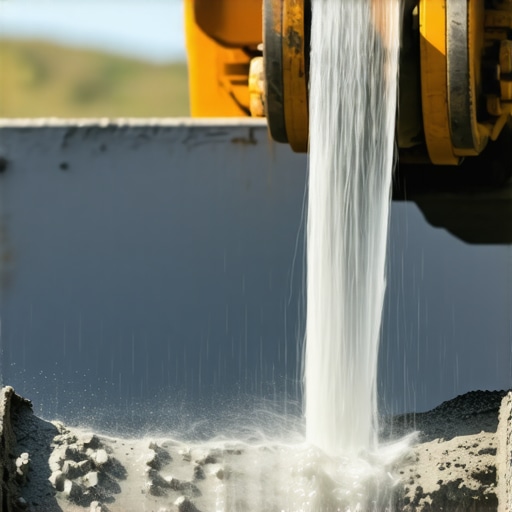
The Sound of Failure: When the Mud Stops Moving
There is a specific, gut-wrenching sound every veteran mason knows—the heavy, rhythmic thud of a concrete pump straining against a blockage. It is the sound of time and money bleeding out of a job site. I have seen rookie crews standing around with shovels, looking bewildered as the pressure gauge redlines, while the mix inside the hose begins to set. In my forty years of staring at the business end of a trowel, I have learned that a blockage is never just bad luck; it is a failure of physics and a lack of respect for the mud. Whether you are performing a concrete masonry unit restoration or a high-pressure core fill, the chemistry of the mix is your only savior.
The Old Master’s Secret: The Grit in the Palm
My grandfather, a man who could tell the compressive strength of a mortar batch just by the way it smelled, used to make me reach into the mixer and grab a handful of the raw aggregate. If it felt too ’round’ or too ‘dusty’ in my palm, he would make the supplier take the whole truck back. He used to say, ‘If the stone doesn’t have the right tooth, the paste won’t have anything to hold onto when the pressure hits.’ He was talking about the mechanical bond, the very thing that prevents segregation when you are forcing concrete through a two-inch line. If the aggregate is too large for the pipe diameter, or if the sand-to-stone ratio is off by even five percent, you aren’t pumping concrete; you are building a dam inside your own hose.
The Physics of the Pipe: Why Mixes Segregate
To understand why a pump blocks, you have to look at the ‘lubrication layer.’ This is the microscopic sheath of cement paste and water that forms against the interior wall of the pump line. In a perfect world, the coarse aggregate floats in the center of the pipe, cushioned by this layer. However, when the mix is poorly graded—meaning there is a gap in the particle sizes—the internal friction increases. The water, being the path of least resistance, gets squeezed out of the paste and forced forward, leaving behind a dry, abrasive plug of sand and stone. This is known as ‘bleeding,’ and it is the primary cause of honeycombing in structural pours.
“Grout shall be proportioned by volume… to provide a flowable consistency without segregation of the constituents.” – ASTM C476
The Freeze-Thaw Factor: Northern Climate Masonry
Up here in the north, we don’t just fight gravity; we fight the very molecular structure of water. When you are dealing with brick spalling prevention, you have to account for the fact that water expands nine percent when it freezes. If your pump mix is too wet—a common ‘cheat’ used by lazy contractors to make it flow easier—you are setting the homeowner up for a disaster. Excess water leaves behind microscopic voids (capillaries) as it evaporates. When winter hits, those voids fill with moisture, freeze, and pop the face right off the masonry. For a proper historic masonry preservation project, we use air-entrained mixes that create billions of microscopic ‘cushions’ for that ice to expand into, preventing the catastrophic failure of the brick lintel replacement or the chimney crown repair.
Micro-Zoom: The Rheology of the Mix
We need to talk about the ‘fines’—the material passing through a #200 sieve. Without enough fines, the mix lacks ‘thixotropy,’ the property that allows it to remain fluid under pressure but stable when at rest. When we are buttering the joints for an outdoor kitchen masonry build or applying chimney interior parging, the mix must be creamy enough to stick to the hawk but firm enough to hold the weight of the course above it. In a pump line, those fines act like ball bearings. If you’re using a ‘lick-and-stick’ approach with stone veneer repair, you’ll often find that the mortar is too rich in Portland cement, making it brittle. You need a balanced mix of lime and Portland to ensure the mud has the ‘suction’ required to bond with the substrate without clogging the delivery system.
The Hardscape Reality: Drainage and Pressure
I’ve walked onto too many scenes of forensic failure where a $100,000 patio looked like a rolling sea. Why? Because the contractor didn’t understand that a retaining wall drainage upgrade is more important than the blocks themselves. When you are performing a retaining wall block replacement, the mix used for the backfill or the core must be permeable enough to handle hydrostatic pressure but strong enough to resist soil heaving. If the mix is too ‘fat’ with cement, it creates an impermeable barrier that traps water, leading to the ‘wavy’ driveway syndrome.
“Water penetration is the single greatest threat to masonry durability.” – BIA Technical Note 7
The Process: Striking the Perfect Balance
1. The Sieve Test: Never trust the supplier blindly. Check your aggregate grading. You want a continuous curve of sizes from the smallest sand grain to the largest allowable stone. 2. The Slump Consistency: For pumping, a 6-inch to 8-inch slump is typical, but it must be achieved through chemical plasticizers, not by ‘killing it’ with hose water. 3. The Slicker Tool: After the pour, use a slicker or jointer tool at the right ‘leather-hard’ stage to seal the surface. This is critical for brick spalling prevention. 4. Cold Joint Management: Never stop the pump for more than 10 minutes. If you do, you risk a cold joint, which is essentially a structural crack waiting to happen. Whether you are building a soldier course over a window or stabilizing a foundation, the continuity of the pour is everything.
Conclusion: Do it Once, or Do it Twice
The masonry world is full of ‘handyman specials’ where the mud was too thin and the heart was too small. If you want to avoid pump blockages, you have to treat the concrete like a living thing. It needs the right nutrition (grading), the right environment (temperature control), and the right handling. Don’t be the guy standing over a burst hose with a look of regret. Respect the physics, use the right admixtures, and remember that in masonry, the cheapest way is always the most expensive way in the long run.