
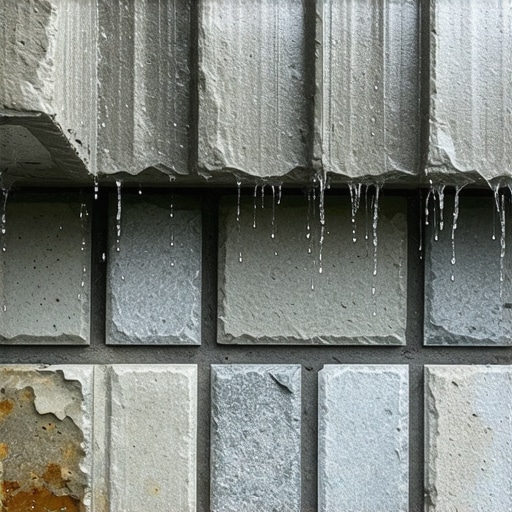
The Parapet’s Silent Protector
I remember walking onto a job site in the North End where a three-story brick townhouse was literally shedding its skin. The owner thought they needed a simple foundation crack repair, but one look at the sidewalk—littered with red dust and shards of 19th-century clay—told a different story. I climbed the scaffolding, reached the top of the parapet, and saw the culprit: the previous contractor had replaced the heavy limestone coping with a thin layer of concrete ‘butter’ slapped over the bricks. No drip edge, no overhang, and no respect for the physics of water. My mentor, an old-timer named Sullivan, used to say that a wall without a proper stone cap is just a sponge waiting for a frost. He would run a finger along the underside of a stone; if there wasn’t a ‘reglet’ or a drip groove, he’d refuse to set it. That townhouse wasn’t failing because of the ground; it was failing because the ‘lid’ was off, and every rainstorm was driving water deep into the heart of the structural masonry.
The Physics of the Drip Edge and Capillary Action
Stone coping is more than an architectural flourish; it is a critical engineering component. When we perform a structural masonry inspection, the coping is the first thing we check. The primary function of coping is to redirect water away from the vertical face of the wall. In a proper installation, the stone must overhang the wall by at least an inch and a half, featuring a deep groove—the drip edge—cut into the underside. This groove breaks the surface tension of the water. Without it, gravity and capillary action pull moisture back toward the wall, where it saturates the mortar joints and the brickwork. In northern climates, this is a death sentence. Water expands by 9% when it freezes. If that water is trapped inside your historic brick salvage, the resulting internal pressure will blow the faces off the bricks—a process we call spalling. This isn’t just an aesthetic issue; it’s a systematic dismantling of the wall’s load-bearing capacity.
“Water penetration is the single greatest threat to masonry durability. Proper flashing and coping are essential to prevent the saturation of the wall assembly.” – BIA Technical Note 7
The Material Science: Natural Stone vs. Modern Substitutes
I’ve seen a rise in ‘lick-and-stick’ stone veneer and cheap concrete flatwork services masquerading as masonry. These materials often lack the density required for a true coping stone. A high-quality limestone or bluestone coping acts as a thermal mass and a moisture barrier. When we talk about historic restoration, we have to respect the breathability of the system. Using sustainable tuckpointing mortars—specifically Type O or Type L lime-based mud—allows the building to ‘exhale’ moisture. If you cap a wall with a non-breathable, high-strength Portland cement, you trap moisture in the ‘cold joint’ between the new work and the old. This leads to salt crystallization, or efflorescence, which eats the masonry from the inside out. My approach always involves matching the stone’s porosity to the environment. For high-exposure areas like chimneys, ensuring a chimney damper repair is accompanied by a solid stone wash is the only way to prevent moisture from rotting the fire-rated masonry installation from the top down.
The Anatomy of a High-Performance Installation
Installing coping isn’t just about laying stones in a line. It’s about managing the ‘mud.’ We start with a full bed of mortar, ensuring there are no voids. Voids are where water collects and where the freeze-thaw cycle does its worst work. For long runs, we integrate control joints to handle thermal expansion. In hot climates, a long stone wall can expand significantly in the sun; without relief, it will buckle or crack vertically, leading to a need for concrete block foundation repair or even self-leveling masonry lifts to stabilize the shifted mass. We use a ‘hawk’ and ‘slicker’ to strike the joints deeply, creating a compact, water-shedding profile. The joints between the coping stones themselves are the most vulnerable point. Many modern masons rely solely on mortar, but a forensic structural inspector knows that these joints should be raked out and filled with a high-grade masonry sealant or a lead ‘T-cap’ for permanent waterproofing.
“The mortar should be softer than the masonry units it joins. It must be the sacrificial element in the system, allowing for movement and moisture wicking without damaging the stone.” – ASTM C270 Standards
Restoration Reality: Tuckpointing and Preservation
When I’m called in for a foundation issue, I often find that the moisture has traveled all the way from a failing roof coping down through the wall cavity, mimicking a basement leak. This is why a holistic view is necessary. We don’t just patch a crack; we look for the source. If the coping is failed, the entire facade likely needs help. We distinguish between ‘tuckpointing’—the cosmetic application of a fine line of mortar—and ‘repointing,’ which is the structural replacement of the mud. Using historic brick salvage requires a delicate touch. You can’t use a high-speed grinder to clear those joints without destroying the ‘tooth’ of the brick. It’s slow, gritty work with a hammer and chisel, but it’s the only way to ensure the new mortar bonds correctly. This level of detail is what separates a thirty-year fix from a three-year ‘handyman special.’ Whether we are dealing with a fire-rated masonry installation in a commercial setting or a simple residential patio, the principle remains: protect the top, and the bottom will stand.
Final Forensic Thoughts on Longevity
Don’t be fooled by contractors offering cheap concrete flatwork services as a substitute for proper stone masonry. A poured-in-place concrete cap will eventually shrink, crack, and pull away from the masonry, creating a funnel for water. Real stone, properly set with a drip edge and integrated into a system of sustainable tuckpointing mortars, is a generational investment. If you see a stair-step crack in your brickwork, don’t just look at the dirt; look at the sky. Check your coping. If the ‘ring’ of the stone is dull and the joints are crumbling into dust, your first line of defense has fallen. Fix the top, secure the foundation, and treat the masonry with the respect its physics demands. Anything less is just putting a bandage on a broken bone.”,