
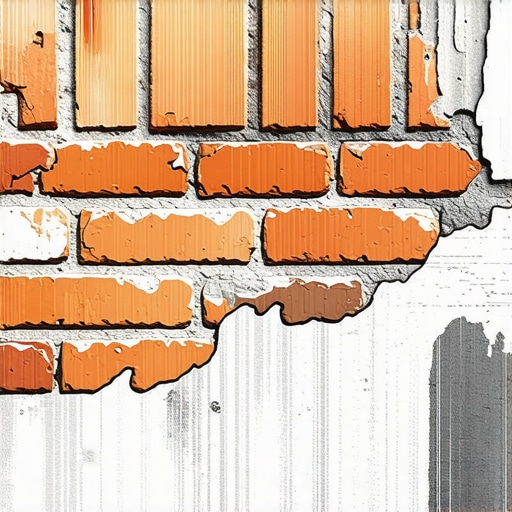
The Forensic Scene: When a Hairline Crack Becomes a Structural Grave
I recently stood before a 1928 Tudor revival that looked, at least from the curb, like a masterpiece of historic charm. The homeowner called me because of a small ‘dusting’ of red powder on the sidewalk and a hairline crack running through the soldier course above the parlor window. To the untrained eye, it was a cosmetic blemish. But when I slid my fiber-optic scope into a weeping head joint, the reality was grim: the structural steel lintel had oxidized so severely it had expanded to twice its original thickness, literally jacking the masonry upward and crushing the surrounding units. This wasn’t a ‘crack’; it was a slow-motion explosion caused by decades of moisture infiltration through failed mortar joints. This is the reality of masonry neglect. When you ignore the health of your mortar, you aren’t just letting the aesthetics slide—you are allowing the fundamental chemistry of your home to dissolve. Professional tuck pointing services are the only barrier between a standing wall and a pile of expensive rubble.
The Chemistry of the ‘Sacrificial Lamb’
To understand why tuckpointing is vital, you have to understand the physics of a wall. In a traditional masonry system, the mortar is designed to be the ‘sacrificial lamb.’ It is supposed to be softer and more permeable than the brick or stone it holds together. This ensures that moisture, which inevitably enters the wall through capillary action, evaporates through the mortar joints rather than the brick faces. When a ‘handyman’ smears modern, high-compressive-strength Portland cement over historic lime-based bricks, he creates a tomb. The moisture gets trapped, freezes, and because it has nowhere to go, it blows the face off the brick in a process known as spalling. We see this often during drone chimney inspections where the upper reaches of the stack are hammered by wind-driven rain and rapid freeze-thaw cycles.
“Water penetration is the single greatest threat to masonry durability. Proper joint profiling and mortar selection are essential to manage moisture movement within the wall assembly.” – BIA Technical Note 7
The micro-zooming into this process reveals a battle of vapor pressure. In a healthy wall, the mortar joints act as a ‘wick.’ If those joints are cracked or have separated from the brick (a condition called ‘debonding’), water enters via gravity and hydrostatic pressure. Once inside, it dissolves the salts within the masonry. When that water evaporates, it leaves behind white, crusty deposits. Effective brick efflorescence removal isn’t about scrubbing the surface; it’s about stopping the internal plumbing leak within the wall itself. If you see white stains, your walls are crying for help.
Tuckpointing vs. Repointing: The Master’s Distinction
Most people use the terms interchangeably, but in the world of high-end restoration, they are distinct disciplines. Repointing is the process of grinding out failed mud to a depth of at least twice the joint width and ‘buttering’ in new, compatible mortar. Tuckpointing is an aesthetic refinement, often seen in historic pointing styles, where two different colors of mortar are used—one to match the brick and a thin, contrasting ‘fillet’ (usually white or cream) to create the illusion of perfectly sharp, narrow joints. This requires a steady hand, a sharp slicker, and a deep understanding of how the ‘mud’ will shrink as it cures. If the mix is too ‘hot’ (too much cement or too little water), it will ‘flash set,’ leading to micro-cracking before the job is even finished. We use concrete pump masonry mixes for large-scale structural fills, but for the delicate face-work of a historic facade, everything is mixed by hand on a hawk to ensure the perfect consistency.
The Chimney: The House’s Most Vulnerable Appendage
Nowhere is masonry failure more rapid than the chimney. It is exposed on all four sides to the elements and subjected to extreme temperature differentials. A chimney sweep and repair professional often finds that the internal flue tiles are sound, but the exterior masonry is ‘honeycombing’—rotting from the inside out. This usually starts at the top. If the chimney cap is cracked, water pours down the internal cavity. Chimney cap replacement is the most cost-effective insurance policy a homeowner can buy. Furthermore, chimney flashing repair at the roofline is critical; if that lead or copper transition fails, the ‘cold joint’ where the masonry meets the wood frame becomes a highway for rot. We use drones to spot these failures early, identifying shifted bricks or failing mortarless masonry systems that have been improperly integrated into traditional stacks.
“The use of mortar that is harder than the masonry units can lead to irreversible damage to the units themselves during thermal expansion and contraction.” – ASTM C270 Standard Specification for Mortar for Unit Masonry
The Restoration of Luxury and History
It isn’t just houses that suffer. Outdoor masonry fountain restoration requires an even higher level of forensic detail. These structures are often built with intricate stonework that is constantly saturated. Without the right historic pointing styles and specialized water-repellent additives, the ‘tooth’ of the stone will eventually smooth out, and the structure will collapse under its own weight. Whether it is a fountain or a 19th-century facade, the goal is always the same: ensure the masonry can breathe. We avoid ‘lick-and-stick’ solutions and focus on the fundamental physics of the build. You can do it once with a master, or you can do it every five years with a charlatan. The choice is written in the stone.