
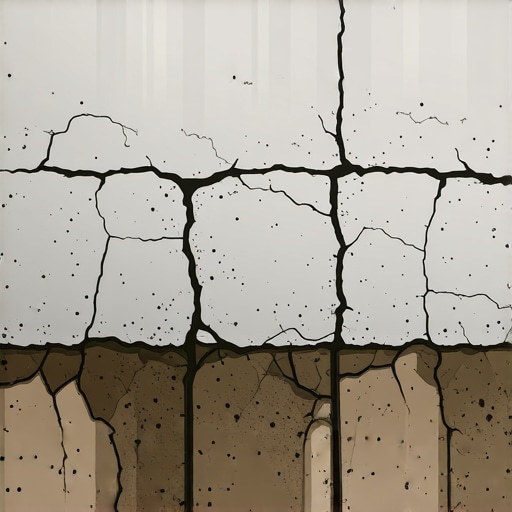
The Lie of the Hairline: A Forensic Perspective
The homeowner stood there, pointing a trembling finger at a thin, jagged line running from the window sill down to the grade. “It’s just a hairline crack, right? A bit of caulk and some paint?” I didn’t answer immediately. I took out my hawk and a small masonry chisel, cleared away the loose debris, and inserted a fiber-optic scope into the void. What I saw on the monitor wasn’t just a cosmetic flaw. Behind that single-course veneer, the structural block was sheared, and the steel reinforcement had oxidized so severely it looked like flaky orange puff pastry. The foundation hadn’t just settled; it was actively rotating. That ‘hairline’ was the first scream of a building losing its grip on the earth. If you ignore a vertical crack in your masonry, you aren’t just ignoring an eyesore; you are ignoring the physics of gravity and the inevitable decay of poorly managed soil.
The Anatomy of Tension: Why Vertical Means Trouble
In the world of masonry, we deal with compression. Bricks love to be squeezed. They can hold up the weight of a cathedral as long as the pressure is constant and downward. But a vertical crack is a sign of tension—and masonry has almost zero tensile strength. When you see a crack running straight up through the bricks and the mortar joints, the wall is being pulled apart horizontally. This isn’t your standard stair-step crack that follows the ‘mud’ or mortar joints; this is a failure of the unit itself. To understand why this happens, we have to micro-zoom into the hydration of the mortar and the suction of the brick. When we butter a brick, the unit draws moisture out of the mortar, creating a mechanical bond known as ‘the tooth.’ If the foundation beneath that bond shifts, the tension exceeds the bond strength, and the wall snaps.
“Vertical expansion joints are necessary to accommodate the thermal and moisture expansion of brick masonry, yet when cracks appear outside these joints, it is often indicative of differential settlement or structural overload.” – BIA Technical Note 18
In colder climates, this is often exacerbated by the freeze-thaw cycle. Water is a relentless invader. It finds its way into those hairline fractures. When it freezes, it expands by approximately 9% in volume. This generates internal pressure that can reach thousands of pounds per square inch, effectively acting as a hydraulic jack that pushes the crack wider every winter. This leads to honeycombing in the concrete below and eventual spalling of the brick faces. This is why emergency masonry repair isn’t just about aesthetics; it’s about stopping the hydraulic destruction of your home’s skeleton.
Foundation Wall Bowing Repair and Geotechnical Reality
Often, a vertical crack in the exterior brick is merely a symptom of a much deeper disease: hydrostatic pressure against the basement or crawlspace walls. When the soil around your home becomes saturated, it exerts immense lateral pressure. If the drainage is poor, that pressure can cause the foundation wall to deflect inward. This necessitates foundation wall bowing repair. As the wall bows, the brick veneer above it, which is tied to the structure with corrugated metal ties, is forced to move. Since the brick can’t bend, it breaks. We see this often in modular masonry construction where the speed of the build often overlooks the nuances of soil compaction. If the backfill wasn’t compacted in ‘lifts,’ it will settle unevenly, pulling the foundation with it.
The Chimney: The Canary in the Coal Mine
If you want to know the health of a foundation, look at the chimney. Because a chimney is a massive, concentrated load on a small footprint, it is usually the first thing to show signs of distress. A vertical crack running up the stack often means the chimney’s independent footing is failing or pulling away from the house. We utilize drone chimney inspections to get a birds-eye view of the masonry crown and the upper soldier course. If the crack has compromised the interior, chimney flue liner installation becomes a safety mandate to prevent carbon monoxide or fire hazards from escaping through the structural fissures. A leaning chimney is more than a brick quoin repair job; it’s a forensic signal that the earth is no longer holding its weight.
The Chemistry of Restoration: Re-pointing Services and Mortar Logic
When we talk about re-pointing services, we aren’t just slapping new mud into a hole. We have to respect the sacrificial nature of mortar. In older homes, the bricks were fired at lower temperatures, making them softer. If a modern ‘handyman’ uses a high-strength Portland cement (Type S) to fix a crack in a historic wall, he has signed the wall’s death warrant. The mortar must be softer than the brick. If the wall moves, the mortar should crack, not the brick. Using brickwork pointing styles like a weathered joint or a struck joint isn’t just for looks; it’s about shedding water away from the core of the wall.
“The mortar should always be weaker than the masonry units so that any stress-induced cracking occurs in the mortar joints where it can be easily repaired.” – ASTM C270 Standard Specification
We also have to address brick efflorescence removal during the repair process. Those white, powdery stains are salts being pushed out of the masonry by moisture. It’s the wall’s way of sweating. If you see efflorescence concentrated around a vertical crack, it means water is