
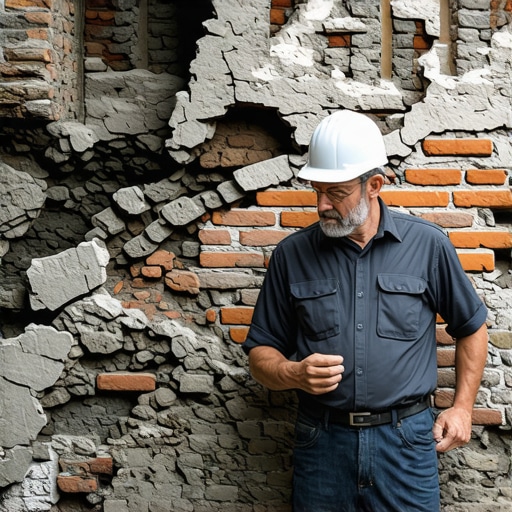
The homeowner told me it was just a hairline crack. She called it ‘settling.’ I pulled out my high-definition borescope and slid it into a core-drilled hole in the third course of the exterior wythe. What we saw wasn’t settling; it was a slow-motion catastrophe. The structural steel lintels were rusted to a flaky, orange dust, expanding with enough force to lift five vertical feet of solid masonry. Inside the wall cavity, the original lime-based mortar had turned back into a damp, sandy sludge. This is the reality of forensic masonry: by the time you see the crack on the surface, the structural integrity has often been compromised for a decade. Skipping an annual inspection is not a cost-saving measure; it is a gamble with the physics of gravity and the chemistry of hydration.
The Anatomy of Decay: Why Brick and Stone Fail
Most modern contractors treat masonry as a cosmetic finish. They treat it like siding. But a true mason knows that a wall is a living, breathing lung. In my grandfather’s day, we understood the ‘tooth’ of the stone and the ‘suction’ of a dry-pressed brick. When you skip your annual walkthrough, you miss the subtle signs of efflorescence—those white, salty stains that look like harmless powder but are actually a symptom of sub-florescence. This is when salt crystals grow inside the pores of the brick. As they crystallize, they exert internal pressures that can exceed 2,000 PSI, literally exploding the brick from the inside out. This is why mortar matching services are so critical; if you shove a hard, high-strength Portland cement into a soft, historic lime joint, the brick will always lose the fight.
“Water penetration is the single greatest threat to masonry durability, leading to efflorescence, spalling, and the corrosion of embedded metals.” – BIA Technical Note 7
In the North, we battle the freeze-thaw cycle. Water expands 9% by volume when it turns to ice. If your tuck pointing services weren’t performed with air-entrained mortar, that water gets trapped in the microscopic pore structure. When it freezes, it shears the face off the brick, a process we call spalling. If you are dealing with commercial tuckpointing, the scale of this damage is magnified. Large-scale buildings move more. They have higher thermal expansion coefficients. Without a master mason checking the relief joints, the entire facade can bow outward, creating a ‘pregnant’ wall that is one heavy windstorm away from a total collapse.
The Micro-Physics of Mortar and Sustainable Materials
We often talk about sustainable masonry materials these days, but the most sustainable thing you can do is preserve what is already standing. The chemistry of carbonation is a slow dance. Lime mortar (Calcium Hydroxide) absorbs Carbon Dioxide from the air over decades to turn back into Limestone (Calcium Carbonate). This process allows the wall to flex. It is self-healing. When a tiny micro-crack forms, water dissolves a bit of the free lime and redeposits it in the crack. This is the ‘Old World’ secret that ‘lick-and-stick’ veneer installers don’t understand. They use ‘mud’ that is too rich in Portland cement, which creates a ‘cold joint’—a failure of the chemical bond between the new repair and the old substrate.
The Retaining Wall Trap
I’ve seen modular retaining walls that looked perfect from the driveway but were leaning three degrees off-plumb because the ‘handyman’ forgot the geogrid or used the wrong backfill. Retaining wall reinforcement isn’t just about the blocks; it’s about the hydrostatic pressure behind them. When soil gets saturated, it weighs twice as much. Without proper weep holes and a clean gravel ‘chimney’ for drainage, that wall is just a dam waiting to break. I’ve performed stone wall repair on structures that stood for two hundred years, only to be ruined by a single afternoon of ‘robotic masonry repair’ that didn’t account for the soil’s angle of repose.
“Mortar should always be weaker than the masonry units it binds, acting as a sacrificial element to protect the integrity of the stone or brick.” – ASTM C270 Standards
The Chimney and the Fountain: Specialized Forensic Zones
An annual inspection must include the chimney. People think chimney flue liner installation is about fire safety, and it is, but it’s also about chemistry. Carbonic acid forms when flue gases mix with moisture. This acid eats the mortar joints from the inside out. By the time you see the ‘soldier course’ at the top of the chimney leaning, the interior structure is often a hollow shell. Similarly, outdoor masonry fountain restoration requires a specialized understanding of submerged masonry. Constant saturation leads to mineral leaching. If you aren’t checking the ‘slick’ of the joints and the integrity of the waterproofing membrane, you aren’t maintaining a fountain; you’re just watching it dissolve.
The Process of Professional Intervention
When I step onto a site for an inspection, I’m looking for more than just cracks. I’m looking for the ‘honeycombing’ in the concrete. I’m looking for ‘buttering’—where a lazy mason just smeared mud on the face of the joint instead of raking it out to a full inch of depth. Tuck pointing services should involve grinding the joints back with a diamond blade, vacuuming the dust, and ‘pointing’ the new mortar in ‘lifts’ to ensure there are no air pockets. If you see a guy with a ‘hawk’ and a trowel just slapping mud over the old stuff, fire him. He’s doing more damage than the weather.
When to Panic and When to Plan
A stair-step crack in a foundation usually means the soil is heaving or settling. A horizontal crack? That’s hydrostatic pressure, and that’s a ‘get the helical piers out’ kind of emergency. During an annual structural inspection, we catch these things while they are still ‘repointing’ jobs and before they become ‘reconstruction’ jobs. The cost of mortar matching services and a few hours of an expert’s time is a pittance compared to the $100,000 price tag of a collapsed commercial facade. Don’t let your building’s ‘breathability’ become a ‘leakability’ problem. Respect the mud, respect the stone, and for heaven’s sake, respect the physics of the wall.