
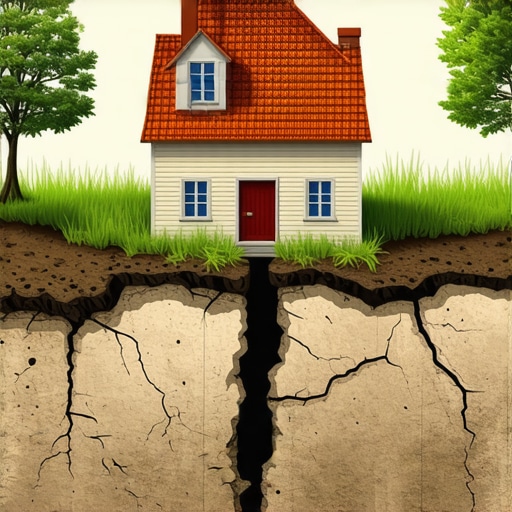
The Forensic Scene: When a Hairline is a Heart Attack
The homeowner stood there, pointing a trembling finger at a thin, jagged line running vertically through her basement wall. She called it a ‘hairline crack.’ She thought a tube of caulk from the big-box store would fix it. But when I pulled out the borescope and slipped it into a weep hole, the reality was a gut-punch: the internal structural steel was so far gone it looked like a rusted-out tailpipe from a ’74 Chevy. This is the forensic reality of masonry. What you see on the surface is rarely the whole story. It is the physical manifestation of a building screaming for help under the weight of thousands of tons of saturated soil and shifting geology.
“Water penetration is the single greatest threat to masonry durability, acting as the primary vehicle for both chemical degradation and physical structural failure.” — BIA Technical Note 7
The Physics of the Silent Squeeze
In regions where the ground breathes—expanding in the spring thaw and contracting in the winter freeze—your foundation is essentially a dam. Water is heavy; it weighs roughly 62.4 pounds per cubic foot. When the soil around your home becomes saturated, it exerts hydrostatic pressure. This pressure doesn’t just push; it grinds. If you have crumbling mortar joint repair needs that have been ignored, that water finds the path of least resistance. It enters the microscopic pores of your brick or block. Through capillary action, the wall sucks in moisture like a thirsty sponge. When the temperature drops, that water expands by 9% in volume. That expansion happens inside the molecular structure of your masonry, literally blowing the face off your brick—a process we call spalling.
Micro-Zoom: The Chemistry of the Mud
Most modern handymen think ‘mud’ is just sand and bag-mix. They couldn’t be more wrong. When we talk about structural repointing or tuckpointing brick walls, we are talking about material compatibility. If you have an older home, you likely have lime-based mortar. If you slap high-strength Portland cement over those soft joints, you’ve just signed the death warrant for your facade. The hard cement is brittle; it won’t move with the house. Instead, it forces the soft historic brick to take the stress, causing it to crack and crush. We look for historic brick salvage specifically because those old-world units possess a unique ‘tooth’ that modern, kiln-fired extruded bricks simply lack. For serious structural stabilization, we are now moving toward fiber-reinforced mortars. These aren’t your grandfather’s mixes; they contain microscopic poly-fibers that act like rebar on a molecular level, providing tensile strength where traditional mortar only offers compression resistance.
The Anatomy of a Failing Joint
Look at your crumbling mortar joint repair needs. If the mortar is recessed more than 1/4 inch, you’re in the danger zone. I’ve seen outdoor kitchen masonry build projects collapse within three seasons because the contractor didn’t understand ‘suction.’ If the brick is too dry when you ‘butter’ it, the brick steals the moisture from the mortar before the hydration process can complete. This results in a ‘flash set’ or a cold joint. The bond never happens. You end up with a wall that looks fine but has the structural integrity of a sandcastle. For precision fixes, we are seeing the rise of advanced masonry adhesives that create a chemical bond stronger than the stone itself, but even these require a pristine, dust-free substrate to work. In the high-end sector, robotic masonry repair is beginning to emerge, using 3D scanning to identify precise failure points and injecting specialized resins with sub-millimeter accuracy. Even 3D printed masonry repairs are becoming a reality for custom ornamental pieces that are too far gone for manual restoration.
“A masonry wall is a living system of balance; the mortar must always be the sacrificial element to ensure the longevity of the masonry unit.” — ASTM C270 Standards
The Hidden Culprit: The Chimney Flue
While you’re staring at the foundation, don’t forget to look up. A failing chimney damper repair issue is often the source of basement water. Rain enters the flue, trickles down the masonry interior, and pools at the base of the foundation, accelerating the decay of the very ‘mud’ holding your house together. This creates a cycle of rot. You might think you need a foundation specialist when what you actually need is a master mason to strike the joints on your chimney crown and install a proper cap. When I’m on the hawk, throwing mud and using a slicker to finish a soldier course, I’m not just making it look pretty. I’m creating a shed-water profile. Every stroke of the jointer tool is designed to compress the mortar and seal the interface between the mud and the brick.
The Hard Truth of the Bill
Ignoring a $500 repointing job this season leads to a $5,000 structural stabilization job next season, and a $50,000 foundation replacement the year after. There is no ‘middle ground’ with physics. The soil will continue to heave, the water will continue to expand, and the honeycombing inside your concrete will continue to spread until the weight of the house exceeds the bearing capacity of the decayed material. Do not trust a ‘handyman’ with a bag of premix. Masonry is a forensic science. It requires an understanding of thermal expansion coefficients, vapor permeability, and the specific gravity of the local soil. Do it once, do it right, or the house will eventually do it for you—right into the dirt.