
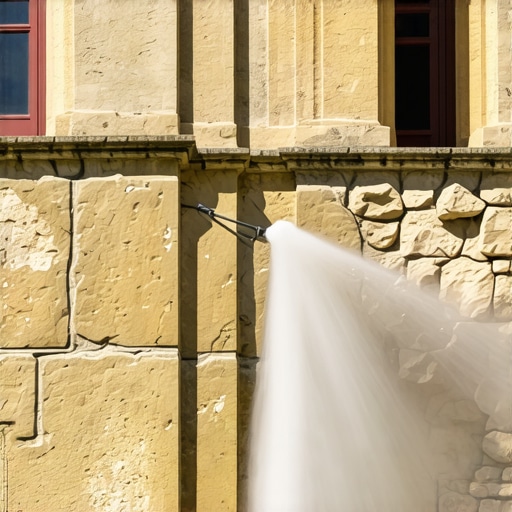
The Blasted Facade: A Forensic Look at Masonry Suicide
I recently walked onto a job site where a homeowner was beaming with pride. He had just spent the weekend ‘cleaning’ his 1890s sandstone foundation with a 4,000 PSI rental power washer. To his untrained eye, the stone looked bright and new. To me, it looked like a corpse. The ground was littered with a fine, sandy grit—the very soul of the building’s structural integrity. He hadn’t just cleaned the stone; he had stripped away the ‘fire-skin’ or the natural case-hardening that had protected that sandstone for over a century. This is the tragic reality of modern tools meeting ‘Old World’ materials without a structural masonry inspection to guide the hand. Sandstone isn’t just a rock; it is a sedimentary record of time, held together by delicate mineral binders that are no match for the kinetic violence of a concentrated water jet.
“Water penetration is the single greatest threat to masonry durability, and the use of high-pressure water can drive moisture deep into the substrate, leading to long-term cyclical failure.” – BIA Technical Note 7
My old mentor used to hold a piece of weathered brownstone up to his ear and joke that he could hear it breathing. He wasn’t crazy. Historic masonry is vapor-permeable; it moves moisture from the inside out through capillary action. When you hit it with a power washer, you aren’t just cleaning the surface; you are forcing gallons of water deep into the stone’s pores under ‘venturi-effect’ pressures. In a historic restoration context, this is a death sentence. Sandstone is friable. Its layers—called lamination—are bonded by silica, calcium carbonate, or iron oxide. High pressure ‘shucks’ these layers like an onion. Once that exterior crust is gone, the stone’s ‘tooth’ is exposed, making it even more porous and susceptible to the brutal freeze-thaw cycles of the North. In cities like Chicago or New York, that trapped water expands by 9% when it turns to ice, popping the face of the stone off in a process we call spalling. Without proper brick spalling prevention, that beautiful facade will be dust within five winters.
The Sacrificial Principle: Why Your ‘Mud’ Matters
The biggest mistake I see ‘handyman specials’ make is trying to patch old stone with modern Portland cement. It’s a fundamental misunderstanding of masonry physics. Old stone is soft; it needs a mortar—or ‘mud’—that is even softer. This is the Sacrificial Principle. The mortar joint is designed to be the weakest link, the part that fails and is replaced (repointing) so the stone doesn’t have to. When you use a hard, brittle Type M or S mortar from a concrete pump masonry mixes truck on historic sandstone, the stone becomes the weakest point. As the building shifts and breathes, the hard cement stays rigid while the soft sandstone crushes against it. This leads to massive cracking and the need for cracked brick wall repair or, worse, total chimney structural repair when the stack begins to lean because the base joints have petrified. I’ve seen brick quoin repair jobs where the corners of a building were literally shearing off because some ‘pro’ thought ‘stronger is better’ and used high-strength mortar on 19th-century units.
“Mortar should always be weaker than the masonry units it binds to ensure that stresses are relieved through the joints rather than the units themselves.” – ASTM C270 Standards
When I’m on a structural masonry inspection, I look for the ‘cold joint’—that ugly gap where new material failed to bond with the old. This is rampant in stone veneer over brick applications. People slap ‘lick-and-stick’ fake stone over historic masonry using polymer-modified thin-set that doesn’t allow for vapor transmission. They create a moisture trap. The water gets in behind the veneer, can’t get out, and starts rotting the original structural brick. If you’re lucky, you just get a messy white powder called efflorescence. If you’re unlucky, you’re calling me for a foundation crack repair because the hydrostatic pressure has bowed the wall. We see this often in retaining wall geogrid installation failures too; people focus on the face and forget the physics of the water behind it. For historic sandstone, the only way to clean is ‘low and slow’—misting systems and soft-bristle brushes, followed by repointing with a Type O lime-based mortar that you ‘butter’ into the joints with a ‘slicker’ tool, ensuring the ‘hawk’ is always ready for the next batch of breathable mud.
The Anatomy of a Proper Restoration
True restoration is a surgical process. It starts with identifying the stone’s bedding plane. If a mason laid the stone ‘on edge’—meaning the sedimentary layers are vertical rather than horizontal—power washing will delaminate the entire block in seconds. This is why chimney rebuild services often fail; the contractor doesn’t understand the ‘lithology’ of the material they are handling. When we approach a brick quoin repair, we aren’t just looking at the surface. We are looking at how the weight is distributed. Is there a need for foundation crack repair due to soil subsidence, or is it purely a material failure? If the stone is too far gone, we don’t just patch it with ‘bondo.’ We Dutch-man in a new piece of matching stone, carefully carved to fit the void, ensuring the ‘tooth’ of the new stone matches the old. We don’t use concrete pump masonry mixes for this; we use hand-mixed lime putty that takes weeks to carbonate and cure, turning back into stone over a century rather than ‘flashing’ in an hour. This is the difference between a repair that lasts a lifetime and a ‘handyman special’ that hides the problem until the check clears. Don’t let someone with a gas-powered wand destroy your history. Real masonry isn’t about force; it’s about chemistry, physics, and a deep respect for the guys who swung the hammers a hundred years before we were born.