
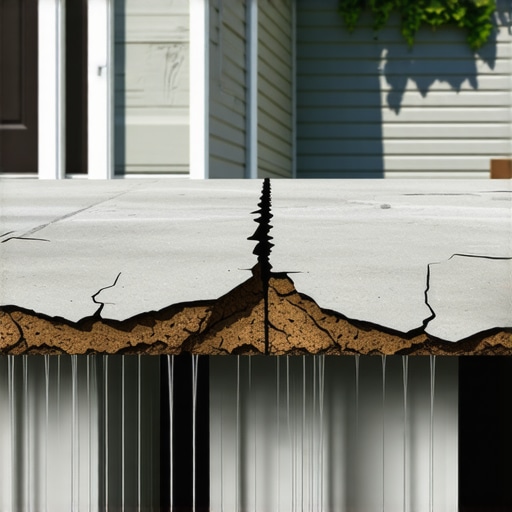
The Weight of the World on a Four-Inch Footer
I’ve spent forty years in the mud. I’ve seen the way a building breathes, and more importantly, the way it chokes. When you’ve buttered as many bricks as I have, you develop a sense for the subtle groan of a structure that’s losing its fight with the earth. Most homeowners treat their foundation like a ‘set it and forget it’ slab of rock, but concrete isn’t just a static mass. It is a chemical cocktail, a rigid sponge that is constantly reacting to the soil, the temperature, and the hydrostatic pressure pushing against its face. If you ignore the signs of settlement, you’re not just looking at a cosmetic blemish; you’re watching the slow-motion collapse of your biggest investment.
The Forensic Scene: More Than a Hairline Problem
The homeowner called me out to a mid-century colonial because she thought she had a ‘dusting’ problem in the basement. She pointed to a vertical fissure, barely wider than a penny, near the corner of the west wall. She thought it was just a hairline crack from a dry summer. But when I pulled my borescope out of my kit and slipped it into the void, the reality was a nightmare. The structural steel—the very rebar meant to provide tensile strength to the concrete masonry unit—wasn’t just rusted; it had oxidized to the point of turning into a red, flaky dust that offered zero reinforcement. The wall wasn’t just ‘settling’; it was rotating. The soil outside had saturated, the drainage had failed, and the lateral pressure was folding that wall like a piece of wet cardboard. This wasn’t a job for a handyman with a tube of caulk; this was a structural masonry inspection that revealed a house on the brink of a catastrophic failure.
“Water penetration is the single greatest threat to masonry durability. It acts as the primary vehicle for the transport of salts and the catalyst for structural degradation.” – BIA Technical Note 7
The Physics of the Stair-Step: Reading the Wall
When I walk a property, I’m looking for the ‘language’ of the cracks. A stair-step crack in a brick veneer is the most common cry for help. This happens because the mortar—the ‘mud’ we use to bond the units—is intentionally designed to be the weakest link. In a perfect world, the mortar yields before the brick pops. When you see that jagged line following the head joints and bed joints, the earth beneath one corner of your house is moving faster than the rest. This is often a result of ‘differential settlement.’ In regions with heavy clay, the soil undergoes a process of adsorption where water molecules wedge themselves between clay plates, causing the ground to heave. When that water evaporates, the soil shrinks, leaving a void. The concrete footer, which might have been poured during a ‘cold joint’—an interruption in the pour that created a weak interface—cannot span that void and snaps under the shear stress.
Micro-Zooming: The Chemistry of Concrete Failure
To understand why foundation settling is so dangerous, you have to look at the C-S-H (Calcium Silicate Hydrate) gel that forms during the hydration of Portland cement. This gel is what binds the aggregate together. However, concrete is notoriously poor in tension. While it can withstand thousands of pounds of compressive force, it only takes a fraction of that to pull it apart. In a concrete masonry unit restoration project, we have to account for the fact that the original blocks have already reached their maximum carbonation. Over decades, CO2 from the air penetrates the concrete, lowering its pH and stripping away the protective alkaline layer around the internal steel. Once that pH drops below 9, the steel starts to ‘bloom’ with rust, expanding up to six times its original volume. This internal pressure, combined with external soil movement, is why those cracks aren’t just ‘settling’—they are the sound of the house’s bones breaking.
The Symptoms: Chimneys, Crowns, and Facades
Foundation failure doesn’t stay in the basement. It travels upward. I often see commercial masonry facade maintenance crews trying to patch up cracks in the upper floors without realizing the problem is thirty feet below them. If your chimney looks like it’s trying to lean away from the house, check the crown. A chimney crown repair is often treated as a simple waterproofing job, but if that crown is cracking repeatedly, it’s because the entire stack is tilting. The masonry waterproofing solutions you apply are useless if the structural brick ties replacement hasn’t been addressed. Those ties are the only thing keeping your brick skin attached to your wooden frame. If the foundation drops, those ties bend, snap, or pull out of the studs, leaving you with a wall that could peel off in a high wind.
“Standard Specification for Mortar for Unit Masonry (ASTM C270) dictates that mortar must be selected based on the structural requirements and the type of masonry unit, ensuring that the bond strength does not exceed the unit strength in historical applications.” – ASTM Standards
The Fix: From Advanced Adhesives to Helical Piers
When I’m called in to consult on a tuckpointing cost estimation, I have to be the bearer of bad news if the foundation is gone. You can’t just put new mud in the joints and expect it to hold. We look at advanced masonry adhesives and carbon fiber wraps to stabilize walls, but often, we have to go deeper. If the soil is the culprit, we look at concrete pump masonry mixes to pressure-inject grout into the voids beneath the slab. For serious settlement, we bring in the big guns: helical piers that screwed into the earth until they hit load-bearing strata. We also focus on sustainable block cutting during the repair phase to ensure that we aren’t wasting material or creating unnecessary dust that contains crystalline silica—a silent killer in this trade.
The Panic Checklist: When to Call the Pros
- The One-Inch Rule: If you can fit your pinky finger into a foundation crack, the time for ‘monitoring’ is over.
- Door and Window Binding: When the frame goes out of square, it’s because the header is being twisted by the settling wall.
- The Basement Sump Test: If your sump pump is running constantly even in dry weather, you have a drainage issue that is eroding your footer.
- Nail Pops: In the living areas, if you see nails pushing through the drywall, the entire skeleton of the house is shifting.
Don’t be the guy who waits until the wall is in his lap to fix the problem. Foundation repair is expensive, but a total structural failure is a total loss. Get an inspection, understand the physics of your soil, and for the love of the craft, don’t let a ‘handyman’ touch your structural masonry with a bag of premix and a prayer.