
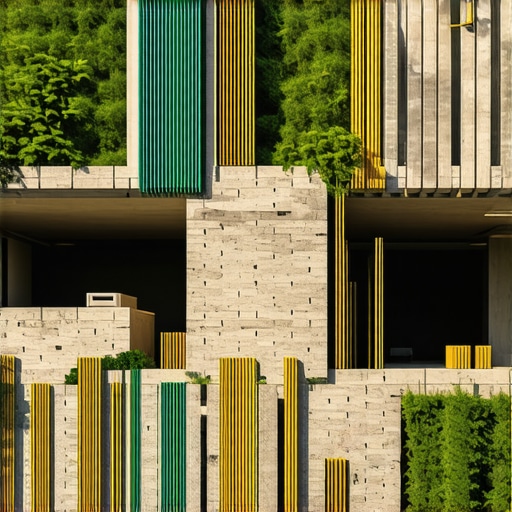
The homeowner thought it was just a hairline crack, a minor blemish on the face of a modern suburban fortress. But when I put my scope inside that cavity, I saw a nightmare that would make an old-timer weep: the structural steel was rusted to dust, eaten alive by trapped moisture and the caustic breath of poor-quality mortar. This is the reality of the traditional ‘lick-and-stick’ era, where speed is king and the planet pays the tax. For three generations, my family has lived by the trowel, and if there is one thing I have learned from inspecting thousands of failing foundations, it is that the way we build today is fundamentally broken. We are throwing carbon into the atmosphere to create structures that start dying the moment the scaffolding comes down. However, the tide is turning. We are seeing a shift toward modular masonry construction, a method that respects the physics of the stone while slashing the environmental cost of our vanity.
The Chemistry of the Carbon Debt
To understand why modular masonry is a necessity, you have to micro-zoom into the kiln. Traditional brick manufacturing is an energy glutton. We are talking about firing clay at temperatures exceeding 2,000 degrees Fahrenheit for days. This process, known as vitrification, creates a durable product, but the carbon intensity is staggering. When you add the site-mixed ‘mud’—the mortar—the debt grows. Site-mixed mortar often suffers from ‘honeycombing’ or poor hydration because the guy on the hawk and trowel is fighting the sun, the wind, and the clock. In a modular environment, the chemistry of the CSH (Calcium Silicate Hydrate) crystals is controlled to the milligram. There is no ‘flash setting’ because the humidity is regulated, ensuring that the bond between the unit and the bed is absolute. This precision means we use less material to achieve higher structural integrity.
“Water penetration is the single greatest threat to masonry durability, and the environmental cost of replacing failed systems far outweighs the initial investment in high-performance materials.” – BIA Technical Note 7
The Digital Twin and Waste Reduction
One of the most significant leaps in the trade is the rise of digital twin masonry projects. In the old days, we’d eyeball a soldier course and pray the cut-offs didn’t fill a three-yard dumpster. Today, we map the entire structure digitally before a single block is cast. This ‘digital twin’ allows us to account for every stone coping installation and every lintel with surgical precision. We aren’t just building; we are manufacturing with zero-waste intent. When we talk about modular masonry construction, we are talking about off-site assembly where ‘cold joints’—those weak points where new wet concrete meets old dry concrete—are virtually eliminated. This isn’t some ‘handyman special’ approach; it is forensic-level engineering. By reducing site waste, we are cutting the embodied carbon of the project by up to 30%. We aren’t hauling tons of debris to a landfill; we are buttering the head joints in a controlled facility where every scrap is recycled back into the mix.
The Tragedy of the Traditional Chimney
Look at chimney repair services. I’ve climbed more roofs than I can count, only to find chimneys that are essentially carbon chimneys in more ways than one. Traditional chimneys are notoriously inefficient and prone to failure. They leak heat, they leak water, and they eventually require chimney heat shield installation or total reconstruction. A modular masonry chimney, however, is designed as a cohesive unit. The thermal mass is optimized, and the joints are struck with a machine-like consistency that a human hand, tired and shaking at the top of a forty-foot ladder, simply cannot match. We are seeing a rise in chimney repair services that specifically focus on retrofitting these older, failing structures with modular components to stop the ‘thermal shock’ that cracks traditional flue liners. This is how we preserve the old world while embracing the new physics of efficiency.
Tuckpointing and the Art of the Curve
Tuckpointing curved walls is perhaps the ultimate test of a mason’s soul. It is a slow, grueling process of grinding out old, failing mortar and replacing it with fresh mud. In the carbon-conscious era, we are realizing that the best way to reduce a building’s footprint is to make it last 200 years instead of fifty. This is where masonry staining and high-quality repointing come in. By using modular masonry for the core and high-performance, breathable finishes on the exterior, we prevent the spalling that occurs when water expands 9% during a freeze-thaw cycle. If you trap that water behind a hard, modern Portland cement on a soft historic brick, the face of the brick will pop right off. That is a failure of physics, and it’s a waste of the carbon originally used to fire that brick. Modular systems allow for better drainage planes and integrated weep holes, ensuring the assembly breathes like a living lung.
“The durability of a structure is its first line of defense against environmental degradation; as the ancients knew, a wall that breathes is a wall that stands.” – Vitruvius, De Architectura
Foundation Physics: The Concrete Block Reality
I’ve spent half my career on concrete block foundation repair. I’ve seen walls bowed like a longbow under hydrostatic pressure because the original builder didn’t understand soil heaving. Modular masonry construction addresses this by using pre-stressed or reinforced units that can handle the lateral loads that would snap a traditional CMU wall like a dry twig. When we perform stone veneer repair on these modern modular systems, we find that the underlying structure is often as pristine as the day it was set. This longevity is the true secret to carbon reduction. If you don’t have to rebuild the foundation every forty years, you are saving more carbon than any solar panel ever could. We are also seeing stone coping installation techniques that integrate directly into these modular systems, providing a watertight seal that protects the entire vertical assembly from the top down.
Restoring the Earth, One Patio at a Time
Even something as simple as brick patio restoration plays a role. Most patios fail because of the ‘base’—if you don’t have the right compaction physics, the bricks will sink and create a wavy, dangerous mess. Modular pavers and modular base systems are now engineered to allow for better permeability. This reduces runoff and helps recharge the local water table, which is a key component of sustainable construction. When we do a stone veneer repair or a patio reset, we are often cleaning and reusing the original materials. The ‘tooth’ of an old brick is a valuable thing; it has history and it has already paid its carbon debt. By combining these recycled materials with modern modular foundations, we create a hybrid that is both beautiful and ecologically responsible. We aren’t just slicking joints; we are building a legacy that doesn’t cost the earth its future. In the end, modular masonry isn’t about taking the craft out of the mason’s hands; it’s about giving us a better ‘hawk’ and a sharper ‘slicker’ to build walls that actually deserve to stand for a century.