
Commercial Property Devaluation: The Forensic Truth About Grimy Facades and Masonry Neglect
I remember a cold morning in the industrial heart of the city where I stood before a ten-story heritage building. The owner was frantic because the appraisal had come in fifteen percent lower than expected. He pointed at the streaks of black soot and white crust. I didn’t see grime; I saw a slow-motion structural execution. My mentor, a man who could tell the density of a batch of mud by the way it slid off a hawk, once told me that a wall is a living organism. If you clog its pores, it suffocates. That building was gasping for air because some cut-rate contractor had applied a non-breathable coating over the original clay. This is the reality of commercial masonry maintenance: it is not about aesthetics; it is about the forensic integrity of the envelope.
“Water penetration is the single greatest threat to masonry durability. Moisture entering a wall assembly through cracked joints or porous units triggers a cascade of chemical failures.” – BIA Technical Note 7
The Chemistry of the Grimy Facade
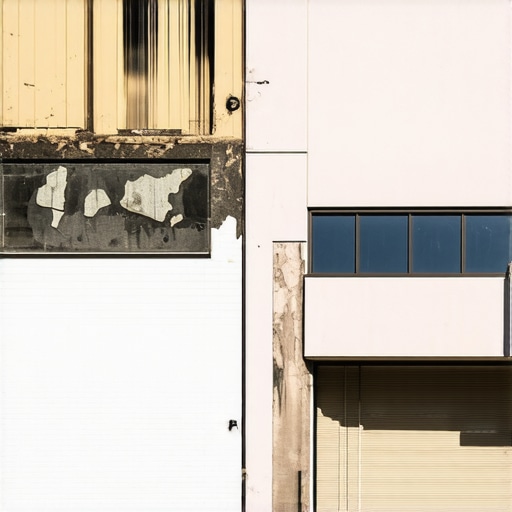
When a commercial facade looks ‘grimy,’ we are often seeing more than just dirt. We are seeing efflorescence, a crystalline deposit of salts left on the surface as water evaporates. Micro-zooming into the brick, we find a network of microscopic capillaries. In a healthy brick wall restoration, these capillaries allow vapor to move freely. However, when atmospheric pollutants like sulfur dioxide react with the calcium carbonate in mortar or limestone, they form gypsum. This gypsum traps soot and dirt, creating a hard, black crust. Beneath this crust, the ‘tooth’ of the stone is being dissolved. The application of metallic brick colors requires a surgically clean substrate, or the metallic pigments will simply delaminate as the underlying salts push them off in a process called subflorescence.
[image]
Structural Stability and the Geogrid Logic
Commercial properties often rely on heavy-duty site work, including massive retaining walls. I’ve seen $100,000 installations fail because someone skipped the retaining wall geogrid installation. Geogrid is a high-tenacity polyester or polypropylene mesh that provides the tensile strength that soil and stone lack. It works through mechanical interlock; the aggregate stones wedge themselves into the apertures of the grid, creating a unified mass that resists the lateral hydrostatic pressure of the earth. Without it, the wall is just a stack of blocks waiting for a heavy rain to turn it into a debris field. When commercial property values drop, it’s often because an inspector spotted the tell-tale ‘bulge’ of a wall that lacked proper reinforcement.
The Art and Science of the Joint
Tuckpointing cost estimation is not a matter of square footage; it is a matter of forensic analysis. In historic restoration, we use the sacrificial principle. The mortar must be softer and more permeable than the brick. If you ‘butter’ a soft 1920s brick with modern Type S Portland cement, you are signing its death warrant. As the building shifts and breathes, the hard cement will stay rigid, and the soft brick will be the one to crush. This leads to spalling, where the face of the brick literally pops off. Proper masonry joint sand repair involves choosing the right aggregate size to ensure the mud has the correct suction. We use a slicker to strike the joint, compressing the mortar to create a ‘weather’ joint that sheds water away from the core of the wall.
“The mortar should be considered the ‘safety valve’ of the masonry wall, designed to fail and be replaced before the masonry units themselves suffer damage.” – ASTM C270 Standards
Modern Interventions: From Sealers to Robotics
To protect these surfaces, we utilize porous stone sealers. These are not ‘paints’ but molecular-level treatments, typically silanes or siloxanes. They have a molecular structure small enough to penetrate deep into the substrate, where they chemically bond with the masonry. They change the surface tension of the capillaries—liquid water is too large to enter, but water vapor is small enough to escape. This is the ‘breathability’ that keeps a building alive. For larger commercial structures, we are even seeing the rise of robotic masonry repair. These systems use high-resolution LiDAR to map every crack and void, allowing for a level of precision in mortar injection that a human hand, even one as seasoned as mine, can struggle to maintain over a twenty-story drop. However, the robot still needs the master’s touch to mix the mud correctly.
The Hidden Danger: Chimney and Internal Systems
A grimy facade often hides internal failures, particularly in chimney flue liner installation. If the liner is cracked, acidic condensate from the heating system eats the mortar from the inside out. This manifests as strange staining on the exterior. It’s not just a maintenance issue; it’s a fire hazard. Commercial masonry maintenance must include a borescope inspection of the flues. If the liner is gone, the structural integrity of the entire stack is compromised. We also look for honeycombing in the concrete or cold joints in the soldier course where the bond has been broken due to thermal expansion. In hot climates, if the contractor didn’t account for the thermal movement, you’ll see vertical cracks that no amount of cosmetic ‘lick-and-stick’ stone veneer over brick can hide for long.
Protecting Your Investment
In conclusion, when you see a grimy facade, do not think of it as a cleaning task. Think of it as a forensic warning. A well-maintained masonry envelope is a sign of a building that will stand for another century. A neglected one is a liability that will continue to bleed value as the moisture does its silent, destructive work. Do it once, and do it right, or you’ll be paying for it every time the temperature swings across the freezing point.