
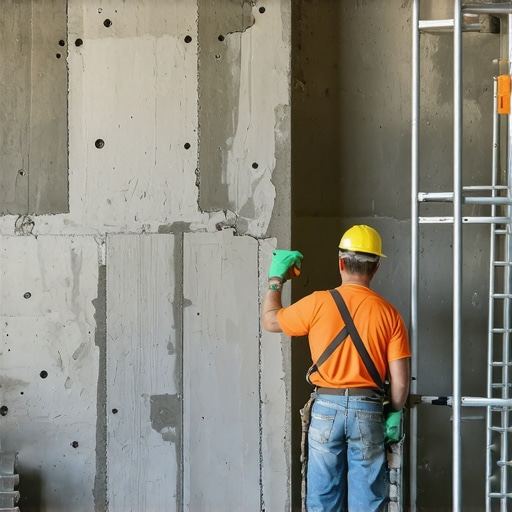
The Thermal Sieve: Why Your Industrial Masonry is Bleeding Money
I remember the first time I walked into a cold-storage warehouse in the dead of a Midwestern winter. The owner was screaming about a heating bill that looked like a phone number for a small country. He blamed the HVAC, but as soon as I pressed my palm against the Concrete Masonry Units (CMU), I felt the truth. Those blocks weren’t walls; they were heat sinks. My old man, who spent forty years on the business end of a trowel, always told me that a wall is only as good as its ‘suction.’ He used to strike a block with a hammer; if it produced a dull thud instead of a sharp, high-pitched ‘clink,’ he knew the aggregate was too porous. That ‘thud’ meant the wall was going to act like a giant sponge, soaking up moisture and letting thermal energy skip right out the door. We aren’t just talking about a little draft here; we are talking about the physics of mass and the failure of modern maintenance.
“Water penetration is the single greatest threat to masonry durability and the primary driver of thermal degradation in building envelopes.” – BIA Technical Note 7
When we look at masonry repair services for industrial sites, most guys want to slap some paint on the block and call it a day. That’s what I call the ‘handyman’s funeral.’ You’re just burying the problem. To actually improve energy efficiency, you have to understand the micro-porosity of the CMU. An industrial block is a thirsty beast. It’s composed of portland cement and aggregate that, under a microscope, looks like a series of interconnected caverns. When water gets into those caverns, it kills the R-value of the wall. In northern climates, that water undergoes the freeze-thaw cycle, expanding by 9% and turning the internal structure of the block into dust. This is why full repointing services are the first line of defense. We aren’t just filling gaps; we are restoring the structural integrity and the thermal seal of the building.
The Chemistry of the ‘Mud’: High-Performance Mortar Mixes
If you’re using standard big-box store mortar for an industrial restoration, you’re failing before you even start. For these heavy-duty walls, we utilize high-performance mortar mixes that balance compressive strength with vapor permeability. You want the ‘mud’ to be the sacrificial lamb of the wall. If the mortar is harder than the block—which often happens when rookies use too much Portland—the block will spall and crack as the building shifts. We look for a mix that offers ‘tooth,’ something that grabs the CMU and creates a monolithic seal. This is where sustainable masonry materials come into play, utilizing lime-based additives that allow the wall to ‘breathe.’ If moisture gets trapped behind a hard, non-permeable mortar, it’ll blow the face of your block right off during the first hard frost.
“Mortar should be designed to be weaker than the masonry units so that any stress-induced cracking occurs in the mortar joints where it can be easily repaired.” – ASTM C270 Standards
During a stone facade restoration or a CMU overhaul, we often find that the foundation has settled, creating those classic stair-step cracks. This isn’t just an eyesore; it’s a thermal bridge. Every crack is a highway for conditioned air to escape. We use brickwork pointing styles like the ‘weather joint’ to shed water away from the wall’s interior. When we get into the guts of the wall, we’re often looking for structural brick ties replacement. Old ties rust out—a process called iron oxide expansion—which can actually exert enough pressure to crack a 12-inch CMU. Replacing these with stainless or galvanized ties ensures the inner and outer wythes act as a single thermal mass, which is critical for maintaining a stable internal temperature.
Fire Safety and Aesthetic Efficiency
In industrial settings, energy efficiency often goes hand-in-hand with safety. Fire-rated masonry installation involves using specialized blocks and mortars that can withstand intense heat for hours. But here’s the kicker: those same dense materials are excellent for thermal lag. A properly fire-rated wall keeps heat in during the winter and out during the summer. Once the structural repairs are done, we move to masonry staining. Unlike paint, which creates a film that eventually peels and traps moisture, a professional stain penetrates the surface. It changes the color while keeping the pores open for vapor transmission. This prevents the ‘honeycombing’ effect where the interior of the block starts to rot because it can’t dry out. It’s about more than just a ‘slicker’ finish; it’s about ensuring the longevity of the foundation and the envelope. If you want to stop ‘buttering’ up your energy bills with wasted cash, you have to treat the masonry as a living, breathing system. Don’t wait for a cold joint to turn into a structural failure; do it once, and do it right.
{“@context”:”https://schema.org”,”@type”:”HowTo”,”name”:”How to Restore Industrial CMU Walls for Energy Efficiency”,”step”:[{“@type”:”HowToStep”,”text”:”Conduct a forensic thermal inspection to identify heat loss zones and moisture penetration.”},{“@type”:”HowToStep”,”text”:”Grind out failing mortar joints to a depth of at least 3/4 inch to ensure a proper bond for new mud.”},{“@type”:”HowToStep”,”text”:”Install structural brick ties where existing ties have suffered from iron oxide expansion.”},{“@type”:”HowToStep”,”text”:”Apply high-performance, vapor-permeable mortar using a weather-struck joint to shed water.”},{“@type”:”HowToStep”,”text”:”Finish with a penetrating masonry stain to seal against bulk water while allowing vapor to escape.”}]}