
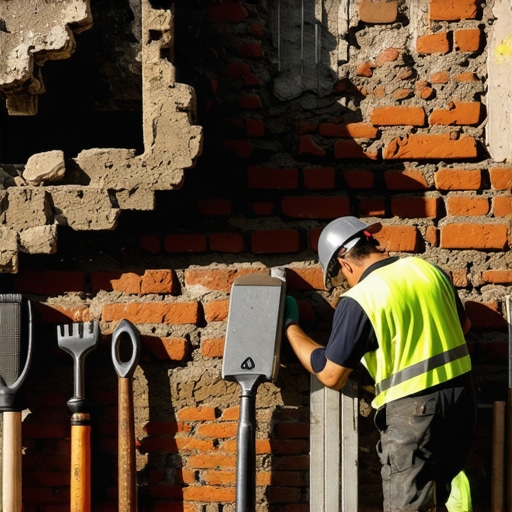
The Autopsy of a Facade: When a ‘Hairline Crack’ Becomes a Six-Figure Liability
The building manager at a mid-rise commercial property downtown told me it was just a hairline crack, a ‘settlement’ thing he’d seen for five years. He wanted a quick bead of caulk. But when I put my digital scope inside that fissure, I didn’t see solid masonry. I saw the structural steel angle iron—the lintel—rusted into what looked like flaky puff pastry. The iron had undergone ‘rust jacking,’ expanding up to ten times its original thickness, literally heaving the brickwork above it. What should have been a routine brick lintel replacement five years ago had morphed into a catastrophic failure that threatened the safety of the sidewalk below. This is the reality of the forensic masonry world; by the time the layperson notices a ‘cosmetic’ issue, the physics of decay are already miles ahead of you.
“Water penetration is the single greatest threat to masonry durability, leading to efflorescence, spalling, and structural instability if not mitigated through regular inspection.” – BIA Technical Note 7
The Physics of the ‘Rust Jacking’ and Lintel Failure
Let’s talk about the chemistry of that steel. When carbon steel is exposed to moisture because of failed masonry waterproofing solutions, it doesn’t just get red. It undergoes an electrochemical reaction. The resulting iron oxide takes up significantly more volume than the original metal. In a commercial setting, where we have massive ‘soldier course’ layouts or heavy brick quoins, that expansion exerts thousands of pounds of pressure per square inch. It will snap a hard-fired brick like a dry cracker. When we perform brick quoin repair, we aren’t just replacing the ‘teeth’ of the building’s corners; we are often rebuilding the very structural anchors that hold the facade to the backup wall. Skipping a check-up means you miss the early weeping of rust that signals the need for a simple scrape and paint, instead committing yourself to a full-scale brick wall restoration.
The Sacrificial Lamb: Why ‘Hard’ Mortar Kills Soft Brick
One of the biggest ‘handyman’ sins I see in historic brickwork repointing is the use of modern Portland cement on pre-1940s buildings. Old bricks are soft, porous, and ‘breathable.’ They move with the seasons. The mortar was designed to be the ‘sacrificial’ element—it was supposed to wear out so the brick wouldn’t have to. When some ‘pro’ slaps a hard Type S mortar into those joints, he creates a wall that is too rigid. When the temperature swings, the brick wants to expand, but the mortar won’t let it. The result? The face of the brick pops off in a process called spalling. This is why structural repointing requires a forensic analysis of the existing ‘mud.’ We look for the lime content. We want a mortar that is slightly softer and more permeable than the masonry units themselves. This is especially critical when tuckpointing curved walls, where the geometry creates unique stress points that a rigid, modern mix will destroy in two seasons.
The Hydrology of Failure in Outdoor Masonry
Whether it is an outdoor masonry fountain restoration or a series of modular retaining walls, the enemy is always hydrostatic pressure. In a fountain, water isn’t just sitting; it’s searching for a path. If the waterproofing membrane has even a microscopic ‘cold joint’ or pinhole, the water will find its way behind the stone veneer. Once trapped, the freeze-thaw cycle begins its work. Water expands by 9% when it turns to ice. In the confined space of a mortar joint, that 9% is a bomb. We see this constantly in modular retaining walls where the ‘contractor’ forgot to include a proper drainage aggregate and weep holes. The soil behind the wall becomes saturated, the weight doubles, and the ‘active pressure’ pushes the wall into a ‘lean’ that no amount of cosmetic ‘buttering’ will fix. You either manage the water, or the water manages your bank account.
“All masonry walls should be designed and maintained to prevent the accumulation of water within the wall system.” – ASTM C1197 Standard
The Precision of Modern Forensics: BIM and Beyond
We are no longer just ‘tapping bricks’ with a trowel, though that old-school ‘ring’ test still tells me more than most degree-holders will ever know. Today, for larger commercial assets, we use BIM masonry projects (Building Information Modeling). This allows us to map every single brick wall restoration point and track the ‘life cycle’ of a facade. We can predict when a parapet wall will need intervention based on its exposure to prevailing winds and salt. It turns the ‘art’ of masonry into a predictable, manageable expense. If you aren’t using these tools to schedule your structural repointing, you are just waiting for a piece of ‘brick rain’ to hit a pedestrian. There is no such thing as a ‘maintenance-free’ masonry building. There is only ‘maintained’ and ‘failing.’
Don’t Just ‘Mud’ Over the Problem
When I’m up on a ‘hawk’ and ‘trowel’ at four stories high, I can feel the ‘tooth’ of the masonry. I can tell if the last guy used a ‘slicker’ to properly compact the joint or if he just ‘smeared’ the face. Most commercial failures I inspect are the result of ‘lick-and-stick’ mentalities. If your masonry professional doesn’t talk about ‘capillary break,’ ‘vapor permeability,’ or ‘thermal expansion coefficients,’ he isn’t a mason; he’s a guy with a bucket of mud. A scheduled check-up catches the brick lintel replacement while it’s still a $2,000 fix, not a $200,000 structural emergency. In this trade, you either pay for the maintenance, or you pay for the funeral of your building’s integrity. There is no middle ground.