
The Telltale Bow: Why Modular Walls Lose Their Spine
I once walked onto a job site where a sixty-foot modular block wall was leaning so hard it looked like it was trying to escape the property. The homeowner had spent sixty thousand dollars three years prior, only to see the face of the wall ‘belly out’ like a pregnant fish. When I jammed my masonry probe into the gaps, I didn’t find geogrid or clean drainage stone; I found heavy, saturated silt. That contractor hadn’t built a retaining wall; he’d built a dam that was failing under the relentless weight of hydrostatic pressure. In the world of structural masonry inspection, we call this the ‘point of no return.’ When you see that bulge, the friction between the units has been overcome by the lateral earth pressure, and gravity is no longer your friend. This isn’t a problem you solve by ‘buttering’ a few joints with fresh mud. You either excavate and reinforce, or you wait for the collapse.
“Retaining walls are structural elements that must resist lateral soil pressure and any surcharge loads, requiring precise engineering of both the units and the backfill zone.” — NCMA TEK 15-1B
The Physics of the Bulge: Hydrostatic Pressure and Soil Shear
To understand why a wall bows, you have to look at the chemistry of the soil and the physics of water. Modular blocks—those dry-stack units you see at every big-box store—rely on mass and friction. But when you have poor drainage, water fills the pore spaces in the soil. In a heavy rain, that soil transforms from a solid mass into a heavy slurry. In regions with heavy clay, the weight can jump from 100 pounds per cubic foot to 125 pounds or more. That extra weight is the ‘surcharge’ that pushes the block outward. If the installer didn’t use fiber-reinforced mortars in the footing or failed to install geogrid, the wall has no tensile strength. It’s just a stack of rocks waiting for a nudge. We often see this coupled with brick veneer detachment repair needs on the primary residence, as the shifting soil that kills the wall often drags the foundation along with it. The structural masonry inspection process must involve checking the soil’s plastic limit and the wall’s ‘batter’—the slight backward lean that counters the earth’s push.
The Deadman Anchor: The Forensic Fix
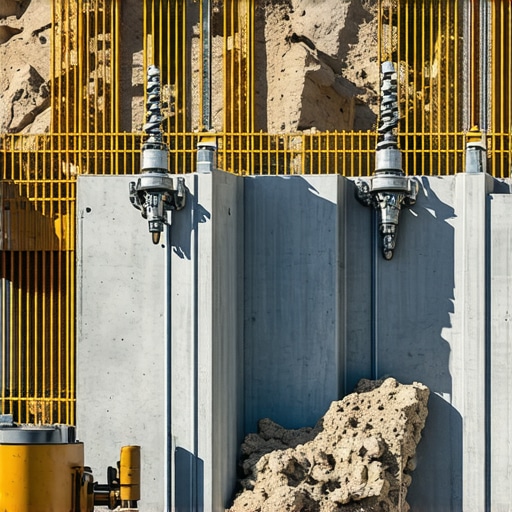
When excavation of the entire wall is cost-prohibitive, we turn to the ‘Deadman Anchor.’ This is an old-world technique modernized with 21st-century hardware. A deadman is essentially a heavy anchor—often a concrete block or a cross-member of treated timber—buried deep in the stable soil behind the wall’s ‘failure plane.’ We drill through the face of the bulging modular block, drive a high-tensile steel rod (the tieback) through the earth, and secure it to the deadman. As we tighten the nut against a steel plate on the wall’s face, we create a tension system that pulls the wall back into alignment. This is far more effective than historic tuckpointing or surface-level patches because it addresses the ‘why’ of the failure, not just the ‘where.’ During this process, I often find honeycombing in the original concrete base—pockets of air where the cement wasn’t vibrated properly, leading to a weak point that allowed the wall to pivot.
Integrating Modern Science: Fiber-Reinforced Mortars and Sealants
Once the wall is stabilized with anchors, we focus on the skin. This is where brickwork sealants application becomes critical. You don’t want a ‘film-forming’ sealer that traps moisture inside the block; that leads to spalling when the freeze-thaw cycle hits. You want a silane-siloxane penetrating sealer that allows the masonry to ‘breathe’ while shedding liquid water. For the joints that have been stressed, we use fiber-reinforced mortars. These contain thousands of microscopic synthetic fibers that bridge micro-cracks, providing a level of durability that standard Type S or Type N mortar can’t match. It’s the difference between a brittle bond and a resilient one. If we’re working on a site with older structures, we might even employ historic pointing styles like a ‘grapevine’ or ‘weathered’ joint to match the existing historic tuckpointing on a nearby chimney or facade, ensuring the repair doesn’t look like a sore thumb.
“Water penetration is the single greatest threat to masonry durability, necessitating integrated drainage and vapor-permeable protection.” — BIA Technical Note 7
The Anatomy of a Full Repointing Service
A full repointing service on a damaged wall isn’t just about aesthetics; it’s a structural necessity. We use a slicker or a jointer tool to compact the mud into the joints. This compaction is vital. If the mortar is just ‘shmushed’ in there loosely, it will have no ‘tooth’—the mechanical bond to the masonry units. We’re looking for ‘suction,’ where the block pulls the moisture out of the mortar at just the right rate to create a crystalline bond. In cases of chimney structural repair, which often goes hand-in-hand with wall stabilization on older estates, we look for ‘cold joints’—places where new concrete was poured against old, creating a permanent weak spot. We bridge these with specialized sustainable masonry materials, like hydraulic lime or recycled aggregate mortars, which offer better flexibility than modern Portland cement.
Preventative Forensic Measures
If you’re seeing hairline cracks, don’t wait for the bulge. A structural masonry inspection can identify early signs of rotation. We look for ‘stair-step’ cracking in the foundation and the separation of the soldier course (the vertical bricks) at the top of a wall. To prevent future issues, we often recommend sustainable masonry materials that have a lower carbon footprint and better thermal compatibility with older stones. Applying brickwork sealants application every five to seven years can prevent the ‘wicking’ action that brings salts to the surface (efflorescence) and degrades the mortar from the inside out. Remember, a wall is a living thing—it breathes, it moves with the seasons, and it requires a master’s eye to keep it standing for another hundred years. Don’t trust your foundation to a guy with a truck and a hawk who doesn’t know the difference between ‘hydrostatic pressure’ and a garden hose.