
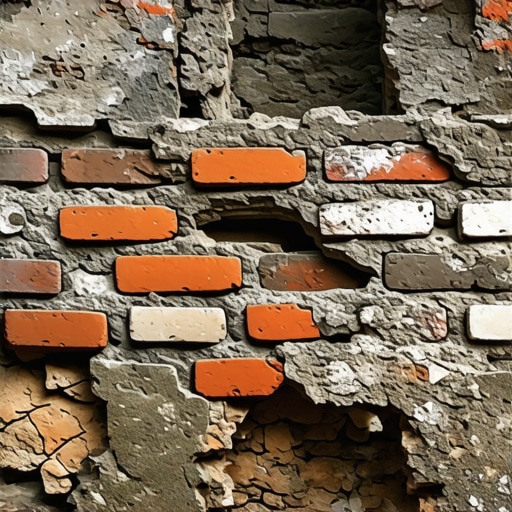
You walk past it every day. A little pile of red dust on the porch. A thin sliver of clay lying on the driveway like a discarded fingernail. To the untrained eye, it looks like the house is just ‘shedding.’ But to a man who has spent forty years with a trowel in one hand and a forensic scope in the other, that red dust is a crime scene. In the trade, we call this spalling. It is the visible manifestation of a brick’s slow, agonizing death. If you ignore it, you aren’t just looking at a cosmetic blemish; you are watching the structural integrity of your building dissolve into powder.
The Forensic Reality: A Case of Internal Sabotage
The homeowner thought it was just a hairline crack, a minor nuisance on a century-old facade. But when I put my scope inside the cavity through a weep hole, I saw the structural steel was rusted to dust, expanding with such force it was literally shoving the brick faces off the wall. This wasn’t a surface issue; it was a systemic failure. The steel lintels, once the hidden skeletons of the brick arch restoration, had become the very thing destroying them. As steel oxidizes, it can expand up to ten times its original thickness. This ‘oxide jacking’ creates a silent, relentless pressure from within, pushing against the fired skin of the masonry until the face simply gives up and pops off.
The Physics of the Spall: Why Bricks Explode
To understand why your bricks are flaking, you have to understand the ‘tooth’ of the material. A brick is a sponge. It has a complex network of capillaries and pores. When we talk about masonry waterproofing solutions, we aren’t just talking about slapping a sealer on the wall—in fact, that’s often how you kill a wall. The problem usually starts with a mismatch in materials. Historically, bricks were fired at lower temperatures, making them softer and more breathable. When a modern ‘handyman’ comes along and uses a high-strength Portland cement for flush pointing services on a pre-1940s building, they are signing the wall’s death warrant.
“The primary cause of masonry deterioration is the presence of moisture within the wall system, often exacerbated by the use of incompatible repair materials.” – BIA Technical Note 1
The physics are brutal. Portland cement is hard and impermeable. It doesn’t breathe. The soft, historic brick, however, wants to move and shed moisture. When water gets trapped behind that hard ‘mud,’ it has nowhere to go. During a freeze-thaw cycle, that trapped water expands by 9%. Since it can’t escape through the mortar joint—the way it was designed to—it exerts thousands of pounds of pressure against the face of the brick. This is where the ‘suction’ of the brick becomes its downfall. The face eventually shears off, leaving the soft, unprotected inner core exposed to the elements. This is why historic pointing styles are not just about aesthetics; they are about thermal and moisture management.
The Salt Trap: Brick Efflorescence Removal and Subflorescence
Sometimes the enemy isn’t ice; it’s salt. You’ve seen the white, powdery stains on walls. That’s efflorescence. Most people think it’s just an eyesore and look for brick efflorescence removal techniques. But there is a deadlier cousin called subflorescence. This happens when the salts don’t reach the surface but crystallize just beneath the brick’s ‘skin.’ As these crystals grow, they create ‘cryptoflorescence,’ a microscopic explosion within the pores. If you are managing commercial masonry maintenance, ignoring these white blooms is a recipe for disaster. It indicates that water is moving through your wall, carrying minerals that will eventually tear the stone facade restoration apart from the inside out.
The Foundation Connection: Self-Healing Concrete and Structural Shifts
Flaking at the base of a wall often points to a deeper issue: the foundation. If you see spalling on the first three courses of a soldier course, you likely have a ‘rising damp’ problem. Groundwater is being wicked up through the masonry. This is where we look into self-healing concrete foundations or advanced damp-proofing. If the spalling is accompanied by a lean, you might be looking at a retaining wall batter correction. A wall that is out of plumb puts uneven stress on the brick faces, causing the ‘shivering’ effect where the edges begin to flake under the sheer weight of the vertical load. Correcting the batter isn’t just about aesthetics; it’s about realigning the physics of the entire structure.
“Mortar should always be weaker than the masonry units so that it acts as a sacrificial element, allowing moisture to escape and accommodating movement without damaging the brick.” – ASTM C270 Standards
The Restoration Reality: Doing it Once vs. Doing it Twice
When I see a brick veneer installation that’s only ten years old and already flaking, I know someone took a shortcut. They probably didn’t use a slicker to properly compress the joints, or they ‘burned’ the mud by working in direct sunlight without wetting the bricks first. This ‘flash setting’ creates a brittle bond that fails at the first sign of thermal expansion. To fix a flaking wall, you don’t just ‘patch’ it. You have to remove the ‘lick-and-stick’ mentality. You grind out the joints to a depth of at least twice the width of the joint. You mix a lime-rich mortar—Type O or Type K—that has the flexibility to move with the building. You ‘butter’ the joints carefully, ensuring no voids are left for water to congregate. This is the difference between a temporary fix and a legacy restoration. If you value your home, you don’t look for the cheapest bid; you look for the man who understands the ‘breathability’ of the clay. Because once that face flakes off, the heart of the brick is exposed, and the clock starts ticking toward a total collapse.