
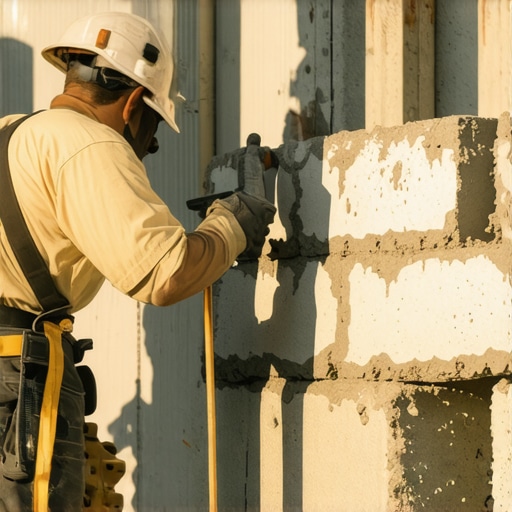
The Forensic Scene: When a Chip Is Never Just a Chip
I remember standing in a damp commercial basement in Detroit, looking at a series of Concrete Masonry Units (CMU) that the owner thought just needed a little bit of paint. He called them ‘beauty marks.’ I put my pick to a corner of the block, and a chunk the size of a beefsteak fell off, revealing a rusted rebar tail that had expanded so much it was literally blowing the block apart from the inside out. The homeowner thought it was just a hairline crack or a surface flake. But when I put my scope inside the hollow core, I saw the structural steel was rusted to dust, and the ‘chip’ was the final gasp of a dying wall. This is the reality of professional masonry restoration; it is a game of physics played out in slow motion over decades.
“Water penetration is the single greatest threat to masonry durability.” – BIA Technical Note 7
The Physics of the Freeze-Thaw Attack
In the North, where the mercury drops and the wind howls off the lakes, CMU blocks face a brutal cycle. Concrete is porous—think of it like a hard sponge. When water infiltrates those pores and hits the 32-degree mark, it expands by approximately 9%. If that water is trapped behind a dense concrete patch that doesn’t breathe, it has nowhere to go but out, taking the face of your block with it. This is called spalling. Most handymen will just slap some ‘mud’ over the hole and call it a day. Within two winters, that patch will be lying on the ground because they didn’t account for the ‘tooth’ of the host material or the vapor permeability required for the wall to sweat.
The Anatomy of a Proper Concrete Patch
To fix a chipped CMU without ripping the whole wall down, you have to understand the bond. You don’t just ‘butter’ the hole. You have to create a mechanical key. I start by grinding out the loose aggregate until I hit ‘bright’ stone—solid, un-weathered concrete. If I see honeycombing, I know the original pour was weak. We then use a bonding agent, but not just any liquid from a big-box store. We’re looking for a high-modulus epoxy or a polymer-modified slurry that creates a bridge between the old crystalline structure and the new repair material.
“The success of a masonry repair depends entirely on the compatibility of the repair mortar with the original substrate.” – ASTM C270 Standards
Why Mortar Matching Services are Non-Negotiable
One of the biggest sins in this trade is a patch that sticks out like a sore thumb. CMU blocks aren’t just grey; they are a symphony of aggregates, sands, and Portland hues. Using mortar matching services is the only way to ensure the repair disappears. We look at the ‘suction’ of the block—how fast it draws water out of the mix. If the block sucks the water out too fast, the mortar ‘burns’ and loses its structural integrity before it can even cure. We often have to pre-wet the CMU, a process we call ‘Saturated Surface Dry’ (SSD), to ensure the hydration process happens within the patch, not just on the surface.
When the Damage Goes Deeper: From Quoins to Piers
Sometimes a chip is a symptom of a larger structural shift. If I see brick quoin repair needs or vertical cracking through the blocks, I’m not looking at a surface issue; I’m looking at the earth moving. This is where foundation helical pier installation comes into play. You can patch the concrete until you’re blue in the face, but if the footing is sinking into plastic clay, the wall will keep tearing. We use masonry birdsmouth cuts to integrate new units into old patterns, ensuring the repair isn’t just a band-aid but a structural graft. For those looking to upgrade the aesthetic while fixing the damage, a brick veneer installation over the CMU provides a second skin that protects the load-bearing core from the elements.
Advanced Aesthetics and Hardscape Integration
Restoration isn’t always about hiding. Sometimes it’s about reinforcing the design. We’ve seen outdoor fireplace rebuild projects where chipped CMU was the core, and we transformed it using metallic masonry finishes or modular retaining walls to divert hydrostatic pressure away from the foundation. Every cut must be precise—no ‘cold joints’ where the new concrete fails to fuse with the old. We use a hawk and slicker to pack the joints tight, ensuring there are no voids where ice can get a foothold next season. It’s about the ‘ring’ of the material; when you’re done, you should be able to tap that block and hear a solid, high-pitched note, not a dull thud.
The Master Mason’s Final Word on CMU Longevity
Don’t be fooled by the ‘lick-and-stick’ crowd who says a little acrylic caulk will fix a spalled block. Real professional masonry restoration is about respecting the chemistry of the Portland cement and the geology of the aggregate. Whether you are dealing with a soldier course that’s bowing or simple surface chips, the goal is to stop the water, stabilize the movement, and match the soul of the original masonry. Do it once, do it right, and you won’t be looking at a pile of rubble in ten years. This isn’t just a trade; it’s a forensic battle against time and the elements.