
The Forensic Reality of the Concrete Masonry Unit
I once walked into a converted textile mill where the new owners were complaining about a persistent, musty odor that no amount of industrial candles could mask. They thought it was old grease. I took my hammer, tapped a section of the grey CMU wall, and heard that hollow, wet thud that sends a shiver down a mason’s spine. When I bored a small pilot hole, nearly a gallon of trapped water bled out of the core like an arterial spray. The previous contractor had ‘restored’ the wall by slapping a thick, non-breathable elastomeric paint over damp block. He hadn’t restored it; he’d built a vertical pond. That is the danger of chasing a ‘modern look’ without understanding the physics of the material you’re standing next to.
The Porous Nature of the Beast
Concrete Masonry Units (CMU), or what most folks call cinder blocks, are not the solid, impenetrable bastions they appear to be. They are essentially rigid sponges. A standard 8x8x16 block is riddled with a network of microscopic capillaries formed during the hydration process of the Portland cement, sand, and aggregate. If you understand the tooth of the block, you understand that whatever you put on the surface is either going to bond at a molecular level or it’s going to be pushed off by hydrostatic pressure from the inside out.
“Water penetration is the single greatest threat to masonry durability. Moisture can enter masonry through various paths, including cracks, capillary action, and absorption through the units themselves.” – BIA Technical Note 7
The Anatomy of Restoration: Cleaning Without Destruction
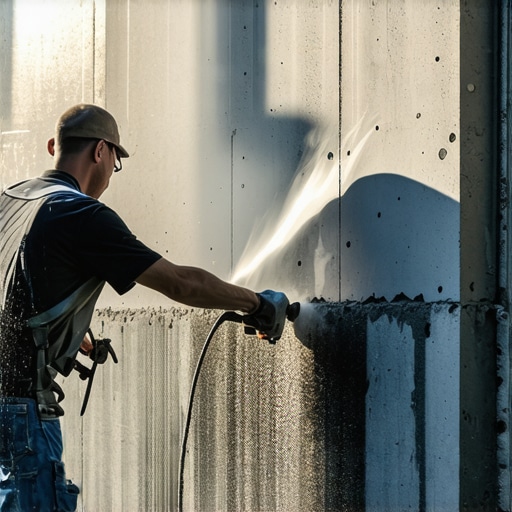
Before you even think about masonry staining or aesthetic upgrades, you have to strip the sins of the past. Most CMU walls in industrial settings are covered in decades of carbon crust, efflorescence, or ‘handyman specials’—layers of cheap latex paint. Mechanical cleaning is often the first instinct, but sandblasting is the enemy of the CMU. It obliterates the ‘fire-skin’ of the block, leaving the soft, internal aggregate exposed to rapid weathering. Instead, we look at chemical restoration. We use acidic detergents—carefully diluted phosphoric or sulfamic acid—to bite into the carbon. You apply the mix, let it dwell until it starts to lift the grit, then use a low-pressure wash. You aren’t just cleaning; you’re opening the pores so your next layer actually has something to grab onto. This is the foundation of masonry water damage repair. If the block can’t breathe, the building dies.
The Art of the Joint: Beyond Simple Tuckpointing
The joints are the weakest link and the most important structural element of a CMU wall. When we talk about tuckpointing brick walls or CMU blocks, we aren’t just ‘smearing some mud’ in the cracks. We are managing movement. If you see a stair-step crack, that’s settlement. If you see a vertical fracture running straight through the blocks, that’s thermal expansion—likely because the original builder skipped the control joints. Tuckpointing cost estimation usually fails because people don’t account for the depth of the grind. You have to remove at least 3/4 of an inch of the old, crumbly mortar until you hit sound material. Then, you ‘butter’ the joints with fiber-reinforced mortars. Why fiber-reinforced? Because CMU is rigid. Modern additives give the mortar a higher flexural strength, allowing it to handle the vibrations of a modern city or the shifting of heavy machinery without popping the face of the block off. In cases where the wall has lost its lateral stability, we move into structural brick ties replacement or internal reinforcement using advanced masonry adhesives injected into the cores to bond the block to the internal rebar.
Achieving the Modern Aesthetic: Staining vs. Painting
If you want that sleek, charcoal grey or muted basalt look that defines modern industrial design, do not reach for a bucket of paint. Paint is a film. Staining is a chemical bond. When you use masonry staining, specifically potassium silicate-based stains, you are initiating a process called silicification. The stain penetrates the surface and becomes part of the stone itself. It doesn’t peel because there is no ‘layer’ to peel. It’s breathable. It allows water vapor to escape while preventing liquid water from entering. This is how you achieve a stone facade restoration look on a humble concrete block.
“The mortar should always be weaker than the masonry units to ensure that any stress-induced cracking occurs in the easily repairable mortar joints rather than the units themselves.” – ASTM C270 Standards
Sealing the Deal: The Physics of Breathability
The final step is the brickwork sealants application. But here’s the rub: if you use a ‘wet look’ sealer from a big-box store, you’re sealing the block’s fate. You need a silane-siloxane penetrating sealer. These molecules are small enough to enter the pores but they don’t fill them. They line the pores with a hydrophobic ‘lining’ that reverses the capillary action. Instead of the block sucking water in, it pushes it out. If you’re dealing with a chimney or an exterior wall, this is non-negotiable. Our chimney rebuild services always include this step because the freeze-thaw cycle in a chimney is more aggressive than anywhere else on the structure. Water expands by 9% when it freezes. If that water is trapped in the CMU, it will blow the face off the block, a process we call spalling.
The Master’s Verdict
Restoring CMU for a modern look isn’t about hiding the block; it’s about honoring its structural integrity while updating its chemistry. From the initial tuckpointing brick walls to the final application of advanced masonry adhesives for structural stabilization, every step must respect the movement of moisture. Don’t let a ‘handyman’ turn your building into a sealed tomb of damp concrete. Do it once, do it right, and let the block ring like a bell when you hit it with a trowel. That is the mark of a master.