
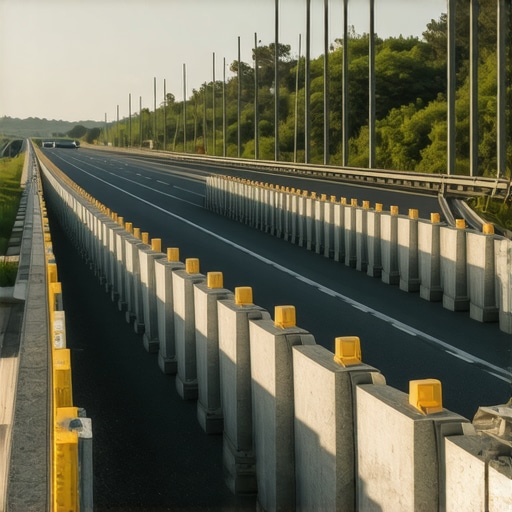
The Echo of Poor Construction: Why Mass Still Matters
I remember my uncle, a man who had more lime in his lungs than the White Cliffs of Dover, pulling me aside on a job site near an interstate bridge. He picked up a standard 8-inch modular block and struck it with his margin trowel. It didn’t have that high-pitched ping of a well-fired clay brick; it had a dull, heavy thud. ‘That thud,’ he told me, ‘is the sound of silence.’ He wasn’t being poetic. He was talking about the acoustic impedance of high-density modular masonry. Most people see a highway sound barrier and think it is just a wall. I see a complex system of mass, diffraction, and structural physics designed to fight a 24-hour war against decibels and the relentless freeze-thaw cycles of the northern climates. When these walls fail, it is rarely the material’s fault; it is usually a failure to respect the chemistry of the mud or the physics of the soil.
“Concrete masonry units provide an excellent sound barrier because of their mass and the fact that they are typically used in a way that minimizes sound transmission through the wall system.” – National Concrete Masonry Association (NCMA) TEK 13-01B
The Physics of Sound Absorption and Modular Masonry
Why do we use modular masonry instead of just pouring a massive slab of concrete? It comes down to the way sound waves interact with surfaces. A flat, poured-in-place wall acts like a mirror for sound, reflecting it right back into the opposite neighborhood. Modular masonry, particularly when we use split-face units or blocks with varying textures, creates a ‘diffuse’ surface. The sound waves hit the irregular ‘tooth’ of the stone and scatter. Furthermore, the internal structure of a modular block—the webs and the cores—can be engineered for specific acoustic frequencies. In the world of forensic masonry, we look for honeycombing in the grout or the core fill. If the grout wasn’t vibrated properly during the self-leveling masonry lifts, you end up with air pockets. To the layman, it is just a hidden void. To the sound wave, it is a highway right through the barrier.
The Enemy Underground: Foundation Underpinning and Waterproofing
You can build the most beautiful soldier course of brick on top of a wall, but if the foundation isn’t right, that wall is going to walk. On highway projects, we deal with immense lateral loads. Wind pressure and the vibration from 80,000-pound rigs create constant stress. If the soil is expansive clay, the wall will heave. This is where foundation underpinning becomes a necessity for older barriers that were built on shallow footings. We see this often in foundation crack repair: a horizontal fracture running the length of the first three courses. That is almost always a sign of hydrostatic pressure or frost heaving. To prevent this, foundation waterproofing and masonry waterproofing solutions must be applied to the ‘blind side’ of the wall—the side facing the dirt. If you don’t manage the water, the water will manage you. I’ve seen 50-foot sections of sound barrier lean three degrees in a single season because the drainage was clogged with silt.
The Chemistry of the North: Freeze-Thaw and Spalling
In regions where the thermometer bounces across the 32-degree mark fifty times a winter, the ‘wicking’ action of masonry is the silent killer. When I am called in for freeze-thaw damage restoration, I am usually looking at spalling—where the face of the block or brick literally pops off like a scab. This happens because water enters the pores of the material, freezes, and expands by 9%. If the contractor used a high-strength Portland cement mud on a softer modular unit, the mortar won’t give. The pressure has to go somewhere, so the brick face explodes. This is why porous stone sealers are not just an ‘extra’—they are a lifeline. A silane-siloxane sealer penetrates deep into the substrate, changing the surface tension of the pores so water beads off instead of soaking in. It is the difference between a wall that lasts eighty years and one that needs stone wall repair after ten.
“Water penetration is the single greatest threat to masonry durability, particularly in climates subject to repeated freeze-thaw cycles.” – BIA Technical Note 7
Restoration of the Old Guard: Brick Arches and Fountains
While highway barriers are functional, we often see them integrated with historical elements like bridge abutments or decorative features in rest areas. Brick arch restoration is a dying art. It requires an understanding of the ‘keystone’ and how load is transferred through the haunches of the arch. If you see a crack in the ‘intrados’ (the underside of the arch), you are looking at structural fatigue. We often see similar issues in outdoor masonry fountain restoration near these public corridors. Fountains are notoriously difficult because they are ‘wet’ masonry. You have constant saturation on one side and evaporation on the other. This creates ‘efflorescence’—that white, salty crust—which is more than an eyesore; it is the sound of the masonry slowly dissolving. Using masonry waterproofing solutions that are breathable is critical here. You want to keep the liquid water out, but you must let the water vapor escape. If you ‘seal’ a wall with a non-breathable coating, you are basically buttering a piece of bread and then wrapping it in plastic—it’s going to get mushy and fail.
The Master’s Perspective: Why the ‘Quick Fix’ Fails
I often see handymen trying to fix a structural crack with a bit of caulk and some slicker work. That is like putting a Band-Aid on a bullet wound. In foundation crack repair, you have to understand why the crack happened. Is it settlement? Is it a cold joint from a bad concrete pour? Or is it thermal expansion? Long highway barriers need control joints every 20 to 30 feet. Without them, the wall will create its own ‘joints’—otherwise known as cracks. When we perform stone wall repair, we don’t just fill the gap. We often have to use stainless steel helical ties to stitch the wythes of the wall back together. This is forensic work. It requires a hawk and a steady hand to butter the joints so that the repair is invisible but the structural integrity is restored. Do not be fooled by the ‘lick-and-stick’ veneer contractors who promise a cheap fix. If they don’t talk about the ‘suction’ of the brick or the ‘slump’ of the grout, they don’t know the craft. You do it right once, or you do it twice at triple the cost. That is the reality of the trade. { “@context”: “https://schema.org”, “@type”: “HowTo”, “name”: “How to Diagnose Masonry Sound Barrier Failure”, “step”: [ { “@type”: “HowToStep”, “text”: “Inspect for efflorescence or white salt deposits, which indicate water infiltration.” }, { “@type”: “HowToStep”, “text”: “Check for spalling or face-bursting, signaling freeze-thaw damage.” }, { “@type”: “HowToStep”, “text”: “Analyze crack patterns: horizontal cracks suggest hydrostatic pressure; stair-step cracks suggest settlement.” }, { “@type”: “HowToStep”, “text”: “Apply a breathable porous stone sealer to prevent future moisture ingress.” } ] }”,