
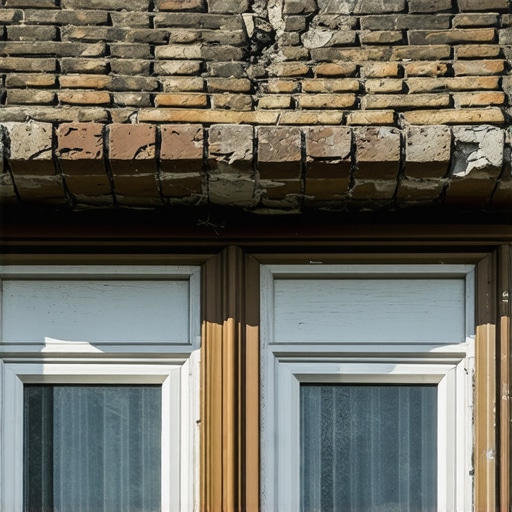
The Forensic Scene: When a Hairline Crack Becomes a Structural Threat
The homeowner stood on the porch, pointing at a zigzag crack that traced the mortar joints above her front bay window. She called it a ‘settlement hairline.’ But when I slid my fiber-optic scope into a weeping joint, the reality was far more violent. I didn’t just see a gap; I saw the structural steel lintel rusted to a bloated, flaky dust. The metal had expanded to three times its original thickness through a process called ‘rust jacking,’ and it was literally lifting the brickwork before gravity forced the inevitable sag. This wasn’t settlement; it was a slow-motion explosion of the building’s skeleton. Most ‘handyman specials’ would involve slapping some mortar in those cracks, but that is like putting a Band-Aid on a compound fracture. You have to understand the physics of the load and the chemistry of the decay to fix this.
The Physics of the Lintel: Your Wall’s Unsung Hero
In the trade, we talk about ‘arching action.’ A brick wall isn’t just a stack of stones; it is a system of weight distribution. When you cut a hole in that wall for a window or door, you interrupt the load path. The lintel—that horizontal piece of steel, stone, or precast concrete—takes the weight of the soldier course and the triangle of masonry above it and transfers it to the jambs. When the lintel fails, the ‘tooth’ of the masonry is lost.
“Lintels must be designed to support the weight of the masonry above the opening, plus any additional loads, unless arching action is accounted for.” – BIA Technical Note 31B
If you see a dip in the middle of your window head, the steel has lost its structural integrity. This often happens because the original builder didn’t use galvanized steel or failed to install proper flashing. In our historic pointing styles, we see this often: moisture gets trapped behind the brick, sits on the steel, and starts the oxidation process. As the steel oxidizes, it creates iron oxide scale. This scale is incredibly powerful. It exerts upward pressure that can crack 5,000 PSI concrete and snap bricks like dry crackers.
The Freeze-Thaw War: Why Geography Matters
In regions where the thermometer bounces across the freezing mark, the lintel becomes a focal point for disaster. Water is a masonry’s greatest enemy. It finds its way into the mortarless masonry systems or cracked joints and sits on the cold steel lintel. When that water freezes, it expands by roughly 9%. In a tight masonry pocket, there is nowhere for that force to go except outward. This results in ‘spalling,’ where the face of the brick literally pops off, leaving the soft, porous interior exposed. If you are looking for full repointing services, you aren’t just looking for someone to make the wall look pretty; you need someone who understands the ‘suction’ of the brick. If you use a modern, hard Portland cement on old, soft bricks, you are sealing a death warrant. The mortar must be the ‘sacrificial lamb’—softer than the brick so that moisture evaporates through the joints, not the masonry units themselves.
The Anatomy of a Proper Repair: No Shortcuts Allowed
Fixing a sagging lintel isn’t about tuckpointing machine services; it is about surgical replacement. We start by shoring up the masonry above the opening using ‘needles’—steel beams that pierce the wall to hold the weight while we perform the extraction. We then ‘grind out’ the surrounding joints, often using masonry cleaning techniques to ensure we have a clean substrate. The old, rusted steel is pulled out, and we inspect the ‘bearing’—the part of the wall where the lintel sits. Often, we find spalled concrete steps repair is needed nearby because the moisture has traveled down the cavity. We replace the failed metal with heavy-gauge galvanized steel or stainless steel, ensuring it has at least 6 inches of bearing on each side.
“Steel lintels in masonry walls should be protected from corrosion by galvanizing or the use of stainless steel, especially in high-moisture environments.” – ASTM A123 / A153 Standards
Then comes the critical part: the flashing and ‘weep holes.’ You have to give the water a way out. Without weeps, you are just building a bathtub behind your bricks.
Stone Facade Restoration and Modern Dilemmas
When dealing with stone facade restoration, the stakes are even higher. Stone is heavy, and its irregular shapes don’t always create the same ‘arching action’ as modular brick. We often see failures in modular retaining walls and parapets where the commercial parapet wall repair was handled by someone who didn’t understand hydrostatic pressure. They ‘butter’ the joints with cheap mud, thinking it will hold. But real masonry requires ‘tooth.’ The mortar must be pushed deep into the joint, ‘struck’ with a slicker to compact the surface, and allowed to cure slowly. If the mud dries too fast—what we call ‘flash setting’—it loses its bond and turns to sand within a season. This is where AI masonry assessment is becoming a tool for us old-timers; we can use thermal imaging to see where moisture is pooling behind a facade before the bricks start to ‘smile’ and sag.
The Cost of Neglect: Do It Once, or Do It Twice
I have spent my life cleaning up after ‘handyman specials.’ People see a sagging window and think they can just ‘tuckpoint’ the crack. They ‘throw some mud’ at it and walk away. Two years later, the sag is worse, and now the window frame is crushed, the glass is cracked, and the interior drywall is molded. Proper full repointing services combined with lintel replacement is an investment in the structural survival of the building. Whether it is a commercial parapet wall repair or a simple residential window, the physics don’t change. You respect the load, you manage the water, and you use the right materials. Anything less is just ‘lick-and-stick’ garbage that won’t survive the next winter freeze. If your brickwork is starting to sag, the time for ‘monitoring’ is over. You are looking at a structural failure that is only moving in one direction: down.