
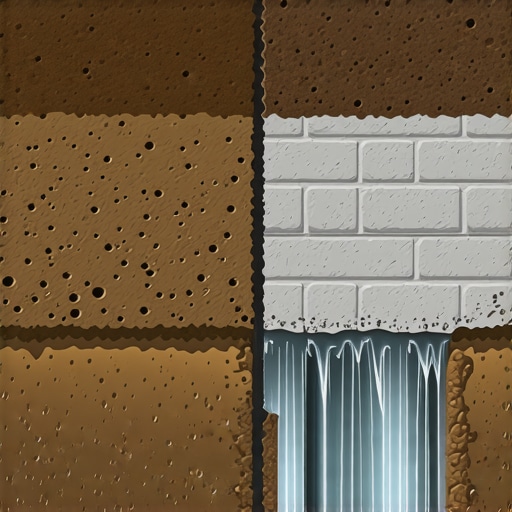
The Ghost in the Basement: A Forensic Scene
I remember a specific walk-through in a mid-century split-level where the owner thought the 1/8-inch horizontal line at the third course of block was just ‘settling.’ It looked like a pencil mark. But when I slid my borescope into a core through a small fracture, the reality was a nightmare. I saw the hollow cores of the concrete masonry units (CMUs) were half-filled with stagnant, murky water. The vertical reinforcement—the structural steel that should have been the wall’s spine—had vanished. It was gone, turned into a handful of orange flakes and a rust stain on the footing. That ‘pencil mark’ wasn’t a settlement crack; it was a shear failure. The wall was held up by nothing but friction and luck. This is the silent reality of structural masonry inspection: by the time you see the bow, the chemistry of the wall has already surrendered to the soil.
The Physics of the Push: Hydrostatic Pressure and Soil Mechanics
To understand why foundation wall bowing is worse in houses with poor drainage, you have to look at the ‘mud.’ When I talk about mud, I’m not just talking about the mortar on my hawk; I’m talking about the saturated earth pressing against your home. Soil isn’t a static weight. It’s a dynamic fluid when water is involved. In a properly drained system, water moves through the soil and into a footer tile. But in a failing system, the soil becomes a heavy, viscous soup. This creates hydrostatic pressure. We are talking about hundreds of pounds per square foot. When you add the weight of a water-logged clay—which expands at a molecular level as water wedges between the silicate layers—you are no longer looking at a wall; you’re looking at a dam that wasn’t designed to hold back a lake.
“Water penetration is the single greatest threat to masonry durability. Moisture accumulation in the cores of CMU walls can lead to internal corrosion and freeze-thaw degradation that is often invisible from the exterior.” – BIA Technical Note 7
The Chemistry of the Block: Why Concrete Block Foundations Fail
In a concrete block foundation repair scenario, we have to look at the porosity of the material. A standard 8x8x16 block is a sponge. If the drainage isn’t pulling water away, that water sits in the ‘tooth’ of the block. In Northern climates, the freeze-thaw cycle is the executioner. Water expands by 9% when it turns to ice. If that water is trapped in the pores of the concrete, it creates internal tensile stress that the concrete cannot handle. Concrete is great in compression, but it’s weak in tension. The face of the block begins to ‘spall’ or flake off, and the bed joints—where the horizontal mortar matching services become critical—begin to compress unevenly. When the mortar is constantly damp, the calcium hydroxide in the cement paste begins to leach out, leaving the joint brittle and sandy. If you ‘butter’ a joint with a hard Type M mortar on an old, soft block, you’re just creating a lever that will snap the block’s face right off when the wall bows.
The Chimney Connection: Vertical Instability
Most homeowners don’t realize their foundation issues are connected to their roofline. A failing chimney crown repair or a missing chimney cap replacement allows water to travel down the internal flues or the space between the liner and the brick veneer. This water eventually pools at the base of the chimney, often saturating the foundation near the hearth. This localized saturation causes ‘differential settlement,’ where one part of the foundation sinks or bows faster than the rest. When we perform a structural masonry inspection, we aren’t just looking at the floor; we’re looking at the sky. A cracked crown is a funnel for the very water that will eventually bow your basement walls.
Commercial Masonry Maintenance and Large-Scale Failure
In commercial masonry maintenance, we see this on a massive scale. Retaining walls are the best teachers. If the retaining wall capstone replacement wasn’t done correctly, or if the drainage swales are clogged, the wall will develop a ‘belly.’ I’ve seen walls where the concrete pump masonry mixes used in the core were too lean, creating honeycombing. Those voids become reservoirs for water. The pressure builds until the wall reaches its ‘plastic limit’ and deforms. Once a masonry wall has bowed past its center of gravity, no amount of ‘tuckpointing’ is going to save it. You’re looking at helical piers or total excavation.
“Horizontal cracking in masonry units is typically indicative of lateral earth pressure exceeding the flexural strength of the wall assembly, a condition exacerbated by inadequate moisture control.” – ASTM C1272 Standard Concepts
The Art of the Fix: Beyond the Band-Aid
Repairing a bowing wall isn’t about hiding the crack. It’s about managing the physics. If the wall is bowing, we first look at brick veneer installation techniques and whether they allow for proper weeping. If it’s a structural block wall, we might use concrete pump masonry mixes to grout the cells solid, but only after we’ve corrected the exterior drainage. We often see ‘handyman specials’ where someone has applied metallic masonry finishes over a damp wall to ‘seal’ it. That is a death sentence. All you’re doing is trapping the moisture inside the masonry, accelerating the rot. You have to let the wall breathe, or you have to stop the water from reaching it in the first place. This is where retaining wall capstone replacement and proper grading come into play. You have to move the water away from the ‘cold joint’ where the wall meets the footing.
The High-Tech Solution: Metallic Finishes and Modern Mixes
Today, we use metallic masonry finishes and advanced siloxanes for aesthetic and protective purposes, but they are only the final step. The real work is in the ‘mud.’ Using mortar matching services to ensure the new repair material has the same modulus of elasticity as the old wall is vital. If the repair is harder than the original wall, the original wall will continue to fail around the repair. We use concrete pump masonry mixes with high flowability but low water-to-cement ratios to fill the cores of bowing walls, creating a ‘monolithic’ structure that can resist the soil’s push. But remember, if you don’t fix the drainage, even a solid concrete wall will eventually bow or slide under the sheer weight of a saturated hill.
Summary: Listen to Your Walls
Don’t ignore the ‘stair-step’ crack in your mortar or the ‘slicker’ marks that seem to be widening. A bowing foundation is a symptom of a larger hydrological failure. Whether it’s a chimney crown repair needed to stop internal water flow or a full-scale concrete block foundation repair, the goal is always the same: control the water, or the water will control your home. Masonry is the art of building for the centuries, but even the best ‘soldier course’ or ‘hawk’ full of the finest mud can’t fight the physics of poor drainage forever. Do it once, or do it twice. The choice is yours, but the earth never stops pushing.