
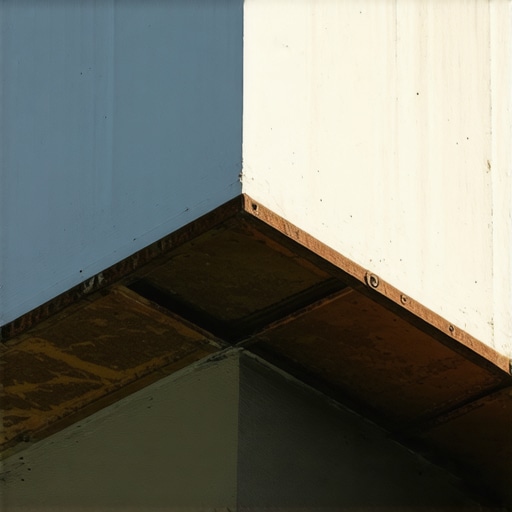
The Forensic Scene: When the Steel Breathes Fire
I was called out to a five-story warehouse conversion last October. The owner was frantic because a single soldier course brick had tumbled from the fourth floor onto the sidewalk. He thought it was a freak accident. I pulled out my digital borescope and threaded it through a hairline crack in the mortar joint directly above the window head. What I saw wasn’t just rust; it was a structural autopsy. The steel lintel, tucked away in the permanent shadow of a neighboring skyscraper, had oxidized so severely it looked like a stack of burnt puff pastry. The steel was literally growing, pushing the masonry apart from the inside out. This is the reality of masonry forensics: the things you can’t see, in the places the sun never hits, are the ones that will eventually bring the house down.
The Physics of the Shadow: Why Sunlight is a Mason’s Best Friend
Most homeowners assume the south-facing side of their house takes the most beating because of the sun. They’re wrong. While the sun causes thermal expansion, it’s the shaded, north-facing walls—or any area permanently blocked by trees or adjacent structures—that suffer the most insidious decay. In the masonry trade, we talk about ‘dwell time.’ This is the duration that moisture remains trapped within the pore structure of the brick and the mortar. Sunlight provides the energy necessary for evaporation. In shaded areas, that energy is absent. When a driving rain hits a wall, the brick acts like a ceramic sponge. A standard clay brick can hold a significant percentage of its weight in water. On a sunny wall, that moisture is pulled back out by the sun within hours. In the shade, that wall stays ‘drunk’ for days. This constant state of saturation creates a permanent electrolytic cell around your steel lintels. Steel doesn’t just rust; it undergoes an electrochemical transformation. In the presence of water and oxygen, iron atoms lose electrons. This isn’t a surface stain; it’s a structural conversion.
“Corrosion of embedded steel is the primary cause of masonry cracking and spalling in modern facade systems.” – BIA Technical Note 18A
Oxide Jacking: The 10,000 PSI Silent Killer
When steel lintels rust in these damp, shaded micro-climates, they undergo a process called ‘oxide jacking’ or ‘rust bursting.’ As the iron converts to iron oxide, it expands to anywhere from three to ten times its original thickness. This expansion is not soft. It exerts upward pressures exceeding 10,000 pounds per square inch. No high-performance mortar mixes or dense bricks can withstand that force. The result is the classic ‘step crack’ or the lifting of the entire masonry veneer above the window opening. This is why commercial masonry facade maintenance is so critical; by the time you see the crack on the outside, the steel inside has often lost 30% of its structural section. We are now seeing the integration of digital twin masonry projects where we can model these moisture zones to predict failure before a brick hits the pavement.
The Critical Role of Proper Brick Wall Restoration
When we approach a brick wall restoration, we aren’t just slapping some ‘mud’ into the joints. We have to look at the chemistry of the wall. In shaded areas, we often see honeycombing in the mortar because the moisture has never allowed the lime to properly carbonate, or conversely, the freeze-thaw cycles have shattered the bond. If you’re looking at tuckpointing cost estimation, you have to account for the depth of the grind. In shaded zones, we often find we have to go deeper because the mortar has turned to a sandy paste. We use a hawk and slicker to pack the joints tight, ensuring there are no voids where water can pool. But if the lintel is already delaminating, no amount of ‘buttering’ the joints will save it. The steel must be mechanically cleaned, treated with a zinc-rich primer, or replaced entirely with stainless steel or hot-dipped galvanized members.
Beyond the Lintel: Chimneys and Retaining Walls
The same logic applies to other shaded structures. Take drone chimney inspections, for example. We often find that the shaded side of a chimney stack has significantly more moss and lichen growth. These organic organisms secrete acids that eat away at the mortar. Inside the flue, chimney interior parging often fails because the exterior wall never dries out, leading to vapor pressure that pushes the parging off the bricks. Moving down to the landscape, modular retaining walls and traditional stone walls suffer from the same lack of drainage. If a wall is in the shade and lacks a proper gravel backfill, hydrostatic pressure builds up. We often have to perform retaining wall batter correction because the wall has started to lean or ‘nose over’ under the weight of water-logged soil. It’s all about managing the water.
“The design and detailing of masonry must prioritize the shedding of water and the rapid drying of the assembly.” – ASTM C1194 Standards
The Sins of Modern Veneer
I have a particular disdain for modern brick veneer installation where the ‘weep holes’ are either omitted or clogged with mortar droppings. In a shaded area, a weep hole is the only way the wall can breathe. If you block those, you are essentially building a vertical swimming pool. The steel lintel at the base of that wall becomes the floor of that pool. It will rot, and it will rot fast. Whether it’s a simple residential window or a complex commercial facade, the physics don’t change. You can’t fight moisture; you can only give it a clear path out of your building. If you don’t, the ‘Old World’ craftsmanship I spent my life learning won’t mean a lick when the rust starts to bloom. Do it once, do it right, or get ready to pay me twice to fix the cold joints and the crumbled dreams of a ‘handyman special.'{“@context”:”https://schema.org”,”@type”:”HowTo”,”name”:”How to Identify and Prevent Lintel Failure in Shaded Masonry”,”step”:[{“@type”:”HowToStep”,”text”:”Conduct a visual inspection for ‘step cracks’ or horizontal shifting in the brickwork above window and door heads.”},{“@type”:”HowToStep”,”text”:”Use a digital borescope to inspect the condition of the steel lintel through existing mortar gaps.”},{“@type”:”HowToStep”,”text”:”Remove damaged mortar using a diamond-blade grinder, ensuring a depth of at least 1 inch for repointing.”},{“@type”:”HowToStep”,”text”:”Clean the steel lintel of all rust scale using a wire brush and apply a high-zinc cold galvanizing spray.”},{“@type”:”HowToStep”,”text”:”Repoint the joints using a high-performance mortar mix that matches the original masonry’s compressive strength.”}]}