
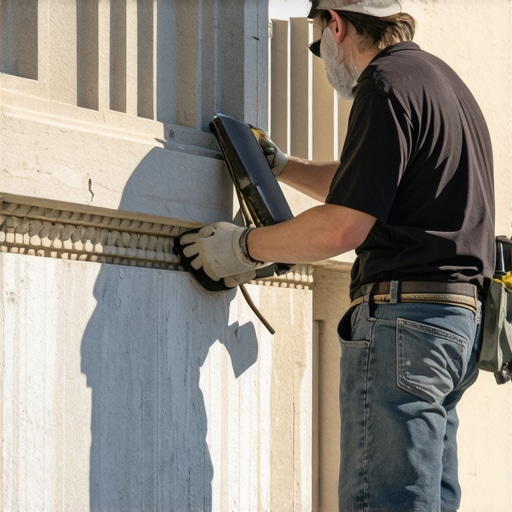
The Forensic Scene: A Facade in Mourning
The homeowner thought it was just a hairline crack. But when I put my scope inside that Indiana limestone header, I saw the structural steel was rusted to dust. They’d spent five years ‘cleaning’ their facade with a high-pressure hose and a bottle of store-bought acid, thinking they were doing the building a favor. Instead, they were feeding the beast. The water had bypassed the stone coping installation and settled right on the lintel, turning a $500 maintenance task into a $15,000 masonry damage assessment and structural overhaul. I’ve seen this a thousand times. You see a bit of algae or carbon crust and you want it gone, so you hire a guy with a truck and a power washer. By the time he’s done, he’s opened up the pores of that limestone so wide you could drive a truck through them. That is not cleaning; that is erosion in fast-forward.
The Microporosity of Ancient Shells
Limestone isn’t just a rock; it’s a sedimentary record of history, primarily composed of calcium carbonate. To understand why you can’t just blast it, you have to micro-zoom into the hydration and carbonation physics. Limestone has a capillary network—a series of microscopic tubes—that allows the stone to ‘breathe.’ When we talk about sustainable tuckpointing mortars or commercial masonry facade maintenance, we are really talking about moisture management. If you use a pressure washer, you aren’t just removing dirt; you are forcing water 3 or 4 inches deep into the stone. In a freeze-thaw climate, that water expands by 9%. It doesn’t care about the ‘tooth’ of your stone; it will pop the face right off in a process we call spalling. This is the heart of freeze-thaw damage restoration: fixing the mistakes of the over-eager cleaner.
“Limestone and marble are highly susceptible to damage from acidic cleaning agents and high-pressure water application, which can lead to irreversible loss of detail and surface integrity.” – ASTM C119: Standard Terminology for Dimension Stone
The Chemistry of Destruction: Why Acid is Your Enemy
Most ‘handyman specials’ involve muriatic acid. On a new brick veneer installation, maybe you get away with it if you’re fast and sloppy. On limestone? You’re dissolving the binder that holds the stone together. It’s like trying to clean a sugar cube by dipping it in hot coffee. The acid reacts with the calcium carbonate, creating a soluble salt that crystallizes just beneath the surface—a phenomenon called sub-florescence. As those crystals grow, they exert internal pressure that exceeds the tensile strength of the stone. You won’t see it today. You won’t see it tomorrow. But in three years, your limestone trim will start shedding like a snake, and no amount of masonry repair services will put it back together. You’ll be looking at full-scale retaining wall capstone replacement just to keep the wall from collapsing under its own weight.
The Proper Protocol: The Nebulous Spray Technique
If you want to clean limestone trim without causing erosion, you don’t reach for a power washer; you reach for a misting system. We call it ‘nebulous spraying.’ You set up a series of nozzles that provide a fine, low-pressure mist over the stone for 24 to 72 hours. This slowly softens the carbon crust without driving moisture deep into the core. Once the soot is soft, you use a natural bristle brush—never wire, never metal. You treat it like a surgeon, not a demolition crew. If you encounter deep biological growth, we use a pH-neutral D/2 biological solution. It’s a slow-burn process, but it respects the material’s integrity. When we do commercial masonry facade maintenance on historic courthouses, this is the only way it’s done. We don’t want a cold joint in our progress; we want a uniform, gentle lift of the contaminants.
Dealing with the Joints: The Mud and the Slicker
Often, the ‘dirt’ people see is actually failing mortar bleeding onto the stone. If your mortar is cracked, you don’t just ‘butter’ over it. That’s a cardinal sin. You have to grind out the joint to a depth of at least twice its width. Use a hawk and a slicker to push in a sustainable tuckpointing mortar—usually a Type O or Type N lime-rich mix. Why? Because the mortar must be softer than the limestone. If you use a high-strength Portland cement, the limestone will be the one to break when the building shifts. We call the mortar the ‘sacrificial lamb.’ It’s supposed to fail so the stone doesn’t have to. During a masonry damage assessment, I always check the hardness of the joints. If I see hard gray cement against soft cream limestone, I know I’m looking at a future failure. Modern robotic masonry repair is starting to allow for precision joint removal in commercial settings, ensuring we don’t nick the stone while we work, but for the average trim, it’s all in the wrist and the trowel.
“Water penetration is the single greatest threat to masonry durability. Proper selection of mortar and cleaning methods is essential to prevent long-term structural decay.” – BIA Technical Note 20: Cleaning Brickwork
Coping and Caps: The First Line of Defense
Your limestone trim is only as good as the stone coping installation above it. If your capstones are cracked or the joints are open, water is running down behind the stone, causing honeycombing and internal rot. When I’m called for retaining wall capstone replacement, it’s usually because the original installer forgot the drip edge. Without a drip edge, water follows the underside of the stone back to the wall face, creating those ugly black streaks. Cleaning those streaks is a waste of time if you don’t fix the drip edge first. You’re just washing a car in a rainstorm. For concrete flatwork services near limestone, ensure the slope is away from the stone. Salt-heavy runoff from a driveway will kill limestone trim faster than a sledgehammer. The salt gets pulled into the stone’s pores and expands, blowing the face off in a classic display of salt-bursting.
The Hard Truth of Restoration
In the world of forensic masonry, we have a saying: ‘If it isn’t broken, don’t clean it until it’s ruined.’ Most people over-clean. A bit of patina is healthy; it’s a protective layer of carbonation. When you strip that away, you’re exposing raw stone to the elements. If you must clean, do it with the respect a 100-year-old material deserves. Don’t fall for the ‘lick-and-stick’ mentality of modern brick veneer installation. Real stone takes real time. Whether you’re looking at a soldier course of brick or a massive limestone pediment, the physics remains the same: manage the water, respect the chemistry, and keep the pressure low. If you do it right, that limestone will be there for your grandkids to complain about. If you do it wrong, you’ll be calling me for a total masonry repair services quote before the next frost hits.”,”image”:{“imagePrompt”:”A macro close-up of a weathered limestone window sill with visible grain and a fine mist of water being applied, a mason’s hand holding a natural bristle brush is visible in the corner, cinematic lighting, gritty texture.”,”imageTitle”:”Proper Limestone Cleaning Technique”,”imageAlt”:”Master mason cleaning limestone trim using low-pressure mist and a soft brush.”},”categoryId”:1,”postTime”:”2023-10-27T10:00:00Z”} Suggested Article Content End.