
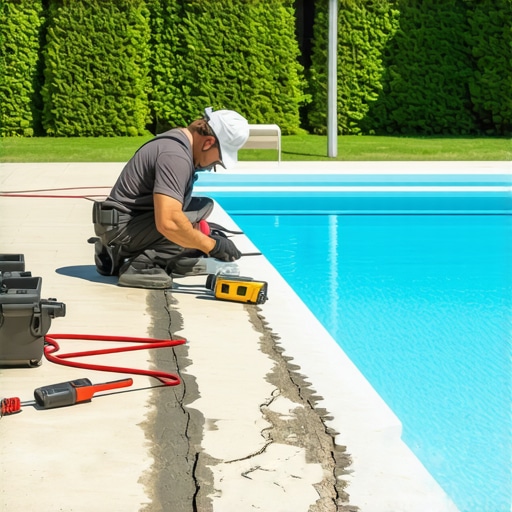
The Forensic Anatomy of a Failing Pool Deck: Why Your Repairs Are Cracking
I was standing on the edge of a residential pool in the heat of a Texas July when I saw it—a jagged hairline fracture that the homeowner had dismissed as ‘settling.’ I knelt down and ran my thumb across the surface. It wasn’t just a surface crack. When I inserted my digital scope into the crevice, the reality became clear: the sub-base had washed away, and the steel reinforcement was blooming into rust like a metallic flower. This wasn’t a job for a tube of caulk from a big-box store. This was a structural failure in the making. Most people think concrete is a solid, unmoving slab, but to a master mason, it is a living, breathing, and expanding lung. If you don’t understand the physics of hydration and the brutal reality of thermal expansion, your repair will fail before the first frost or the next 100-degree day.
“Adhesion of repair materials to a concrete substrate is the most critical factor for ensuring the longevity of a structural patch.” – ASTM C1059 Standard Specification for Latex Agents for Bonding Fresh to Hardened Concrete
The Physics of the ‘Burn’ and Thermal Expansion
In the southern heat, we deal with a phenomenon known as flash setting. When you throw your mud—that’s your mortar—onto a hot, dry concrete slab, the existing concrete acts like a sponge. It sucks the moisture right out of the new repair material. This prevents the chemical process of hydration from ever completing. You aren’t left with a bond; you’re left with a dried-out, crumbly biscuit of sand that will pop out the first time a kid jumps near it. To prevent this, we practice ‘saturated surface dry’ (SSD) techniques, drenching the old concrete until it can’t drink any more water before we ever start the repair. This is the difference between a handyman job and structural repointing for horizontal surfaces.
The Enemy Within: Hydrostatic Pressure and Soil Heaving
Concrete pool decks face a unique double-threat. On one side, you have the weight of the water in the pool; on the other, you have the soil. In areas with high clay content, the soil expands when it rains and shrinks when it dries. This creates a rhythmic ‘shoving’ against the deck. If the original builder didn’t use enough compaction or failed to install a proper 8-inch gravel base, you get ‘honeycombing’ underneath the slab. This is why brick paver driveway repair often involves more work underground than on the surface—if the base is soft, the top will follow. When I see a soldier course of bricks along a pool edge starting to tip, I know the hydrostatic pressure is winning the war.
The Solution: Advanced Materials for Permanent Bonds
We don’t use standard Type N mortar for pool decks. It lacks the flexural strength. Instead, we move toward fiber-reinforced mortars. These contain microscopic synthetic fibers that act like internal rebar, holding the mud together even when the ground moves. For the hairline cracks, I rely on advanced masonry adhesives that have a high polymer content. These aren’t just ‘glue’; they are chemical bonds that integrate into the microscopic ‘tooth’ of the concrete. This is the same level of precision required in stone balustrade restoration, where the weight and safety of the structure depend on the chemical integrity of the bond.
Micro-Zoom: The Hydration of Portland Cement
When we mix water with Portland cement, we aren’t just getting it wet. We are initiating a chemical reaction that creates calcium silicate hydrate (CSH) crystals. These crystals grow and interlock like a million tiny fingers. If you don’t use fiber-reinforced mortars, those fingers have nothing to grab onto when the deck undergoes thermal expansion. A pool deck can move up to a quarter-inch in a single day depending on the sun exposure. If your repair material is too rigid—much like using hard cement in a brick arch restoration where soft lime is needed—the repair will shatter the surrounding stone.
“For if the lime and the sand be of good quality, and the work be done with care, the wall will be of a lasting nature and will not crumble.” – Vitruvius, De Architectura
The Process: From Grinding to Sealing
To repair a crack correctly, you have to ‘chase’ it. I take an angle grinder and cut the crack into a V-shape. This creates more surface area for the mud to grab. If you just smear advanced masonry adhesives over the top, it’s a ‘Band-Aid.’ You need a slicker or a jointer tool to pack the material deep into the void, ensuring there are no air pockets. For the pool coping, specifically when dealing with intricate masonry birdsmouth cuts at the corners, the precision must be absolute. Any gap left behind is an invitation for water to seep in, freeze (if you’re in the north), or cause rebar rot (if you’re in the south).
Preserving the Facade: Beyond the Deck
A failing pool deck is often symptomatic of larger masonry issues on the property. I’ve seen homeowners spend $10,000 on a deck only to ignore a chimney cap replacement or a failing stone balustrade restoration project. Water is a patient enemy. It will travel from a cracked chimney down through the wall cavity and settle under your pool deck. This is why full repointing services are often a holistic necessity. Once the repair is set, we apply porous stone sealers. These sealers are ‘breathable.’ They allow water vapor to escape from the concrete while preventing liquid water from entering. If you use a non-breathable sealer, the vapor pressure will eventually blow the face of the concrete off—a process known as spalling.
The Professional Verdict: When to Panic
If your crack is wider than a quarter-inch and one side is higher than the other (a ‘vertical shear’), you have a soil stabilization issue. No amount of advanced masonry adhesives will fix a deck that is sinking into a void. In those cases, you need a forensic inspector to look at the drainage. But for the standard cracks, the ‘spiders’ that web across your sun-soaked deck, the fix is in the chemistry. Use the right fiber-reinforced mortars, respect the suction of the concrete, and never—ever—work on a dry slab. Do it once, do it right, or you’ll be calling me back in two years to chip out your ‘handyman special’ with a jackhammer. Treat your concrete with the same respect you’d give a brick arch restoration, and it will last another fifty years.