The Anatomy of a Pregnant Wall: Why Your Masonry is Failing
I stood looking at a sixty-foot stretch of segmental block that had developed a belly so pronounced it looked like it was about to give birth to a ton of wet clay and limestone. This wasn’t just a cosmetic issue; it was a structural catastrophe in slow motion. The homeowner thought they could fix it with a simple concrete patch or some masonry cleaning to hide the efflorescence. They were wrong. When I see a wall leaning at a twelve-degree angle, I don’t see stones; I see a massive failure of soil mechanics and a complete ignorance of lateral earth pressure. The original installer had built a ‘gravity wall’ far beyond its height limitations without a single inch of reinforcement. This is the ‘handyman special’ that keeps forensic masons like me in business.
“The primary cause of retaining wall failure is the lack of adequate drainage and the subsequent buildup of hydrostatic pressure, which often exceeds the structural capacity of unreinforced masonry.” – National Concrete Masonry Association (NCMA) Design Manual
The Physics of the Bulge: Hydrostatic Pressure and Soil Friction
To understand why we use geogrid, you have to understand the enemy: water. In the freeze-thaw belts of the North, water is a silent wrecking ball. When it gets trapped behind a wall, it saturates the soil, increasing its weight and reducing its internal friction angle. Then, the temperature drops. Water expands by 9% when it turns to ice. That expansion has to go somewhere, and it usually goes straight into the back of your failing retaining wall repair project. Without proper tuckpointing weatherproofing and drainage, the wall becomes a dam, and dams that aren’t designed to hold water eventually break. We talk about the ‘angle of repose’—the steepest angle at which a sloping surface formed of loose material is stable. When you exceed that with a vertical face, you need a skeletal system to hold the earth back. That is where geogrid comes in.
Micro-Zooming into Geogrid: The Polymer Skeleton
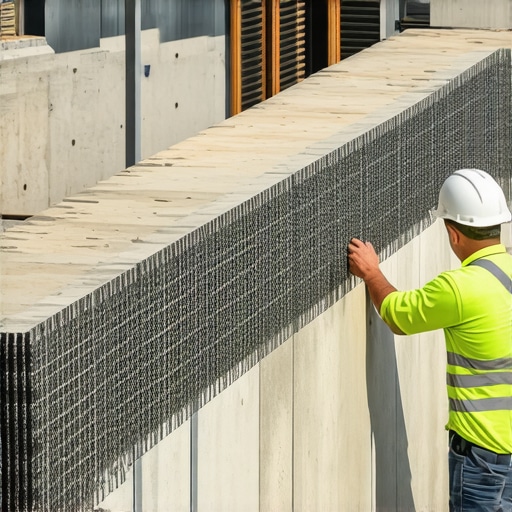
Geogrid isn’t just ‘plastic mesh.’ It is a high-tenacity polyester or polypropylene grid designed with specific aperture sizes to lock into the aggregate. When we talk about using geogrid to save a bulging retaining wall, we are talking about creating a ‘reinforced soil mass.’ The grid works through three mechanisms: lateral restraint, improved bearing capacity, and tension membrane effect. When you lay a course of block and ‘butter’ your joints—though in segmental work we’re usually dry-stacking—you must roll out the grid so it sits between the layers. The ‘tooth’ of the stone or the pins of the block lock into the grid, extending back into the soil by 70% to 100% of the wall’s height. This turns the entire hillside into a single, cohesive structural unit rather than just a pile of stones held up by hope. For high-stakes jobs, we even use digital twin masonry projects to simulate the load-bearing stresses before we ever break ground.
The Forensic Process: From Excavation to the ‘Deadman’
If you’re dealing with a concrete block foundation repair or a brick infill panel repair, you’re usually working in a confined space. But for a retaining wall, you have to go deep. You can’t just slap some ‘mud’ on the cracks. You have to excavate the ‘failure zone.’ We look for ‘honeycombing’ in the backfill—pockets of air where water has washed away the fines. We replace that junk with clean, angular 3/4-inch stone. Why angular? Because rounded stones roll like ball bearings; angular stones lock together like a puzzle. This aggregate is what the geogrid grabs onto. We also address the chimney damper repair mentality—the idea that you can just fix the top. No, the failure starts at the toe. We ensure the base course is buried at least six inches for every three feet of height. This prevents ‘kick-out’ at the bottom, which is the precursor to the ‘bulge’ in the middle.
“Properly designed soil reinforcement using geosynthetics converts the soil itself into a structural component, drastically increasing the factor of safety against sliding and overturning.” – ASTM D6637/D6637M Standard Test Method
Hardscape Truths: Why Pavers and Walls Fail Together
Often, a failing wall is preceded by a brick paver driveway repair call. The driveway starts to sink near the wall because the sub-base is migrating. The ‘slicker’ you make the surface, the more you realize that what’s underneath is what matters. If you don’t have a ‘soldier course’ or a proper edge restraint, everything moves. In freeze-thaw damage restoration, we see this constantly. The pavers heave, the wall bulges, and the homeowner asks for a concrete patch. I tell them: you’re asking for a Band-Aid for a broken femur. You need to excavate, install a perforated drain tile (the ‘weep system’), and layer your geogrid every two courses of block. This is the difference between a wall that lasts ten years and a wall that lasts a century. Don’t be the guy who does it twice; be the guy who understands the ‘suction’ of the soil and the chemistry of the polymers.
The Final Strike: Preserving Your Structural Investment
Whether you’re doing tuckpointing weatherproofing on an old facade or failing retaining wall repair on a modern estate, the principles remain the same: respect the physics of water and the weight of the earth. Modern ‘lick-and-stick’ masonry has made people forget that stone is heavy and dirt is fluid. Using geogrid is the only way to counteract the massive lateral forces of a saturated hillside. It’s not about the ‘pretty’ face of the wall; it’s about the hidden skeleton behind it. If you see a crack, don’t just fill it. Look at the lean, check the drainage, and if that wall is pregnant, call a forensic mason who knows how to use a ‘hawk’ and a ‘mud’ board but also understands the molecular tension of a biaxial geogrid. Do it once, or do it forever. That’s the masonry truth.