
The Ghost in the Wall: A Mason’s Warning
I remember my old man standing in front of a sprawling red-brick Georgian back in the late eighties. He didn’t look at the architecture; he looked at the white, powdery haze creeping up from the water table like a slow-moving fungal infection. He pulled out a piece of dark slate and scraped a bit of that white dust into his palm. ‘That’s the ghost of a bad job, kid,’ he told me. He explained that if we didn’t stop the salt from migrating now, any finish we put on that wall would peel off before the next season changed. He was talking about efflorescence, and thirty years later, I’m still fighting the same battle against the physics of water and salt. Most guys today just want to slap a stain on and collect the check, but if you don’t understand the ‘tooth’ of the brick and the chemistry of the bloom, you’re just putting expensive makeup on a corpse.
The Molecular Treachery of Soluble Salts
Efflorescence isn’t just a cosmetic nuisance; it is a diagnostic signal of a moisture crisis. At its core, it is the crystalline deposit of salts left behind when water evaporates from the surface of masonry. You have to look at your brick as a dense forest of microscopic capillaries. When the high-performance mortar mixes are used or the bricks are fired, they contain soluble salts—sodium, potassium, calcium. When rainwater or ground moisture penetrates the wall, it dissolves these salts. As the sun hits the face of the wall, it creates a vapor pressure differential, pulling that brine to the surface. The water vanishes, but the salt stays, crystallizing into that white crust. If you apply a stain over this, you are trapping those crystals. The resulting osmotic pressure is enough to blow the face off a brick—a process we call spalling.
“Efflorescence is the migration of a salt to the surface of a porous material, where it forms a coat. The essential process involves the presence of a salt, the presence of water, and a path for the water to reach the surface.” – BIA Technical Note 23
The Forensic Inspection: Finding the Leak
Before you even think about opening a bucket of stain, you have to find out why the wall is ‘weeping.’ In my experience, efflorescence on new brickwork often points to a failure in the chimney cap replacement or a lack of proper flashing. If the white stuff is concentrated at the top of the wall, your cap is leaking, or your brick arch restoration didn’t include a proper drip edge. If it’s at the bottom, you’ve got a rising damp issue. This is where foundation health comes into play. I’ve seen cases where a lack of foundation underpinning led to hairline fractures that allowed groundwater to bypass the damp-proof course. Sometimes I have to fly drone chimney inspections just to see the cracks in the crown that are feeding the wall with water. You have to kill the source, or the ghost will keep coming back. Even modern mortarless masonry systems can suffer if the drainage plane behind the veneer is clogged with ‘mud’ dabs from a sloppy crew.
The Chemistry of the Clean: More Than Just Soap
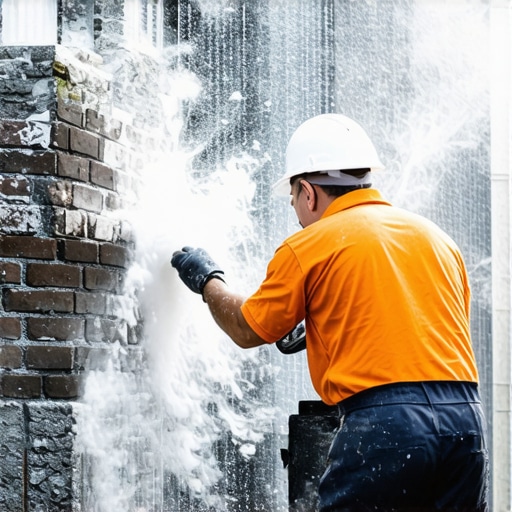
You can’t just power-wash efflorescence away. All that does is push the salt back into the brick, only for it to reappear three days later. You need a chemical intervention that neutralizes the salt and opens the pores of the brick. I use a mild acidic solution, but you have to be careful with the ‘suction’ of the brick. If the brick is bone-dry, it will suck the acid in too deep, causing ‘burning’ or ‘iron staining.’ You have to pre-wet the wall until it’s saturated but not dripping. This is what we call ‘SSD’ or Saturated Surface Dry. Then you apply your cleaner with a low-pressure sprayer, working from the bottom up to prevent streak-etching. Scrub it with a stiff natural-bristle brush—never wire, unless you want to leave behind metal fragments that will rust and ruin your tuckpointing job. For commercial tuckpointing, we often use a pressurized steam system to help dissolve the harder sulfate crusts that cold water won’t touch.
“Masonry units and mortar should be kept dry. If they become saturated, they should be allowed to dry before being used in the wall.” – ASTM C67/C67M Standard Test Methods for Sampling and Testing Brick
The ‘Butter’ and the ‘Tooth’: Preparing for the Stain
Once the salt is gone and the wall has been neutralized with a heavy water rinse, you have to let it breathe. I tell homeowners that a brick wall is a lung. If you seal it with a cheap, non-breathable acrylic, it will suffocate. When we prepare for staining, we are looking for the ‘tooth’—the microscopic roughness that allows the pigment to bite into the clay. This is especially critical on chimney rebuild services where the heat from the flue increases the thermal expansion of the brick. If the stain doesn’t have a chemical bond, the heat will delaminate it. We test the pH of the wall; if it’s too alkaline from the new tuckpointing mud, the stain will ‘soap’ and fail. You want a pH between 7 and 10 before you even think about pulling out the sprayer. If you’re working on an old historic facade, you might even need a lime-based wash rather than a modern stain to maintain the sacrificial nature of the mortar joints.
The Final Strike: Protecting the Investment
If you’ve cleaned the salts, fixed the foundation drainage, and ensured the chimney cap replacement is watertight, you are finally ready. But don’t get lazy now. The stain should be a siloxane or silane-based product that is vapor-permeable. This allows water vapor to escape while preventing liquid water from entering. It’s the difference between wearing a plastic bag and a high-end Gore-Tex jacket. I’ve seen 200-year-old arches that look brand new because the mason knew how to manage moisture. Don’t be the guy who ignores the white powder. Efflorescence is a warning. Listen to it, fix the physics, and then—and only then—give the wall its new color. Doing it twice is a hobby; doing it once is masonry. Avoid the ‘handyman special’ mentality and treat the brick with the respect its chemistry demands. That’s how you build a legacy that doesn’t wash away in the first spring rain.