
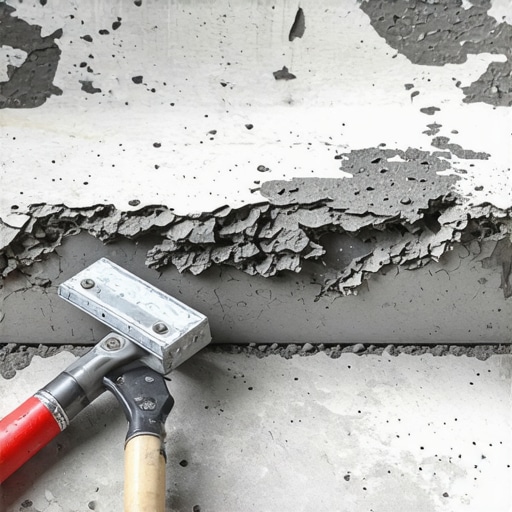
The Forensic Scene: The Anatomy of a Scabbed Step
I stood on a set of wide, sweeping concrete steps in the dead of February, watching a homeowner scrape at a grey, potato-chip-sized flake of concrete with the toe of his boot. He thought it was a bad batch of ‘mud’ from the local plant. I knew better. I knelt down, pulled my slicker from my back pocket, and pressed it into the exposed aggregate. What looked like a simple cosmetic flaw was actually a structural surrender. When I put my scope into a deeper fissure near the landing, I didn’t see solid portland cement; I saw the carbonated remains of a slab that had been strangled by its own chemistry. The homeowner wanted to rip the whole thing out—a twelve-thousand-dollar death sentence for a perfectly salvageable core. I told him to put the sledgehammer away. We weren’t going to pour a new slab; we were going to perform a masonry rescue after disaster.
The Microscopic Sabotage: Why Concrete Flakes
To understand why your steps are ‘spalling’—that’s the trade term for flaking—you have to micro-zoom into the hydration of tricalcium silicate. Concrete isn’t a static rock; it’s a living chemical reaction. When that reaction is interrupted by the freeze-thaw cycle, the physics of water expansion takes over. Water enters the capillary pores of the concrete. As the temperature drops, that water expands by exactly 9%. In a dense, air-entrained mix, there are microscopic voids that act like tiny pressure-release valves. But in cheap, hand-mixed ‘handyman specials,’ those voids don’t exist. The expanding ice has nowhere to go but out, popping the ‘face’ of the concrete off like a scab. This is worsened by de-icing salts, which create an osmotic pressure that draws even more water into the concrete matrix, leading to sub-surface crystallization that shatters the Interfacial Transition Zone (ITZ) between the cement paste and the aggregate.
“Scaling of concrete is generally caused by the use of de-icing chemicals on concrete that has low entrained air content or has been finished improperly, leading to a weak surface layer.” – American Concrete Institute (ACI) 302.1R
The Forensic Audit: Digital Twins and Slab Jacking
Before we touch a bag of sustainable masonry materials, we have to determine if the steps are just flaking or if the whole structure is failing. This is where digital twin masonry projects come into play for higher-end forensics. By creating a 3D digital model of the steps’ current state versus their original geometry, we can detect minute shifts in the foundation. If the steps are tilting away from the house, the issue isn’t just surface scaling; it’s soil settlement. In these cases, we don’t just ‘butter’ the top and pray. We utilize foundation slab jacking. We drill small holes through the slab and inject high-density polyurethane foam or a cementitious grout to ‘jack’ the steps back to level. This stabilizes the base, ensuring our surface repair doesn’t crack the moment the ground heaves in April.
The Restoration Protocol: Cleaning the Wound
You cannot fix a flaked step by just throwing new wet mud over old dry concrete. That creates a ‘cold joint’ with zero ‘tooth.’ The first step in concrete masonry unit restoration is aggressive mechanical preparation. You need to grind away every bit of loose, ‘punky’ material until you hit sound aggregate. I’ve seen guys try to skip this, just ‘painting’ a thin layer of mortar over the scales. That’s a ‘lick-and-stick’ mentality that leads to total failure in one season. You need to expose the pores of the concrete. If you don’t see the ‘grit’ of the original stone, you haven’t gone deep enough. Once ground, the surface must be cleaned of all dust. I prefer a high-pressure wash, but you have to be careful not to saturate the slab to the point of ‘bleeding,’ which will ruin the bond of your new material.
Robotic Masonry Repair and Modern Overlays
In the industrial sector, we’re seeing the rise of robotic masonry repair, where precision arms grind out damaged joints and apply repair mortars with a level of consistency a human hand can’t match. For a residential set of steps, you are the robot. You need a high-performance, polymer-modified cementitious overlay. These aren’t your standard bags of Quikrete. These materials are engineered with acrylic or SBR resins that provide massive tensile strength and ‘suction’ to the old substrate. They are essentially ‘super-glued’ concrete. When applying these, you must respect the ‘open time’ of the material. If the sun is beating down on a 90-degree day, the material will ‘flash set,’ burning the bond and leaving you with a chalky mess that will peel off by winter.
“The bond between the old concrete and the new overlay is the most critical link in the repair chain. Surface preparation is 90% of the success of any masonry restoration.” – International Concrete Repair Institute (ICRI)
The Finishing Touches: Staining and Sealing
Once the repair is cured, it often looks like a patchwork quilt of different greys. This is where masonry staining becomes your best friend. We use penetrating acid stains or water-based pigments that soak into the concrete rather than sitting on top like paint. This masks the repair and gives the steps a uniform, natural look. But we can’t stop there. Those steps need protection. To prevent future spalling, you must address the drainage. This might include retaining wall weep hole cleaning if the steps are flanked by walls, or even installing a retaining wall geogrid installation if the surrounding soil is pushing against the structure. Finally, we treat the masonry joint sand repair if there are pavers involved, and apply a high-quality silane-siloxane sealer. This chemical sealer doesn’t just sit on the surface; it reacts with the calcium hydroxide in the concrete to create a hydrophobic barrier that keeps water out while still letting the slab ‘breathe.’
The Verdict: Do It Once, Do It Right
Repairing flaked concrete is a battle against entropy and physics. It’s not about making it look ‘pretty’ for the weekend; it’s about restoring the structural integrity of the stone. If you ignore the chemistry of the bond or the physics of the freeze-thaw cycle, you’re just throwing money into a hole. But if you prep the surface until it’s raw, use high-grade polymer ‘mud,’ and seal it like your life depends on it, those steps will outlast the house they’re attached to. Don’t let a contractor tell you a full pour is the only way out. Most of the time, they just don’t have the patience for the ‘forensic’ work required to save what’s already there.