
The Forensic Scene: Beyond the Hairline Crack
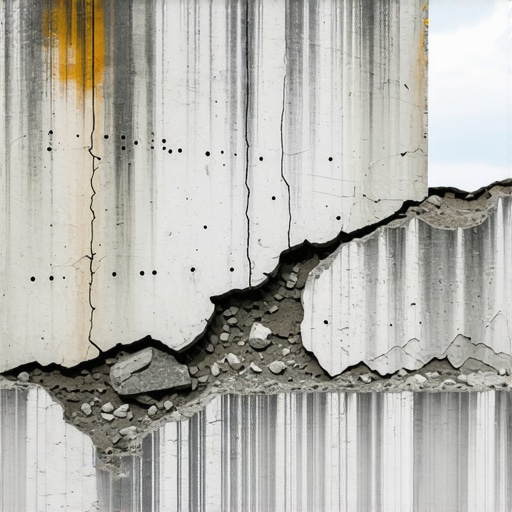
The homeowner thought it was just a hairline crack. A minor inconvenience in the basement corner, perhaps a weekend project for a tube of hardware store epoxy. But when I put my digital scope inside that fissure, the reality was grimmer than any surface-level assessment could reveal. I saw the structural steel was rusted to dust, the rebar having undergone a ‘rust burst’ expansion that had literally blown the concrete masonry unit restoration apart from the inside. This wasn’t just a crack; it was a symptom of a systemic failure in moisture management and structural physics. Most people see a gap and want to plug it, but as a third-generation mason, I know that plugging a moving crack is like trying to hold back a tidal wave with a cork. The reason most crack injections fail within six months isn’t just poor application—it’s a fundamental misunderstanding of the geotechnical forces at play.
The Physics of the Failure: Why Rigid Injections Don’t Work
Concrete and brick are not static materials. They are living, breathing entities that expand and contract with the mercury. In the cold North, we deal with the brutal freeze-thaw cycle. When water penetrates a joint, it doesn’t just sit there. It undergoes a molecular transformation, expanding by approximately 9% in volume. If you have injected a rigid, non-flexible epoxy into a crack, you have created a hard point. When that wall tries to move again—and it will move—the stress isn’t absorbed by the injection. Instead, the pressure is transferred to the ‘bond line,’ the interface where the injection meets the substrate. Because the injection is now harder than the surrounding material, the wall simply cracks again, usually a fraction of an inch away from the original repair. This is the ‘Cold Joint’ tragedy I see in almost every failed basement job.
“Water penetration is the single greatest threat to masonry durability.” – BIA Technical Note 7
When we talk about brick wall restoration, we aren’t just talking about aesthetics. We are talking about the ‘suction’ of the brick. If you’re performing mortar repointing services on a historic home and you use a high-strength Portland cement on a soft, pre-1940s brick, you are signing the wall’s death warrant. The old bricks are the ‘sponge,’ and the mortar must be the ‘sacrificial lamb.’ If the mortar is harder than the brick, the brick face will spall off during the first freeze. This is why re-pointing services must always match the compressive strength of the original materials. Using ‘Type S’ mortar when you should have used ‘Type O’ is a classic amateur mistake that leads to irreversible masonry damage.
The Anatomy of Proper Repointing and Tuckpointing
True tuckpointing curved walls or standard facades requires more than just a hawk and a slicker. It requires an understanding of the carbonation process. Unlike modern cement which ‘sets’ through a chemical hydration process, historic lime mortars ‘cure’ by absorbing carbon dioxide from the air over months, or even years. When I see a tuckpointing tools for DIY kit being used by a weekend warrior, I usually see ‘honeycombing’—voids left deep in the joint because the mud wasn’t packed tightly enough. You have to ‘butter’ the joints with precision. Brickwork pointing styles like the ‘weathered joint’ or the ‘grapevine joint’ aren’t just for show; they are designed to shed water away from the core of the wall. A poorly executed flush joint will hold water on its top edge, inviting the freeze-thaw demon to start peeling your facade.
Failing Retaining Walls and the Hydrostatic Pressure Myth
A failing retaining wall repair usually starts with the capstone. If the retaining wall capstone replacement wasn’t done with a proper drip edge, water is running straight down the back of the wall. This leads to hydrostatic pressure—the weight of water-saturated soil pushing against the masonry. No amount of fiber-reinforced mortars can stop a wall that is being pushed by ten tons of wet clay. You have to solve the drainage first. I’ve seen concrete masonry unit restoration projects where the contractor spent thousands on ‘lick-and-stick’ veneer but didn’t put a single weep hole in the base course. Within one season, the ‘lick-and-stick’ was on the ground because the vapor pressure from the saturated blocks literally pushed the stones off the wall.
“Mortar shall be classified as Type M, S, N, or O in accordance with the proportion specifications.” – ASTM C270
The chemistry of fiber-reinforced mortars is impressive, offering better tensile strength than traditional mud, but it’s not a magic bullet. These materials are best used for surface stabilization and preventing micro-cracking during the curing phase. In a forensic sense, I look for the ‘tooth’ of the repair. If the old joint wasn’t ground out to a minimum depth of twice the joint width, the new mortar has no mechanical bond. It’s just sitting there, waiting to fall out. Professionals know that you don’t just ‘skim coat’ a joint; you excavate it until you reach sound material.
The Hard Truth About Moisture and Masonry
In hot climates, the enemy changes from ice to thermal expansion. A long soldier course or a run of standard stretchers will expand significantly in the Texas sun. Without relief joints, the wall will ‘bow’ or develop vertical cracks. If you inject these with a rigid material, you’ve essentially locked a spring in its compressed position. When the sun goes down and the wall tries to shrink, it will tear itself apart. This is why understanding the specific geotechnical and climate logic of your region is mandatory. You don’t treat a chimney in Seattle the same way you treat a foundation in Phoenix.
If you’re looking at a crack in your masonry, don’t reach for the injection gun first. Reach for a level and a moisture meter. Is the wall plumb? Is the soil saturated? If you don’t address the root cause—be it settlement, hydrostatic pressure, or material mismatch—you’re just decorating a disaster. Masonry is the art of managing gravity and water. Respect the physics, or the physics will disrespect your wallet. Do it once, with the right materials and the right ‘mud,’ or prepare to do it every six months until the wall finally gives up the ghost.