
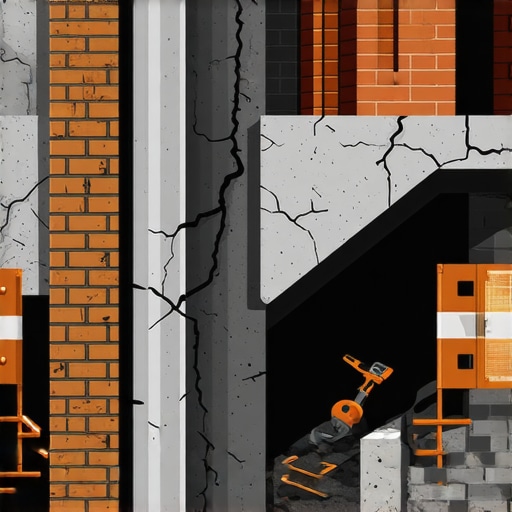
The Forensic Scene: When a Hairline is a Heart Attack
The homeowner in the high-end suburb of the North Shore thought it was just a hairline crack, a cosmetic nuisance behind the hydrangeas. She wanted a quick patch, maybe some cheap caulk and a coat of paint. But when I slid my fiber-optic scope into that 1/8-inch fissure, I didn’t see solid masonry. I saw a tomb. The internal structural brick ties, those critical steel sinews holding the outer wythe to the backup wall, were gone. They hadn’t just rusted; they had oxidized into a brittle, orange powder that offered zero lateral stability. The entire brick facade was bowing outward, held up by nothing but gravity and luck. This is the reality of forensic masonry: by the time you see the symptom, the disease has often reached the bone.
The Crack Whisperer: Decoding the Language of Failure
To the untrained eye, a crack is a crack. To a third-generation mason, a crack is a map of the forces trying to tear your home apart. We look for the vectors. A stair-step crack following the mortar joints usually signals differential settlement—one part of your foundation is sinking faster than the rest. Perhaps the soil wasn’t compacted properly, or a localized leak is washing away the fines in the subgrade. However, a horizontal crack midway up a basement wall is a different animal entirely. That is the calling card of hydrostatic pressure. When the clay soil outside becomes saturated, it expands, exerting thousands of pounds of lateral force against the wall until the masonry unit actually snaps. This isn’t just about ‘mud’ and bricks; it’s about physics and the unrelenting weight of the earth.
“Water penetration is the single greatest threat to masonry durability. Moisture is the catalyst for almost every form of masonry degradation, from sulfate attack to freeze-thaw spalling.” – BIA Technical Note 7
The Chemistry of the ‘Mud’: Why Your Repointing Fails
I see it every week: a well-meaning handyman takes a bag of modern Type S Portland cement and slaps it into a 100-year-old brick wall. He thinks he’s making it ‘stronger.’ He’s actually signing its death warrant. Old bricks, fired in kilns decades ago, are relatively soft and porous. They need to breathe. If you pack a soft brick with a rock-hard, non-permeable modern mortar, the moisture gets trapped. When the temperature drops and that water expands by 9%, it can’t escape through the mortar. Instead, it blows the face right off the brick. We call this spalling. Proper
mortar repointing services
require a deep understanding of the ‘sacrificial principle.’ The mortar must always be slightly softer and more permeable than the masonry unit itself. This ensures that any stress or moisture-related movement sacrificial occurs in the joint, which is cheap to fix, rather than in the brick, which is permanent to lose.
The Anatomy of the Chimney: The House’s Most Vulnerable Limb
Your chimney is a vertical pier exposed to the elements on all four sides. It takes the worst of the wind, rain, and thermal shock. If you haven’t looked at your
chimney flashing repair
needs lately, you’re asking for a ceiling leak. The flashing is the interface between the masonry and the roof—a critical junction where two different materials move at different rates. If that seal is compromised, water bypasses the masonry entirely and rots your rafters. Furthermore, a failing flue or the need for
chimney damper repair
can lead to more than just drafts; it can allow acidic combustion byproducts to eat away at the interior mortar joints from the inside out. Once that happens, the structural integrity of the entire stack is compromised. We often recommend
tuckpointing brick walls
on chimneys specifically with lime-rich mixes to allow for the massive thermal expansion that occurs during every winter fire.
The Science of Restoration: From Ties to Veneer
When the internal skeleton of the wall fails, we talk about
structural brick ties replacement
. Modern helical ties can be driven through the mortar joints into the backup structure, cinching the building back together without tearing down the whole wall. It’s surgical masonry. For those dealing with modern aesthetics,
stone veneer repair
often reveals the dark side of ‘lick-and-stick’ construction. Without a proper drainage plane and a weep system, water gets trapped behind the stone, liquefying the lath and rotting the sheathing. We don’t just ‘butter’ the back of a stone and hope it stays; we ensure the ‘tooth’ of the scratch coat is sufficient and the moisture management is flawless. Even a
brick patio restoration
requires more than just aesthetics; it’s about the compaction of the base and the ‘suction’ of the units to ensure they don’t migrate over time.
“Cracks larger than 1/16 inch often indicate underlying structural movement that requires forensic investigation to determine the root cause before remediation.” – ASTM C1558
Modern Innovations: Self-Healing Concrete and Beyond
The industry is changing. We are now seeing
self-healing concrete foundations
that utilize crystalline technology. These additives, when exposed to water entering a new crack, react to form insoluble crystals that plug the gap. It’s like a biological immune system for your basement. While this is a ‘game-changer’—though I hate the term—it doesn’t replace the need for basic maintenance like
facade cleaning
to remove salts and atmospheric pollutants that cause sub-florescence. Whether you need
flush pointing services
for a sleek, modern look or a historical restoration, the rule remains the same: respect the materials, or the materials will fail you. Don’t let a ‘handyman special’ turn a maintenance task into a demolition project. A master mason knows that the best repair is the one that works with the building’s natural movement, not against it.