
The Death of the Facade: Why Superficial Repairs Are a Death Sentence
I recently stood in front of a 1914 Victorian where the homeowner was beaming with pride over a recent crumbling mortar joint repair. To his untrained eye, it looked clean. To me, it looked like a crime scene. A previous contractor had performed what we call ‘shmearing’—simply buttering a thin layer of new mud over the old, weathered joints. I took my tuckpointer’s hammer and gave a light tap to a soldier course above the window. A three-foot section of mortar simply sloughed off, hitting the dirt like dried grey skin. This is the reality of masonry failure: if you don’t respect the physics of the bond, you are just decorating a disaster.
“Mortar should always be weaker than the masonry units so that any stress-induced cracking occurs in the mortar joints where it can be easily repaired.” – BIA Technical Note 1
My old mentor, a man who had more limestone dust in his lungs than oxygen, used to say that a brick joint is like a marriage; it only works if there is deep, mutual penetration. He wouldn’t let a man on his crew touch a hawk or a slicker until they understood the ‘two-to-one’ rule of grinding. If your joint is a half-inch wide, you better be grinding back a full inch. Anything less, and you’re just creating a cold joint that will pop the first time the temperature swings. This is especially true in chimney structural repair, where the masonry is attacked by acidic flue gases from the inside and driving rain from the outside.
The Micro-Physics of the Mechanical Bond
To understand why deep grinding is mandatory, we have to zoom into the cellular level of the brick. High-quality historic brick salvage from the early 20th century is incredibly porous. When we mix our mud—ideally a lime-rich Type O or K for restoration—the water carries fine cementitious particles into the ‘tooth’ of the brick. As the mortar cures, these particles crystallize within the brick’s own pores. This is the mechanical bond. When you fail to grind deep enough, you are trying to bond new mortar to a surface that is already ‘choked’ with old, carbonated lime dust. There is no suction. There is no grip. It is a failure waiting for the first freeze.
In northern climates, the enemy is the hydraulic pressure of the freeze-thaw cycle. Water is a relentless wedge; it expands 9% when it turns to ice. If you have a thin skin of hard Portland cement over a soft, crumbling interior, that water gets trapped. It can’t breathe out. So, it pushes. It pushes until the face of your historic brick spalls off, leaving a pile of red dust on the porch. This is why flush pointing services must be preceded by a surgical extraction of the failing material. We aren’t just cleaning the joint; we are excavating a foundation for the new mud.
The Anatomy of a Professional Outdoor Fireplace Rebuild
An outdoor fireplace rebuild presents even harsher conditions than a standard wall. Here, we deal with thermal shock. The masonry expands rapidly when the fire is lit and contracts as it dies. If the crumbling mortar joint repair was done with a shallow grind, the differential expansion rates between the old core and the new skin will cause immediate delamination. I’ve seen brick column repair jobs on massive estate gates fail for the same reason—the sheer weight of the structure causes micro-shifts that a thin ‘butter’ coat cannot accommodate.
“Water penetration is the single greatest threat to masonry durability.” – BIA Technical Note 7
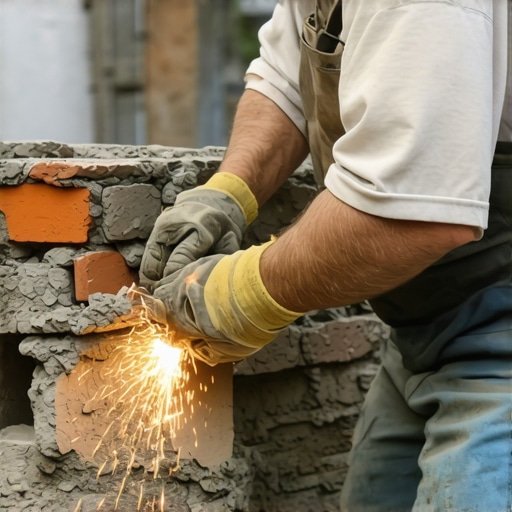
When we approach a chimney repair services project, we start with diamond-tipped blades and dust-shrouded grinders. We are looking for ‘sound’ material. Sometimes that means going back two inches until we hit mortar that hasn’t been compromised by a century of carbonic acid. Once the ‘U’ shape is cut—never a ‘V’ shape, which creates a wedge that will spit out the new mortar—we begin the process of brick efflorescence removal. Those white, salty stains you see are the masonry’s way of crying; it’s the sound of minerals being leached out by internal moisture. If you don’t stop the moisture by deep-grinding and repointing, the efflorescence will return to ruin your brick infill panel repair within months.
Green Roofing and the New Masonry Frontier
Modern trends like green roofing masonry integration add a new layer of complexity. When you put a living ecosystem on a roof, you are essentially strapping a wet sponge to the top of your building. The parapet walls and chimneys are now under constant moisture attack. In these scenarios, flush pointing services must be executed with a precision that borders on the fanatical. We use specific lime-putty mixes that allow for high vapor permeability, ensuring the wall can ‘sweat’ out the moisture from the roof garden without compromising the brick column repair holding up the structure. It’s a delicate balance of ancient chemistry and modern engineering.
Ultimately, masonry is a game of patience and grit. The ‘handyman special’ involves a bag of premix and a trowel; a forensic restoration involves a grinder, a vacuum, and a deep respect for the historic brick salvage we are trying to protect. You can pay for the deep grind now, or you can pay to replace the entire wall when the face of the bricks starts falling off like wet bread. In this trade, there are no shortcuts—only long-term consequences. Do it once, do it deep, and let the building breathe for another hundred years.