
I once walked into a basement where the homeowner thought a ten-dollar tube of silicone caulk would fix a hairline crack. To the untrained eye, it looked like a minor settlement issue, a natural part of a house ‘finding its feet.’ But when I pushed my borescope through the fissure and into the dark space behind the concrete, I saw the structural reality: the footing wasn’t just cracked; it was suspended over a four-inch void. The expansive clay had retreated during a record-breaking drought, leaving the entire southwest corner of the structure hanging on nothing but hope and a few rusted rebar ties. This is the forensic reality of masonry in regions with high-plasticity soil. When the ground beneath your feet decides to move, your brickwork becomes a giant, brittle accordion.
The Physics of the Stair-Step Crack
Most people see a crack and think about the wall. I look at a crack and think about the soil’s ‘Void Ratio’ and ‘Hydrostatic Pressure.’ When we see a stair-step crack following the mortar joints in a brick veneer, the house is telling us that the load is no longer being distributed evenly across the footing. Masonry is incredibly strong under compression—you can stack bricks to the moon—but it has the tensile strength of a dry biscuit. As the soil shrinks, the foundation drops, and the masonry is forced to span a gap it was never designed for. This is where brick quoin repair becomes a necessity, as the corners (the quoins) are often the first to shear away from the main body of the wall.
“The stability of a masonry wall depends entirely on the integrity of its support system and the geotechnical conditions of the site.” — BIA Technical Note 28B
The movement isn’t just vertical. Soil heaving and lateral pressure can push a wall inward, a phenomenon known as ‘bowing.’ This is often exacerbated by poor foundation waterproofing. When water saturates the backfill around a foundation, it adds thousands of pounds of weight. If that water freezes, the 9% expansion of the ice crystals creates a ‘frost heave’ that can snap a concrete block wall like a toothpick. This is why we don’t just ‘patch’ cracks; we address the geotechnical failure.
Helical Piers: The Surgical Strike on Settlement
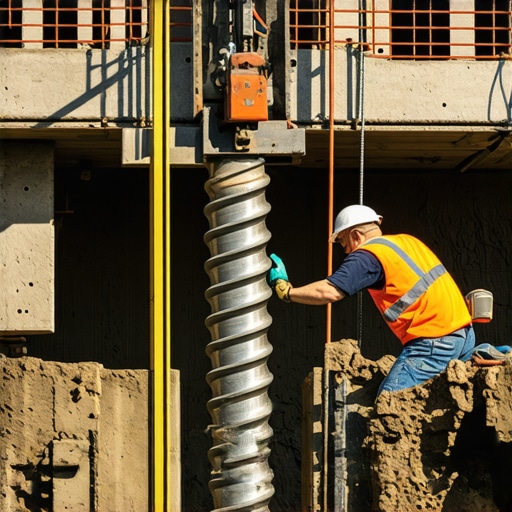
When a foundation is sinking, we have two choices: we can try to ‘float’ it with high-density foam (the ‘Band-Aid’ approach), or we can reach down into the earth’s crust to find something solid. This is why we use helical piers. Think of a helical pier as a massive, industrial-grade screw. We aren’t just driving a pipe into the ground; we are ‘torquing’ it down until it hits a load-bearing strata—usually dense sand or bedrock—that can actually support the weight of the structure.
The science here is in the ‘Flighting’—the screw-like blades on the end of the pier. As the hydraulic motor drives the pier, we monitor the torque. There is a direct mathematical correlation between the torque required to turn the pier and the load-bearing capacity of the soil. Once we hit the required depth, we attach a heavy-duty steel bracket under the foundation. Then, using self-leveling masonry lifts, we can often jack the house back to within millimeters of its original elevation. But be warned: lifting a house is a violent act. The ‘Mud’ (mortar) that has been sitting in a stressed state for years will likely crumble, requiring professional mortar matching services to ensure the new repairs don’t look like a patchwork quilt of different greys and tans.
The Chimney: The Canary in the Coal Mine
If you want to know if your house is sinking, look at your chimney. Because a chimney is a tall, heavy, and relatively narrow column, it often sits on its own small footing. This makes it the first part of the house to show signs of distress. I’ve seen chimneys lean so far away from the house that you could fit a whole hand in the gap. In these cases, chimney rebuild services aren’t just about aesthetics; they are about safety. A leaning chimney often has a compromised chimney flue liner installation, which can leak carbon monoxide or sparks into the wall cavities.
When we stabilize a chimney with piers, we also have to look at the interior. A shifting chimney often cracks the internal firebox. We frequently have to perform chimney heat shield installation to seal those internal cracks and prevent a house fire. It is a holistic forensic process. You can’t just fix the ‘lean’; you have to fix the thermal integrity of the stack.
“Foundations must be designed to resist the forces of the soil and any hydrostatic pressure present to ensure long-term structural performance.” — ASTM D3740
Beyond the Pier: Protecting the Masonry Facade
Once the piers are set and the house is stable, the work moves from the dirt to the ‘Slicker.’ We have to repair the ‘Honeycombing’ in the concrete and the cracked joints in the brick. This involves brickwork pointing styles that match the original architecture. You can’t just slap some Type S mortar into a 100-year-old wall; the ‘Mud’ has to be softer than the brick, or the next time the ground moves, the brick faces will ‘spall’ (pop off). We call this the sacrificial principle: the mortar should fail before the brick does.
To prevent future issues, we also look at retaining wall capstone replacement if the drainage on the property is pouring water toward the house. Water is the architect of ruin. Once we’ve fixed the structural issues and repointed the joints, applying brickwork sealants application can provide a silane/siloxane barrier that keeps the moisture out while still allowing the masonry to ‘breathe.’ If you trap moisture inside a brick wall with a cheap ‘lick-and-stick’ sealant, you’re just inviting the freeze-thaw cycle to eat your house from the inside out.
The Cold Reality of Foundation Repair
There are plenty of ‘handyman specials’ who will offer to fill your foundation cracks with epoxy and call it a day. That’s like putting a fresh coat of paint on a sinking ship. A ‘Cold Joint’ in a foundation—where new concrete meets old—is a permanent weak point. Without the mechanical connection of helical piers or significant excavation and waterproofing, that crack will open back up the next time the soil’s moisture content changes. You do it once, or you do it twice. Professional masonry forensics is about understanding that the house and the soil are in a constant, invisible dance of physics and chemistry. If you don’t respect the ‘tooth’ of the stone and the power of the earth, the earth will always win.