
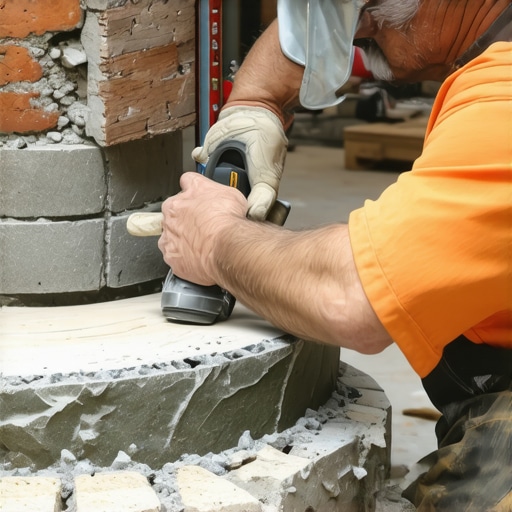
The call came in as a routine chimney leak detection for a Queen Anne Victorian with a beautiful rounded turret. The homeowner thought it was just a hairline crack, a minor annoyance from a wet spring. But when I put my scope inside that cavity, the reality was much grimmer. I saw the structural steel lintels had been reduced to orange flakes—rust-jacking so severe it was physically lifting the soldier course of bricks. The culprit wasn’t just age; it was a previous repair job where a local handyman had tried to ‘fix’ the circular mortar joints with a standard straight jointer. Looking at the facade was like looking at a broken record. Because a standard slicker is a straight piece of steel, it can’t follow the arc of a radius. It leaves ‘flat spots’ in the mortar, creating tiny ledges where water sits, dwells, and eventually migrates into the core of the wall. This is where professional masonry restoration separates the craftsmen from the guys just looking for a paycheck.
The Geometry of Failure: Why Radius Work Requires Custom Tooling
When you are dealing with circular masonry features—whether it is a chimney crown repair or a rounded garden wall—you are fighting the physics of the curve. A standard 6-inch jointer is a linear tool. When you press it against a curved joint, it only makes contact at two points. The middle of the tool remains ‘proud’ of the brick, or worse, the ends dig into the brick faces, scarring the ‘fire’ or the protective outer skin of the clay. This scarring is the beginning of the end. Once you break the fire of a brick, you expose the porous interior to the freeze-thaw cycle. In the masonry world, we call this ‘opening the door to spalling.’ Water penetrates, freezes, expands by 9%, and literally pops the face off the brick.
“Mortar joints should be slightly softer than the masonry units they bind together to ensure that the mortar is the sacrificial element in the wall system.” – BIA Technical Note 20
On a radius, the joint itself is often wedge-shaped. If you are using standard rectangular bricks on a curve, the ‘head joint’ (the vertical one) is wider at the face than it is at the back. If you don’t ‘butter’ those bricks with the right consistency of ‘mud’—what we call mortar—you end up with massive voids inside the wall. These voids, or honeycombing, become reservoirs for water. When the wind-driven rain hits that facade cleaning can’t even touch the deep-seated issues; the water finds those pockets and stays there, leading to a slow-motion explosion of the masonry unit from the inside out.
The Chemistry of the ‘Mud’: Why Your Mix Is Killing Your Brick
One of the biggest sins in masonry repair services today is the use of high-Portland cement mixes on historic structures. If your house was built before 1940, it was likely laid with lime-based mortar. Lime mortar doesn’t ‘set’ like concrete; it ‘cures’ through a process called carbonation. Over decades, the lime (calcium hydroxide) reacts with CO2 in the air to turn back into limestone (calcium carbonate). This is a slow, beautiful chemical dance that allows the wall to ‘breathe’ and even ‘self-heal.’ When a micro-crack forms in a lime joint, rainwater dissolves a bit of the free lime and redeposits it into the crack—a process known as autogenous healing. When some ‘pro’ comes in and performs historic tuckpointing using a hard Type S Portland mix, they are effectively installing a rigid glass rod between two soft marshmallows. The brick wants to expand and contract with the sun. The Portland mortar won’t budge. Something has to give, and it’s always the brick that loses. This leads to the catastrophic face-shearing we see in failed masonry water damage repair jobs.
“Water penetration is the single greatest threat to masonry durability.” – BIA Technical Note 7
The Forensic Approach to Masonry Waterproofing Solutions
When I’m called for foundation crack repair or chimney crown repair, I don’t just reach for a tube of caulk. Caulking is a ‘handyman’s band-aid.’ Real masonry waterproofing solutions involve managing the flow of moisture through the wall. On a circular feature, the ‘wash’ or the slope of the chimney crown is critical. If the crown doesn’t have a proper ‘drip edge’ or if the radius is uneven, water will hug the masonry and travel down the face via capillary action. We use a hawk and a slicker to create a ‘concave joint’ that specifically sheds water away from the center. For curved work, I often have to grind my own custom jointers from spring steel to match the specific radius of the building. It’s the difference between a suit off the rack and one from a master tailor.
Tile Grouts and the ‘Lick-and-Stick’ Disaster
I’ve seen a rising trend of people using tile grouts on masonry for exterior repairs. This is insanity. Interior tile grout is designed for a controlled environment. It has no business being exposed to UV radiation and thermal expansion. When used for facade cleaning or minor repairs, it lacks the ‘tooth’—the mechanical bond—to stay attached to the brick. It eventually shrinks, cracks, and falls out, leaving a ‘cold joint’ where the new material meets the old. These cold joints are highways for moisture. True professional masonry restoration requires a mortar that matches the original in color, texture, and—most importantly—compressive strength. If you see a contractor pulling out a bag of generic grout for your historic chimney, fire them before they touch the hawk.
The Long Game: Preserving the Radius
Repairing a curved wall or turret isn’t just about aesthetics; it’s about preserving the structural integrity of the home. Foundation crack repair on a radius requires an understanding of how weight is distributed differently than on a straight wall. A curved wall acts like an arch on its side; it’s incredibly strong under compression but vulnerable to lateral ‘hydrostatic pressure’ from saturated soil. If you don’t address the drainage behind the wall, no amount of mortar work will save it. You have to ensure that the moisture has a way out, usually through properly placed ‘weep holes’ that are often missing in modern ‘lick-and-stick’ veneer jobs. Do it once, do it right, or you’ll be doing it again when the next freeze hits.