
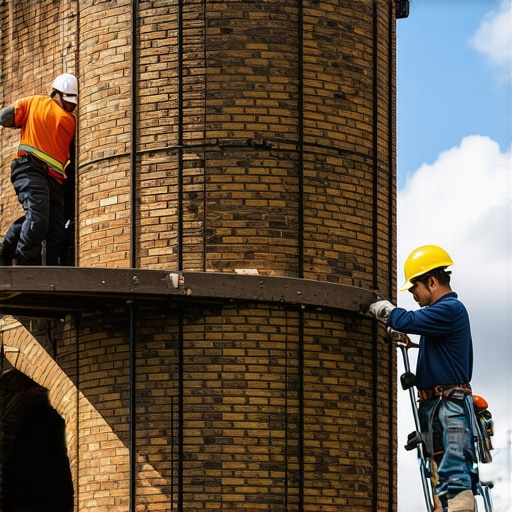
The Tragedy of the Squared Slicker
I once walked onto a job site in an old industrial corridor where a crew was trying to repoint a 1920s radial brick chimney with standard 6-inch straight slickers. From the ground, it looked like they were working hard. From my perspective on the scaffolding, it was a crime scene. Every joint they finished was flat, creating a tiny, microscopic shelf at the top and bottom of the mortar bed because a straight tool cannot follow the radius of a curved brick. Those shelves are water traps. In three winters, those traps will fill with moisture, freeze, and pop the faces right off those historic bricks. This is the reality of masonry forensics: the wrong tool doesn’t just look bad; it destroys the structure through physics. My mentor, an old-school mason who spent forty years on industrial stacks, used to say that if you didn’t have the right curve in your tool, you were just ‘buttering the bread for a disaster.’ He’d spend hours grinding down custom steel jointers to match the specific diameter of the stack we were working on. If the tool didn’t glide like a skate on ice along that curve, he wouldn’t let us touch the mud to the wall.
“Mortar joints in circular masonry must be finished to a profile that ensures rapid shedding of water, as the radial geometry increases the surface area exposed to wind-driven rain.” – BIA Technical Note 10B
The Geometry of Failure: Why Flat Tools Kill Curves
When you are tuckpointing curved walls, you aren’t just dealing with aesthetics; you are managing the vector of water runoff. In a standard flat wall, water runs down. In a circular chimney, water wraps. Due to the Coanda effect and wind vortex shedding around a cylinder, moisture is often pushed sideways and upwards simultaneously. If a mason uses a standard flat jointer on a radial brick, they leave ‘shingled’ edges. These edges break the capillary break. Once water gets behind that mortar skin, the high-suction nature of old lime-based bricks will pull that moisture into the core. In a freeze-thaw environment, that water expands by 9%, and because the mortar is usually harder than the weathered brick, the brick loses the fight. This is how we get spalling—the slow, painful death of a chimney. Specialist curved tools, or ‘slickers,’ are designed to create a concave or ‘V’ joint that is perfectly concentric with the chimney’s radius. This ensures the mud is packed tight against the tooth of the brick without leaving any ledges.
The Physics of the Radial Joint
Circular masonry is a marvel of compressive strength, but it’s a nightmare for thermal expansion. A chimney undergoes massive thermal cycling—internal temperatures can reach 800 degrees Fahrenheit while the exterior is at sub-zero. This creates a massive thermal gradient. In a circular structure, the entire mass expands radially. If you’ve used a modern, rigid Portland-based mortar (Type S or M) instead of a historically appropriate Type O or K lime mortar, the chimney has no room to breathe. It’s like putting a steel band around a balloon and then trying to blow it up. The mortar must be the sacrificial element. We talk about ‘breathability,’ but what we really mean is vapor permeability and low compressive strength. The mortar must be softer than the brick. This is especially true in brick arch restoration and circular stacks where the geometry locks the units in place. For modern applications, we are seeing the rise of advanced masonry adhesives and mortarless masonry systems in residential hardscaping, but for a structural chimney, the ‘wet’ trade and the chemistry of lime carbonation remain king.
“The selection of mortar for historic masonry must prioritize lower compressive strength and higher water vapor transmission rates than the masonry units themselves to prevent irreversible structural damage.” – ASTM C270 Standards
Modern Tech in an Old World Trade
We are now moving into the era of digital twin masonry projects. For massive restoration jobs, we use LiDAR to create a 3D model of the chimney before we ever set up the pipe scaffolding. This allows us to see where the stack is leaning or where the ‘bulge’ from rusted internal rebar—often called ‘mushroming’—is occurring. We can even 3D print custom templates for 3D printed masonry repairs to replace missing ornamental pieces. But even with all this tech, the man on the wall still needs to know how to butter a brick. If you’re doing a fire-rated masonry installation, the precision of the joint is what prevents hot gases from escaping the flue and hitting the structural timber of the house. This is where fire-rated masonry installation techniques overlap with forensic inspection. I’ve seen chimneys where the ‘lick-and-stick’ veneer on the outside looked great, but the internal wythe was a honeycomb of voids because the mason didn’t have the right curved tools to reach the back of the radial joint.
Moisture Management and the Green Frontier
One of the biggest threats to the base of these chimneys today is green roofing masonry integration. Everyone wants a living roof, but they don’t realize that a garden bed sitting against a brick chimney is basically a wet sponge. Without a proper retaining wall drainage upgrade mindset applied to the chimney flashing, the constant hydrostatic pressure will push moisture into the basement or the hearth. You need a retaining wall capstone replacement strategy for the chimney crown itself. A flat wash on a chimney crown is a failure. It needs a drip edge and a slight pitch, just like a retaining wall capstone. If the crown fails, the whole stack is toast. I always recommend a high-polymer modified mortar for the crown, but for the tuckpointing curved walls below, we go back to the soft stuff. It’s about understanding where to be rigid and where to be flexible. Masonry isn’t a static thing; it’s a slow-motion dance of minerals and water. If you try to fight the physics with cheap tools and hard cement, you’ll lose every time. Do it once, do it right, and use a tool that matches the curve of the history you’re trying to save.