
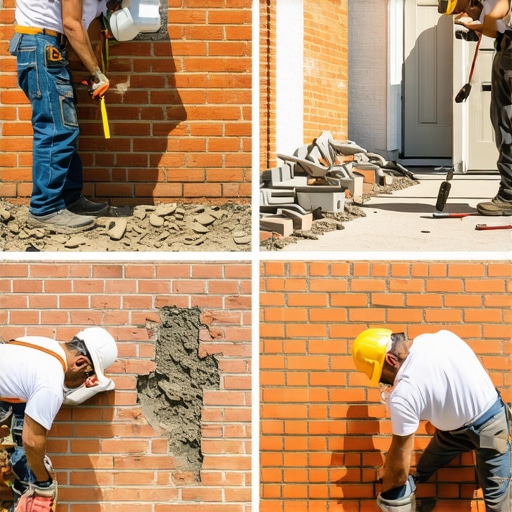
The Forensic Scene: A Facade in Agony
The homeowner stood there with a plastic squeeze bag in his hand, looking at a 1920s Tudor revival that was weeping. He thought it was just a hairline crack, a cosmetic blemish on a century of history. But when I put my digital scope inside the void he had ‘sealed’ with a hardware store DIY kit, the reality was grim. I saw that the structural steel lintel above the window was rusted to dust, expanding like a puff pastry and blowing the soldier course bricks right out of their seats. By using a high-strength, non-breathable sealant from a kit, he hadn’t fixed a leak; he had built a dam. The water was trapped behind a wall of Portland-heavy ‘mud,’ and the winter freeze was currently eating the faces off his historic clay bricks. This is the reality of forensic masonry: most of my work isn’t fixing 100-year-old mistakes; it is fixing 6-month-old DIY disasters.
“Water penetration is the single greatest threat to masonry durability. Moisture trapped within a wall system through improper mortar selection or lack of drainage will inevitably lead to cyclic freeze-thaw damage.” – BIA Technical Note 7
The Chemistry of Failure: Why ‘Mud’ Isn’t Just Mud
To understand why those $30 tuckpointing kits are a death sentence for your home, you have to look at the microscopic level. Modern masonry kits are almost always packed with Type S mortar—a high-strength mix heavy on Portland cement. This is great for building a skyscraper, but it is poison for a pre-1940s home. Historic bricks were fired at lower temperatures, making them softer and more porous than the rocks we bake today. In the masonry world, we live by a sacred rule: the mortar must always be softer than the brick. This is the sacrificial principle. When the house shifts or the temperature swings, the mortar joint is supposed to take the stress and crack. You can repoint a joint for a few hundred bucks. You can’t replace a shattered brick facade without a second mortgage.
When you ‘butter’ a joint with that hard DIY stuff, you create a rigid cage. When the wall expands in the July sun, the soft brick has nowhere to go. It crushes against the hard mortar, and the face of the brick pops off. This is brick spalling prevention 101. Once that hard outer ‘crust’ of the brick is gone, the soft interior is exposed like an open wound. It begins to soak up water like a sponge, leading to structural repointing needs that go far beyond a simple cosmetic touch-up. True professional masonry restoration requires understanding the ‘tooth’ of the stone and the suction rate of the unit.
The Physics of the Freeze-Thaw Cycle
In northern climates, water is the enemy. It expands approximately 9% when it turns to ice. If you have used a cheap kit to ‘slick’ your joints, you have likely created honeycombing behind the surface. This happens when the new mortar doesn’t properly bond to the old, leaving a hidden cavity. Water finds its way in—it always does—and when the temperature drops, that 9% expansion acts like a hydraulic jack. It pushes the mortar out, creating a cold joint where the new material simply peels away from the old. This is why foundation waterproofing is a system, not a sealant. If the moisture is coming from the ground up through capillary action, ‘sealing’ the outside of the brick just traps the salt and minerals inside, a process called efflorescence that eventually turns to subflorescence, exploding the brick from the inside out.
“Mortar for restoration of historic masonry should be matched in color, texture, and especially in compressive strength and vapor permeability to the original materials.” – ASTM C270 Standards for Unit Masonry
Beyond the Trowel: The Systems Approach
Masonry isn’t just about what you see on the surface. When I’m called for an AI masonry assessment, I’m looking at the retaining wall batter correction and the foundation slab jacking needs. Often, a crack in the brick is just a symptom of a sinking footing. A DIYer sees a crack and fills it. A master mason sees a crack and asks why the earth is moving. If you don’t address the chimney cap replacement or the brick paver driveway repair that is directing water toward your foundation, you are just painting over a house fire. We use mortar matching services to ensure the new ‘mud’ has the same thermal expansion coefficient as the original 19th-century lime putty. Without this, the wall will never move as one unit, leading to vertical sheer cracks that no ‘slicker’ tool can fix.
The Value of the Master’s Hawk
There is a tactile language to this trade. It’s the way the mortar feels on the hawk, the ‘ring’ of a solid brick, and the precision of the strike. When we perform structural repointing, we are meticulously grinding out the old, decayed material to a specific depth—usually twice the width of the joint—to ensure the new material has enough surface area to grab onto. We don’t just ‘smear’ it on. We pack it in layers, allowing each to reach its initial set before adding the next. This prevents honeycombing and ensures the wall can breathe. If you want to do it once, hire a pro. If you want to do it every three years until your wall collapses, buy the kit. Professional foundation waterproofing and masonry work are investments in the skeletal integrity of your home. Don’t let a $30 bucket of ‘lick-and-stick’ mud turn into a $50,000 structural failure.