
The Scent of Stone and the Tragedy of the Scaled Facade
Walk up to an eighteenth-century fountain in the dead of autumn and you will smell it—that damp, mineral-heavy breath of limestone that has been saturated for a hundred years. It is a noble smell, but to a forensic mason, it is the smell of a ticking time bomb. I have spent thirty years looking at stone that the world thinks is eternal, only to watch it peel away like a bad sunburn. This isn’t just an aesthetic ‘weathering’; it is a cellular failure of the material. When the face of a stone fountain begins to flake off in thin, brittle layers, you are witnessing spalling, a violent physical reaction occurring at the microscopic level. Most contractors see a ‘chip’ and reach for a bucket of modern patch or a high-performance mortar mix, but that is like trying to heal a gunshot wound with a Band-Aid. To fix a fountain, you have to understand the ‘tooth’ of the stone and the savage physics of the freeze-thaw cycle.
My Uncle Elias, a man who had more limestone dust in his lungs than oxygen, used to drag me to the old civic plazas before dawn. He wouldn’t just look at the fountains; he would press his ear to the wet stone as the sun came up. He claimed he could hear the ‘thirst’ of the rock. He’d take a small steel hammer and run it across the carved frieze. If the stone rang with a high-pitched ‘tink,’ it was sound. But if it gave a dull, thudding ‘thwack,’ he’d spit and tell the city manager to get the checkbook out. That ‘thwack’ was the sound of internal delamination—the stone was already dead inside, it just hadn’t fallen off yet. He taught me that once the capillary network of a historic stone is compromised, you aren’t just a mason anymore; you’re a surgeon performing a transplant.
“Water penetration is the single greatest threat to masonry durability. In saturated conditions, the stresses of ice crystal growth can exceed the tensile strength of the stone itself.” – BIA Technical Note 7
The Micro-Physics of Spalling: Why the Face Pops
To understand why your fountain is falling apart, we have to zoom into the pores. Stone is not a solid block; it is a complex web of interconnected voids. In a historic outdoor fountain, these pores are constantly drinking. In northern climates where we deal with freeze-thaw damage restoration, the physics are brutal. When water turns to ice, it expands by approximately 9% in volume. If that water is trapped in a pore near the surface, it exerts an internal pressure that can exceed 100,000 psi. No limestone or sandstone on earth can hold back that force. The result? The face of the stone is literally pushed off from the inside out.
This is often exacerbated by what I call the ‘Mortar Trap.’ I see it every week: a well-meaning handyman sees a missing joint and fills it with a modern, high-strength Portland cement. He thinks he’s helping. But old stone is soft and breathable. Modern cement is hard and vapor-impermeable. When moisture gets behind that hard cement, it can’t evaporate through the joint. Instead, it gets forced into the stone, where it sits and waits for the first frost. This is why we use ‘sacrificial’ lime-based mortars. The mortar must be softer than the stone so that the mortar fails first, sparing the historic masonry. If your ‘tuck pointing services’ involve a guy with a bag of Type S from a big-box store, run him off the job site before he ruins your heritage.
The Restoration Protocol: From Forensics to ‘Butter’
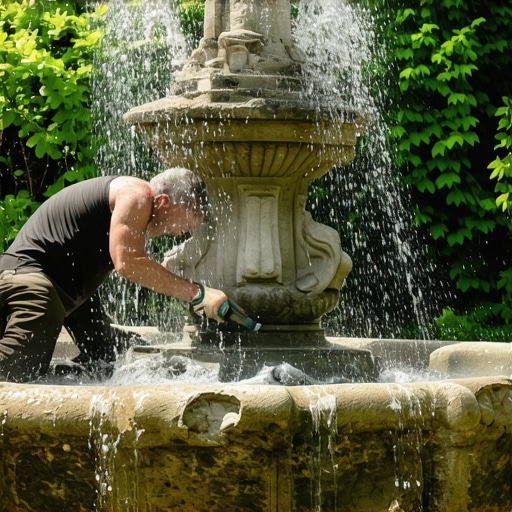
Fixing a spalled fountain requires a multi-stage approach that respects the chemistry of the original material. First, we have to remove the ‘scales’—those loose, delaminated layers. We use small, pneumatic chisels or hand-carving tools to reach ‘sound’ stone. You can’t just ‘butter’ over the rot; you have to find the tooth. Once we are down to a solid substrate, we analyze the stone’s suction. A dry, historic stone will suck the water out of fresh mortar so fast the ‘mud’ will ‘flash set’ and fail to bond. We have to pre-hydrate the stone, bringing it to a ‘saturated surface dry’ condition.
For the repair itself, we don’t just use any mix. We utilize high-performance mortar mixes that are custom-blended to match the vapor permeability and thermal expansion coefficient of the original stone. We might even incorporate ‘self-healing concrete foundations’ logic by using crystalline additives that react with moisture to seal hairline cracks before they become chasms. In large-scale restorations, like a commercial parapet wall repair or a massive tiered fountain, we may even deploy robotic masonry repair techniques for precision carving of replacement ‘Dutchman’ patches. These are small blocks of matching stone that are surgically inset into the damaged area, bonded with a breathable lime-paste and a stainless steel pin if the mass is significant.
“The mortar should always be weaker than the masonry units so that it acts as a sacrificial element, accommodating movement and allowing for moisture evaporation.” – ASTM C270 Standards
Tuckpointing and the Art of the Slicker
The joints are the lungs of the fountain. When we perform tuck pointing services, we aren’t just making it look pretty. We are restoring the drainage and evaporation paths. We use a ‘slicker’ or a jointer tool to strike the joint, compressing the mud to ensure a tight seal against the edges of the stone. This prevents ‘honeycombing,’ where small air pockets allow water to pool inside the wall. If we’re dealing with a massive amount of linear footage, we might use tuckpointing machine services to ensure consistency, but the final ‘strike’ is always done by hand. It’s about the ‘feel.’ You can tell when the mortar has the right ‘suction’—it resists the tool just enough to let you know the bond is forming.
For those dealing with the aftermath of a catastrophic winter or a structural shift, ‘masonry rescue after disaster’ is about more than just the stone. We look at the ‘cold joints’—those places where new work meets old—and ensure there is no ‘bridge’ for water to cross. If the fountain’s base is shifting, causing that dreaded ‘stair-step’ crack, we don’t just patch it. We look at failing retaining wall repair techniques, perhaps introducing helical piers or improving the drainage behind the wall. Without proper drainage, hydrostatic pressure will eventually push even the best stonework into the dirt.
The Long Game: Maintenance and Modern Innovations
Once the spalling is fixed and the joints are struck, we have to protect the work. This doesn’t mean slathering it in a plastic sealer—that’s a death sentence for stone. We use silane-siloxane breathables that allow water vapor to escape while preventing liquid water from entering. We also educate the owner on the ‘winterization’ of stone. A fountain left full of water in December is just a block of ice waiting to explode. In some high-end projects, we’re even seeing the rise of ‘robotic masonry repair’ for ongoing monitoring, using sensors to detect moisture levels deep within the masonry core.
Whether it’s a brick paver driveway repair that’s heaving due to poor base compaction or a 200-year-old marble fountain, the rules of masonry don’t change. You respect the physics, you understand the chemistry, and you never, ever take a shortcut. My grandfather used to say that a mason’s work is his only ghost—it’s the only thing that stays behind after he’s gone. If you do it right, that fountain will still be ‘ringing’ like a bell for another hundred years. If you do it wrong, it’ll be a pile of dust before your grandkids are grown. Choose the right mud, use the right tool, and treat the stone like the living thing it is. That is the only way to beat the freeze-thaw and keep the history alive.