
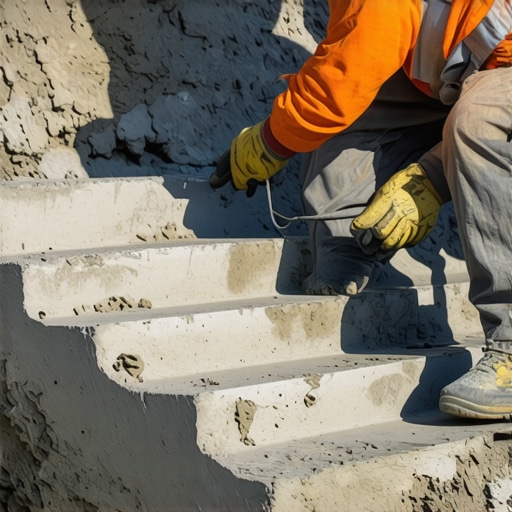
The Forensic Scene: The Skeleton Under the Stoop
The homeowner told me it was just a cosmetic issue—a little flake here, a thin crack there. But when I slid my fiber-optic scope into the void beneath the second riser, the reality was much grimmer. The internal rebar, once the high-tensile backbone of these concrete steps, had expanded to three times its original size. Rust is a slow-motion explosion. As that steel oxidized, it exerted thousands of pounds of internal pressure, literally pushing the concrete apart from the inside out. This is the classic failure of traditional reinforcement in a freeze-thaw environment. When we talk about spalled concrete steps repair, we aren’t just talking about a fresh coat of cement; we are talking about a fundamental shift in how we handle tensile stress. In the old days, we relied on heavy steel. Today, we rely on microscopic lattices of fiber-reinforcement to prevent the next collapse.
The Physics of the Freeze: Why Steps Fail
In the North, we live and die by the 9% rule. When water penetrates the capillary pores of a concrete step and hits 32 degrees Fahrenheit, it expands by 9%. If your masonry doesn’t have the internal ‘give’ to handle that pressure, it fractures. Traditional concrete is incredibly strong in compression—you can park a truck on it—but it’s brittle in tension. This is where professional masonry restoration turns into a game of molecular management. In a standard mix, the distance between pieces of aggregate is a weak point. Micro-cracks form at these ‘interface transition zones.’ Without reinforcement, these cracks connect, forming a highway for road salt and meltwater to reach the structural core.
“Fiber-reinforced concrete (FRC) provides increased residual strength and prevents the coalescence of micro-cracks into major structural failures.” – ASTM C1116 Standard Specification
When we apply fiber-reinforced overlays during stone wall repair or step restoration, we are essentially knitting the ‘mud’ together with millions of tiny bridges. Whether it’s alkali-resistant glass, polypropene, or carbon fibers, these strands intercept cracks before they become visible to the naked eye. This isn’t just a ‘patch’; it’s a composite material that mimics the flexibility of wood with the durability of stone.
Micro-Zooming: The Chemistry of Fiber-Bonding
Let’s get tactile. Imagine you’re on your knees with a hawk and trowel, ‘buttering’ the edge of a damaged riser. If you’re using a standard Portland-sand mix, the suction of the old concrete will pull the water out of your new patch too fast. This ‘flash setting’ leaves the repair brittle—I call it ‘sugaring.’ You can rub it with your thumb and it just turns back to dust. Fiber-reinforcement changes the rheology of the mix. The fibers hold the moisture in suspension, allowing for a slower, more complete hydration process. This is critical for brickwork sealants application later on; if the substrate isn’t chemically sound, no sealant in the world will save it.
In brick infill panel repair, fibers allow us to create a thinner, stronger bond that doesn’t add massive dead weight to the structure. We’re talking about a tensile capacity that traditional mortar simply can’t match. When the building shifts—and all buildings shift—the fiber-reinforced joints act like a shock absorber rather than a glass rod. This is the same logic we apply to foundation wall bowing repair. While fibers alone won’t hold back a failing mountain of soil, they are essential in the parging layers used to stabilize the masonry surface after helical piers or carbon fiber straps are installed.
The Restoration Reality: Beyond the Surface
I see it every week: a ‘handyman’ comes in and slaps some lath and a layer of cheap cement over a crumbling stone wall. Within two winters, the whole thing peels off like a scab. They didn’t account for the thermal expansion. In stone wall repair, you have to respect the ‘tooth’ of the original material. We use a high-bond fiber matrix that actually grows into the pores of the old stone. This creates a monolithic bond. This same precision is required for chimney interior parging. A chimney is a thermal engine; it expands and contracts violently every time you light a fire. If your parging mix isn’t fiber-reinforced, the heat will spiderweb the surface within a month, leading to chimney damper repair issues or, worse, carbon monoxide leaks.
“Water penetration is the single greatest threat to masonry durability, and the control of shrinkage cracking through secondary reinforcement is the primary defense.” – BIA Technical Note 7
BIM Masonry Projects and Modern Forensics
We are entering an era where BIM masonry projects (Building Information Modeling) allow us to predict exactly where stress concentrations will occur in a high-rise brick facade or a complex stone staircase. We can now specify the exact denier and distribution of fibers needed for chimney repair services or large-scale restorations. This isn’t guesswork anymore. We are looking at the ‘interfacial bond strength.’ When I’m slicking a joint, I know that the fiber matrix is providing a mechanical interlock that goes deeper than just the surface tension. It’s the difference between ‘licking and sticking’ and true structural integration.
The Final Strike: Do It Once, Do It Right
If you’re looking at a set of steps that look like they’ve been through a war zone, don’t let someone tell you they just need a ‘skim coat.’ A skim coat without fiber-reinforcement is a temporary lie. You need to excavate the rot, clean the ‘honeycombing’ out of the old concrete, and build it back with a material designed for the 21st century. Whether it’s spalled concrete steps repair or a complex foundation wall bowing repair, the goal is always the same: permanent stability. Don’t settle for ‘mud’ that doesn’t have a spine. Insist on fiber-reinforcement, or prepare to pay for the same repair again in three years. Masonry is meant to last generations, not seasons. It’s time we started building like it again.