
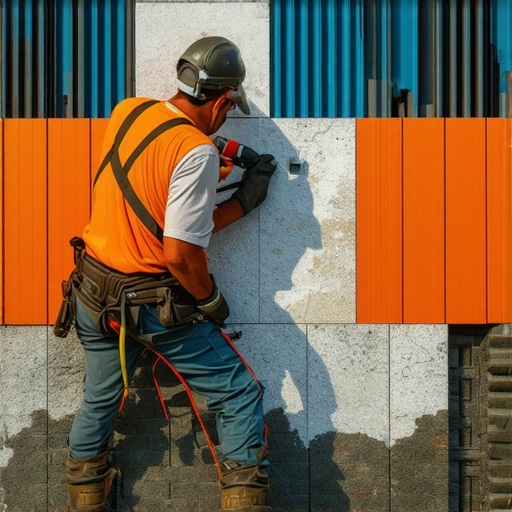
The Forensic Scene: When the Walls Start Weeping
I remember standing on a suspended scaffold twelve stories up, looking at a modular panel system that was less than five years old. The owner had called me because of what he described as ‘sweating’ on the interior drywall. When I put my moisture probe to the joint, the reading went off the charts. I pulled out my hawk and a sharp blade, cutting a six-inch sample of the sealant. It popped out like a dry rubber band. There was zero adhesion to the concrete substrate. The contractor had ignored the ‘tooth’ of the stone and skipped the primer, thinking the ‘lick-and-stick’ nature of modern modular systems would save them. Underneath that failed ribbon of silicone, the steel relief angles were already blooming with rust, expanding and putting pressure on the concrete masonry unit restoration work below. This wasn’t just a leak; it was a slow-motion structural collapse caused by a lack of respect for the chemistry of the joint.
The Physics of Movement and the Freeze-Thaw War
In our northern climates, where the thermometer swings fifty degrees in a single day, modular masonry panels aren’t static objects; they are living, breathing, moving beasts. We are dealing with the physics of thermal expansion and the brutal reality of the freeze-thaw cycle. When water penetrates a joint and gets trapped behind a panel, it doesn’t just sit there. When that temperature hits 32 degrees Fahrenheit, that water expands by approximately 9% in volume. That expansion generates thousands of pounds of pressure per square inch. If your sealant isn’t elastomeric or if it has lost its bond, that pressure will cause spalling, eventually leading to brick veneer detachment repair that costs ten times the price of a proper sealant job.
“Water penetration is the single greatest threat to masonry durability. Proper joint design and sealant selection are the primary defenses against premature structural degradation.” – BIA Technical Note 7
We see this often in concrete masonry unit restoration where the original mortar joints were too rigid. Modern modular panels require a joint that can handle ‘extension’ and ‘compression’ without failing. This is where the Young’s Modulus of the sealant comes into play. You want a low-modulus sealant for high-movement joints, allowing the panels to shift without tearing the sealant off the ‘faces’ of the masonry. If you use a high-modulus, rigid material in a modular system, the sealant will stay intact, but it will pull the face of the brick or stone right off with it.
Micro-Zooming: The Chemistry of the Bond
Before you ever ‘butter’ a joint with sealant, you have to understand the substrate’s pH and porosity. Modular panels, especially those using concrete pump masonry mixes, often have a residual alkalinity that can interfere with adhesion. When we talk about the ‘tooth’ of the masonry, we’re talking about the microscopic profile of the surface. If the surface is too smooth—often a result of the manufacturing mold—the sealant has nothing to grab onto. This is why we use a wire brush or a grinder to ‘open’ the pores of the masonry before application. Professional masonry restoration isn’t just about looking good; it’s about molecular-level preparation.
Then there is the issue of ‘flash setting’ and ‘skin time.’ In the heat of the summer, if you apply your mud or sealant to a bone-dry, hot panel, the moisture or solvents are sucked out of the material instantly. This ‘burns’ the bond. You end up with a ‘cold joint’ where the material is physically touching the panel but not chemically bonded. In my years of forensic inspection, I’ve seen miles of sealant that you could peel off with your bare hands because it was applied to a ‘hot’ wall without proper shading or substrate cooling.
The Process: From Backer Rods to the Slicker
Applying sealant to modular masonry panels is a multi-step surgical procedure. First, you must ensure the joint is clean, dry, and free of any ‘honeycombing’ from the original pour. If I see honeycombing in the concrete pump masonry mixes used to cast the panels, I know water is going to find a home there. Next comes the backer rod. You don’t just shove it in. You need a closed-cell polyethylene backer rod for exterior joints to prevent ‘three-sided adhesion.’ If the sealant bonds to the back of the joint as well as the sides, it cannot stretch; it will tear during the first thermal cycle. The backer rod creates the ‘hourglass’ shape that is critical for elasticity.
Once the rod is set, you apply the sealant using a bulk gun, ensuring you are ‘wetting’ the sides of the joint as you go. Then comes the art of the tool. A master mason doesn’t just leave a bead; they use a slicker or a jointing tool to compress the sealant into the joint. This compression is what forces the sealant into the ‘tooth’ of the masonry. If you don’t tool it, you don’t have a seal. It’s the difference between a amateurish handyman special and a professional masonry restoration that will last fifty years.
“Sealants shall be installed in accordance with ASTM C1193 to ensure the mechanical performance meets the design requirements of the building envelope.” – ASTM C920 Standards
Integrating the Envelope: Foundations and Chimneys
A modular panel system is only as strong as its weakest link. I often see cases where the panels are perfectly sealed, but the homeowner is still getting water in the basement. This is where chimney leak detection and foundation crack repair come into the forensic picture. Hydrostatic pressure from poorly managed drainage can push water up through the foundation underpinning and behind the veneer. If the moisture can’t escape through weep holes—because some genius decided to caulk them shut—the water will eventually force the sealant joints to fail from the inside out.
We use tuckpointing machine services to ensure the structural repointing of the surrounding traditional masonry is consistent with the modular panels. You can’t have a rock-solid, non-breathable sealant joint next to a soft, crumbling lime mortar joint in a retaining wall installation without creating a massive pressure imbalance. The entire building envelope must act as a single, cohesive unit. This is why we look at foundation underpinning and structural repointing as part of the same forensic puzzle. If the foundation is heaving, those modular panels are going to snap their seals no matter how good your ‘mud’ is.
The Cynical Reality of Modern Construction
The industry is currently obsessed with ‘lick-and-stick’ stone and modular panels because they are fast and cheap. But speed is the enemy of durability. I’ve seen too many ‘professional’ crews skipping the cleaning phase, ignoring the moisture content of the panels, and using the wrong type of sealant for the geography. In the South, you’re fighting UV degradation and thermal expansion; in the North, it’s the 9% expansion of ice. If you don’t adapt your chemistry to the climate, you’re just building a future lawsuit. Do it once, do it right, or you’ll be calling me back in five years to perform a forensic audit on why your ‘maintenance-free’ building is falling apart. Modular masonry is a high-performance system, and it requires high-performance execution. No shortcuts, no excuses, just the hard, gritty work of proper masonry craftsmanship.